Tuesday, 5 October 2021

Norwegian MP of Sri Lankan origin takes a courageous stand

 SPECIAL REPORT : Part 388
Published


By Shamindra Ferdinando

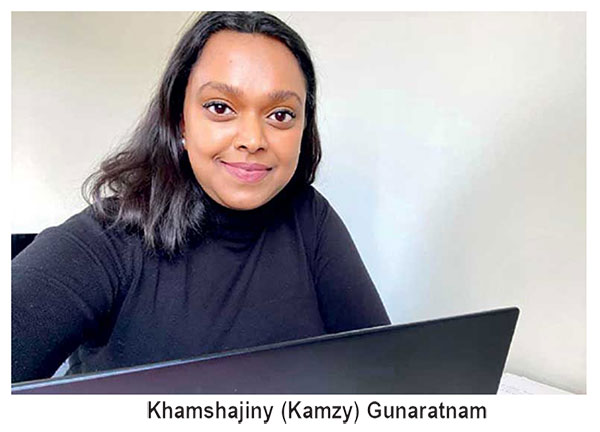
Newly elected Norwegian lawmaker of Sri Lankan origin Khamshajiny (Kamzy) Gunaratnam, in one sentence, denied any knowledge of the Geneva-based United Nations Human Rights Council (UNHRC) intervention in Sri Lanka. Having declared her strong faith in ‘outside actors’ inquiring into war crimes accusations, Gunaratnam declared: “I haven’t followed that, so I cannot answer that. I’m sorry. Gunaratnam said so, in response to my former colleague Paneetha Ameresekere’s quite simple query as to what her position vis-a-vis UNHCR Resolution 46/1 was?

On behalf of Ameresekere, now with The Ceylon Today, that question was posed by Balasingam Yogarajah, who handled Gunaratnam’s Zoom media briefing on Sept 26. Yogarajah repeated the question twice so there cannot be any confusion.

Of several questions that had been emailed by Amarasekera to the MP as advised by the Norwegian embassy, Yogarajah asked two. In addition to the query on 46/1, Yogarajah repeated Ameresekere’s second question what lessons in respect of multiculturalism that Sri Lanka can learn from Norway? Gunaratnam briefly explained how people from about 10 different backgrounds, including her, had been elected to Parliament at the recently concluded general election. She made reference to a Somali being among the newly elected to the 169 member Norwegian Parliament. Kamzy Gunaratnam’s shocking declaration that she hadn’t been aware of the much touted Geneva process should be an eye opener to all those interested in genuine post-war reconciliation process.

The MP’s claim should be examined against the backdrop of 46/1 being the culmination of a process initiated on Oct 1, 2015. Norway backed that US-led initiative meant to haul up Sri Lanka before the hybrid judicial court.

Now, the UK is spearheading that project which received a further boost with 22 countries of the 47-member UNHRC voting for the resolution and 11 against in March this year. Fourteen countries, including India and Japan (both Quad members) skipped the vote on Sri Lanka. How can Gunaratnam be unaware of such a long high profile process if she is pushing for war crimes probe here with foreign intervention? Therefore, Gunaratnam’s claim is questionable to say the least.

The Zoom meet arranged by the Norwegian Embassy in Colombo drew altogether 36 journalists and other interested persons from various parts of the world. Harim Peiris, one-time spokesperson of President Chandrika Bandaranaike Kumaratunga had been among those participants though he didn’t pose any questions.

The media should be grateful to the Norwegian embassy for arranging the interview, especially giving an opportunity to those genuinely interested in the issues at hand to submit their questions to the Norwegian Member of Parliament several days before the zoom event. Whatever the circumstances, Gunaratnam, by denying knowledge of 46/1 resolution clearly indicated that it hadn’t been discussed therein, at least in her Labour Party.

Amarasekera must have been quite surprised by Gunaratnam’s reaction to his first question. The writer was simply flabbergasted by Gunaratnam’s genuine or feigned ignorance.

How can she be unaware of 46/1, it so strongly underscored the accountability process.

Having declared at the onset of her statement that she followed the war in Sri Lanka and the subsequent escalation finally leading to the conclusion of the armed conflict in 2009, Gunaratnam emphasised that there wouldn’t be any room for reconciliation unless Sri Lanka let someone independent from the international community to investigate war crimes.

“War must be investigated before you talk about reconciliation. It is about closure. Everyone wants closure. And it is about openness. And yes, it is about openness and transparency and those two key words are most important …So, when it comes to reconciliation, I think that the Sri Lankan government have to let in independent actors to investigate war crimes.

Gunaratnam’s comment on the critical importance of external intervention is quite contrary to her claimed ignorance of the 46/1 adopted by the UNHRC at its March 2021 session. Gunaratnam’s unawareness of the Geneva process certainly reflected very badly on her political party, the Labour as well as the entire Norwegian political setup. Having invested so much on disastrous Sri Lanka peace mission, her not knowing accountability resolutions pertaining to the country of her birth cannot be believed under any circumstances.

In the midst of a massacre

Gunaratnam had been a 23-year-old member of the Labour party’s youth wing when she joined a summer camp on Utoya Island in late July 2011. Having arrived in Norway at the age of three with her parents, Gunaratnam had been quite an active member of the youth branch. However, she may not have received the opportunity to move up the political ladder quickly if she hadn’t joined the summer camp. That is the undeniable truth. Right-wing extremist Anders Behring Breivik, who infiltrated the Labour party youth camp on Utoya Island, opened fire, killing 69. It was the deadliest mass shooting by a lone gunman in modern history. Breivik killed eight others in a car bomb that targeted a government building complex in central Oslo close to the Norwegian Parliament.

As Breivik attacked what the Norwegian media called workers’ youth league camp, Gunaratnam had swum across 500 metres of the Tyrifjorden Lake to escape the carnage.

The Norwegian media quoted Gunaratnam as having said: Eventually, I decided I would rather drown than be shot. The Oslo massacre obviously gave a mega boost to Gunaratnam’s political career. She received the prestigious post of Deputy Mayor, Oslo, in the third week of Oct, 2105, at the age of 27. That is certainly a significant achievement. Having secured a second term in late Oct 2019, Gunaratnam quickly advanced to the next phase of her continuing high profile rise, a parliamentary role. As expected Gunaratnam entered parliament as a member of the ruling coalition at the Sept 13, 2021 general election. Jonas Gahr Støre’s Labour Party brought an end to the centre-right government’s eight-year rule under Prime Minister Erna Solberg to an end.

Breivik made references to the LTTE’s eviction of Muslims from the North in the 1990 in his so-called ‘manifesto.’ There had been two references (i) Pro-Sri Lanka (supports the deportation of all Muslims from Sri Lanka) on page 1235 (ii) Fourth Generation War is normally characterised by a “stateless” entity fighting a state or regime. Fighting can be physically such as the Liberation Tigers of Tamil Eelam (LTTE) to use a modern example (Page 1479)

Several Labour Youth League members, who survived the July 2011 Oslo massacre entered Parliament at subsequent elections. The writer submitted several questions to Gunaratnam though facilitator Balasingam Yogarajah raised only one.

The writer submitted the following questions to Gunaratnam as advised by the Norwegian Embassy in Colombo:

(A) Before your entry into Norwegian Parliament this year, how many of those who had escaped Anders Breivik’s rampage in June 2011 entered Parliament in 2013 and four years later? (1) In addition to you, did any other survivors enter Parliament this year?

Gunaratnam responded that one entered Parliament in 2013, two in 2017 and six this year. (However, a section of the international media, including Reuters reported that four young Norwegian Labour Party members who survived Breivik’s rampage were elected to Parliament at the 2013 election. They were among 33 Labour Party candidates in the parliamentary election who had escaped Breivik’s bullets. The Reuters story was based on information provided by Anne Odden, spokeswoman for the party’s Parliamentary group. Perhaps, Gunaratnam should re-check numbers elected from her party.

(B) When did you reach Norway, what was your age? Please name family members who accompanied you? When did Norway grant your family political asylum and Norwegian citizenship? What was your hometown in the Jaffna peninsula?

According to reports your parents as soon as they arrived in Norway had worked as fishers in a northern town, but later settled down in Oslo. So how did they get so much help and how did they manage without knowing much English?

You have graduated from Norwegian local politics to the country’s national stage. What made you choose politics as a vocation?

(C) Why did the family leave Sri Lanka? Did Sri Lanka Army (SLA) kill family members? Did SLA harass the family? Did any family member die fighting for the LTTE or any other group trained by India? Did any members of your family or relatives perish during IPKF operations?)

(D) Did your family leave Sri Lanka by boat to India and then fly to Norway? Or left the country on fraudulent travel documents or did the Norwegian Embassy issue necessary travel documents required by your family to reach the final destination?

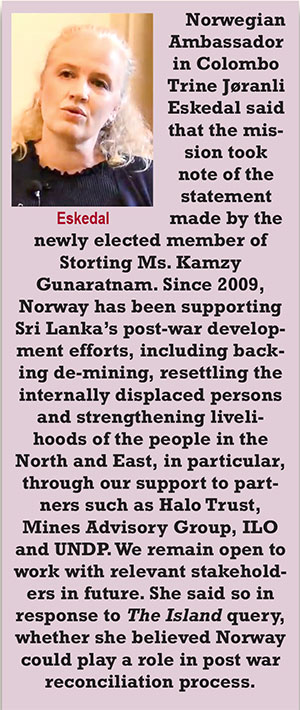
(E) During your political career did you study the role played by Norway in Sri Lanka? Do you still believe Norway can assist Sri Lanka in addressing post-war reconciliation issues?

(F) Will you be interested in visiting Sri Lanka to see the ground situation? And finally

(G) How many Norwegian passport holders of Sri Lankan origin are there as at 2021?

During the 90-minute meet, the writer, through Balasingam Yogarajah asked Gunaratnam when did she reach Norway. She said 1991. The MP didn’t respond to emails requesting her to reveal the month of their arrival in Norway. She had been born on March 27, 1988 during the Indian intervention in Sri Lanka’s northern and eastern provinces. The Gunaratnams fled the country after the Indian withdrawal in March 1990.

A Norwegian suicide bomber of Somali origin

MP Gunaratnam, during Sunday, September, 26 zoom meet, made reference to the election of a Norwegian of Somali origin along with nine others. It would be pertinent to examine the danger in granting citizenship to unknown foreigners without proper vetting.
Let me remind the readers of the case of a Norwegian of Somali origin carrying out a suicide mission in early 2014. Somali terrorist group Al Shabaab in March 2014 identified the suicide car bomber, Abdullahi Ahmed Abdulle, who carried out an attack on a hotel at Buulo Burde, in Southern Somalia, as a Norwegian of Somali origin.

The AFP, in a Mogadishu datelined story, quoted Al Shabaab military spokesman, Sheikh Abdul Aziz Abu Musab, as having said: The attacker of Buulo Burde was a 60-year-old man who came from Norway to fight the enemies of Allah. He paid the sacrifice in order to be close to Allah by killing his enemies. The violent incident is showing us that there is no age limit for Jihadists.

Al Shabaab mounted a car bomb attack in response to a large scale military operation launched by the African Union forces.

The Norwegian of Somali origin was perhaps the oldest person to carry out a suicide mission. Did Norway examine how the Shabaab terrorist entered Norway, secured citizenship and subsequently returned to Somalia to launch a suicide mission on March 18, 2014? Did the Norwegian Foreign Service help the Al Shabaab terrorist leave Somalia clandestinely? Sri Lanka should study such cases. Did Norway provide Al Shabaab killer political asylum? Had he been involved in terrorism or engaged in such related activities in Somalia at the time he entered Norway?

Commonwealth member Kenya, too, had been threatened by foreign terrorists of Kenyan origin. Unfortunately, the Sri Lankan government never realised the need to examine such threats faced by other countries.

Clandestine projects

Sri Lanka should be concerned about the Western world accommodating its citizens. New Zealand recently admitted that Ahamed Adil Mohamed Samsudeen, who was shot dead by police after stabbing seven people in an Auckland shopping mall, had been on a terror watch list and was under surveillance. Having entered New Zealand on a student visa in 2011, Samsudeen had received refugee status two years later. Subsequently, the youth from Kattankudy, the hometown of the 2019 Easter Sunday carnage mastermind Zahran Hashim, attracted the attention of New Zealand security authorities. However, the New Zealand judicial system prevented Samsudeen from being deported on the basis he faced threats in Sri Lanka.

The then Sri Lankan Ambassador in Myanmar Prof. Nalin de Silva questioned the rationale in New Zealand Prime Minister Jacinda Ardern naming the ISIS inspired terrorist as a Sri Lankan instead of as a person accepted as a refugee in her country nearly a decade ago. Samsudeen migrated to New Zealand after having been a student in a Colombo school.

A subsequent incident revealed the New Zealand mindset. New Zealand had no qualms in providing political asylum to another Sri Lankan (a Sinhalese) wanted in connection with the 2019 Easter Sunday carnage. On the basis of reportage of the issue at hand, New Zealand accepted the suspect, who had claimed he hadn’t been aware of the Easter Sunday perpetrators though he facilitated the transfer of funds to them from abroad. United Nations Human Rights Commissioner Michelle Bachelet who commented on the Easter Sunday carnage at her latest oral update on Sri Lanka last month should look into New Zealand’s response to terrorism.

Sri Lanka lacked the political will to take up these issues with powerful Western governments. How many Sri Lankans received foreign passports and new identities over the years? How many members of the proscribed LTTE received foreign citizenship? A significant number of Sri Lankans categorised as ‘missing’ or ‘disappeared’ sought by the Office of Missing Persons (OMP) can be among those carrying new foreign passports.

Take the case of Khamshajiny Gunaratnam aka Kamzy, now a Norwegian lawmaker. What is the status of Gunaratnam family in Sri Lanka? Had they been accommodated on some missing persons list? Categorised among the so called disappeared? However, Gunaratnam should earn the respect of all for her fearless and courageous stand on Sri Lanka. Having paid a glowing tribute to the Tamil community in Norway, Gunaratnam didn’t mince her words when she underscored her position. She declared: “….do not represent the Tamil Diaspora but Norwegian Parliament.” Gunaratnam’s stand should be appreciated.

Gunaratnam’s response to Deputy Editor of the Daily Mirror Kelum Bandara, too, underscored her readiness to take a principled stand on contentious issues. Asked whether she believed in a separate state for Tamils in Sri Lanka, Gunaratnam responded: “I do not understand why people asked us. I’m a Norwegian citizen. I have to run to another country with my father to start a new life. We should not have an opinion about how Tamils, Sinhalese and Muslims live. It is their decision. They should make the decision.”

Gunaratnam however reiterated her commitment for a greater partnership and also investigations into alleged war crimes.

A substantial number of Sri Lankans, including members of the LTTE had received Norwegian citizenship, hence the freedom to travel in Europe, as well as the Scandinavian region, without any hassle. Had some of them given new identities or in special cases changed ethnicity? Although Sri Lanka summoned the then Norwegian ambassador, Hilde Haraldstad, over a secret project to help Sri Lankans leave the country, Sri Lanka never really pursued the case. The then Foreign Secretary, the late Karunathilake Amunugama, raised the issue on behalf of External Affairs Minister Prof. G.L. Peiris (Helping 12 persons out of Sri Lanka: Government summons Norwegian envoy-The Island March 20, 2011).

Denying any wrongdoing on Norway’s part, Haraldstad insisted she was not at liberty to discuss individual cases. The External Affairs Ministry never pursued the clandestine Norwegian project thereafter, though Norway brazenly played politics with Sri Lanka.

A section of the Norwegian media exposed the clandestine Norwegian project. The revelation was made by the Norwegian newspaper, Aftenposten, regarding the Norwegian diplomatic mission in Colombo buying air tickets for 12 would-be Sri Lankan asylum seekers deemed to be at risk in Sri Lanka. Aftenposten quoted one-time Norwegian peace envoy in Sri Lanka, Erik Solheim, as having endorsed the project undertaken by the Norwegian diplomatic staff in Colombo. Solheim also accused Sri Lanka of ex-judicial measures, including killings during the last phase of the conflict. Ambassador Haraldsrad said that she couldn’t confirm the figure given by Aftenposten with regard to the number of Sri Lankans given political asylum in Norway. Although the number of Norwegians of Sri Lankan origin is relatively smaller when compared with communities in Canada or the UK, the Norwegian grouping is one of the most influential among pro-separatist expatriate groups.

Wednesday, 29 September 2021

Missed opportunities!

 SPECIAL REPORT : Part 387

Published


By Shamindra Ferdinando

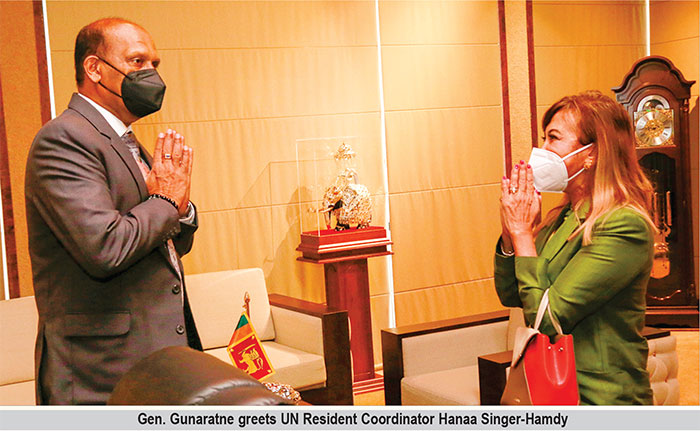
UN Resident Coordinator in Colombo Hanna Singer-Hamdy paid a courtesy call on Defence Secretary (retd.) Gen. Kamal Gunaratne on Sept. 23 at the Defence Headquarters Complex, Sri Jayewardenepura, Kotte. The Egyptian was accompanied by the head of the United Nations Office on Drugs and Crime (UNODC) Alan Cole, formerly of the British Royal Navy.

The discussion covered Sri Lanka’s high profile ongoing campaign against narcotics trade and the government’s response to the raging Covid-19 epidemic.

A brief press release issued by Lt. Col. Nalin Herath, Officiating Director, Army Media Centre, in Sinhala, Tamil and English didn’t make reference to any other issue. Therefore, the writer rationally ascertained that no other matter had been taken up at the discussion.

Against the backdrop of the 48th session of the Geneva-based United Nations Human Rights Council (UNHRC) and the 76th session of the UNGA in New York, the Sri Lanka Podujana Peramuna (SLPP) government could have used the Sept. 23 meet to brief the UN Resident Coordinator Singer as regards the accountability process.

The Defence Secretary, on behalf of the government, could have handed over a comprehensive report to the top UN official in Sri Lanka, in response to one-sided and high-handed the war crimes agenda pursued by the UNHRC against the country. Unfortunately, the government didn’t. The failure on the part of the government to do so underscored the absence of a cohesive mechanism to counter the campaign targeting Sri Lanka. Shoddy handling of the accountability process is an affront to the war-winning military that sacrificed so much to fight and defeat, militarily, ‘the world’s worst terrorist outfit’. More than 12 years after the eradication of the Liberation Tigers of Tamil Eelam (LTTE), Sri Lanka remains under the UNHRC microscope, while many other countries, that caused death and misery to millions by launching false pretext wars or through illegal regime change actions are allowed to go scot-free.

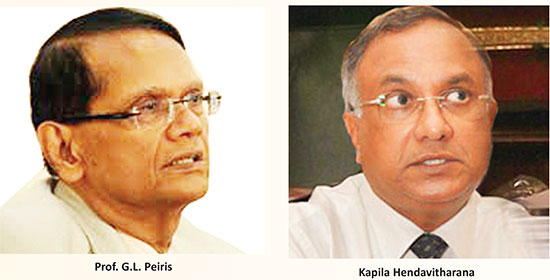
For some strange reason, most probably for lack of competence at the Foreign Ministry, the government is reluctant to properly present Sri Lanka’s case before the international community. Let us hope that with Prof. G.L. Peiris, the eminent former law academic at the helm of the Foreign Ministry, we can mount a relentless diplomatic campaign to have the country cleared from such blatant accusations. In the process, it could even go to the extent of exposing, particularly our main accusers, who despite having plenty of innocent blood in their hands are pursuing this vendetta against us due to geo-political agendas.

The wartime General Officer Commanding (GoC) the elite 53 Division, the then Maj. Gen. Gunaratne could have meticulously briefed the UN Chief here, who, too, has had the audacity to make public comments on the country’s internal affairs and get away with such behaviour.

The author of ‘Road to Nanthikadal’, Gunaratne commanded one of the two fighting Divisions, the other being the 58 Division commanded by the present Army Commander, General Shavendra Silva, involved in the final phase of the offensive. It would be pertinent to mention that a battalion (4 Vijayabahu Infantry Regiment) that had been under the overall command of the then Maj. Gen. Gunaratne killed Prabhakaran. The 53 Division had been involved in the unprecedented Anandapuram battle (late March-early April 2009) along with 58 Division and Task Force 8 that dealt a massive blow to the LTTE.

Why didn’t the government exploit the Sept. 23 meet that took place the day after President Rajapaksa addressed the 76th session of the UNGA in New York?

Sri Lanka’s continuing failure to set the record straight should be examined taking into consideration UNHRC Chief Michelle Bachelet’s latest oral update on the situation in Sri Lanka (on Sept. 13), Foreign Minister Prof. G.L. Peiris’ response by Zoom to the former twice Chilean President Bachelet on the following day, President Rajapaksa’s meet with UNSG Antonio Guterres (on Sept. 19), President Rajapaksa’s address to the UNGA (Sept. 20) and three meetings Foreign Minister Prof. G.L. Peiris had with Commonwealth Secretary General Patricia Scotland, Australian Foreign Minister Marise Payne and Indian Foreign Minister Dr. S. Jaishankar also in New York.

The Defence Secretary is the ideal person to discuss the accountability issue. With Sri Lanka firmly on the UN agenda and the issue coming up for scrutiny once again at the 49th session in March 2022, the government cannot turn a blind eye to the developments taking place.

Vanni war compared with Ruwanda et al

Antonio Guterres’s predecessor, Ban Ki-moon once compared the Vanni offensive with that of Ruwanda and Serbia genocides in the 1990s. Gunaratne strongly disputed Ban Ki-moon’s comparison of Vanni offensive with clear cut cases of genocide in those two countries
South Korean Ki-moon played his part to facilitate the Western agenda in spite of his own mission in Colombo contradicting unsubstantiated accusations.

The government owed an explanation why absolutely no attempt was made in Geneva or New York to challenge the unsubstantiated war crimes allegations that paved the way for Western powers and other interested parties to place Sri Lanka on the Geneva agenda.

Instead of setting the record straight, President Rajapaksa assured his readiness to work with domestic stakeholders, international partners, UN, civil society and Tamil expatriate groups, whereas FM Peiris reiterated Sri Lanka’s commitment to some key provisions in the resolution co-sponsored by the then Yahapalana government in 2015 as fait accompli, while strongly rejecting external interventions.

In separate meetings with Aussie Foreign Minister Patricia, Scotland Marise Payne and Indian counterpart Dr. Jaishankar, Prof. Peiris explained ground realities and the hostile approach adopted by interested parties. Prof. Peiris also elucidated to Scotland the wrongness in replacing domestic accountability mechanisms with external bodies, particularly the ad-hoc mechanism approved at the 46th Geneva session.

 Bachelet declared in her Sept. 13 speech that the UNHRC was going ahead with the investigation. Sri Lanka shouldn’t expect Scotland to take a stand favourable to Sri Lanka, under any circumstances, as the organisation Bachelet leads conveniently turned a Nelsonian eye to Indian sponsored terrorism that ravaged Sri Lanka. Did Commonwealth ever take a stand on the destabilisation of the smaller neighbour by the Commonwealth giant?

Prof. G.L. Peiris told his Australian counterpart Marise Payne how Bachelet followed a policy extremely detrimental to Sri Lanka as regards the accountability process. A Foreign Ministry press release quoted Prof. Peiris as having told Payne: “….there is a need to allow local institutions the space and opportunity to carry out their mandates and the establishment of an ad-hoc external mechanism that overrides this work is unnecessary and detrimental. It is premature and inappropriate to have a mechanism selectively targeting Sri Lanka that goes against the very principles of the UN Charter.”

Australia is aware of the Geneva project meant to undermine Sri Lanka. Regardless of close bilateral relations between Australia and Sri Lanka, the former will abide by the US position vis-a-vis Sri Lanka. The Australian policy should be examined, keeping in mind its role in the US-led alliances against China and extremely close relationship between Sri Lanka and China, the emerging world power.

The surprise Australia, the UK and the US (AUKUS) alliance struck recently, at the expense of France, on supplying a nuclear powered submarine fleet to their colonial cousin Australia should be an example of the old adage that blood is thicker than water.

The new three nation Anglo-Saxon alliance suddenly arrayed against China should also serve as a warning to New Delhi that it is already an odd partner, though one of the earliest to sign up for Quad, comprising the US, Japan, India and Australia ranged against China. If they could ditch long standing European ally France without batting an eye lid, Delhi can imagine how they will treat her if they suddenly see India too as a rival like China.

French Foreign Minister Jan-Yves Le Drian went to the extent of alleging US President Joe Biden of stabbing France in the back.

“It’s really a stab in the back. We had established a relationship of trust with Australia, this trust has been betrayed”, Foreign Minister Jean-Yves Le Drian told France Info radio. “I’m very angry today, and bitter… this is not something allies do to each other”, he said, noting that Australia would now have to explain how it would exit the contract.

A lesson for France

So Sri Lanka should not depend on foreign powers, entirely. It would be Sri Lanka’s responsibility to present its case before the global community. Major Western powers will never take a stand in support of a smaller nation at the expense of their overall strategy and lucrative business interests, the only exception being the case of Israel. There cannot be a better example than Australia going back on an agreement with France for what it considered a much better arrangement for Canberra. Obviously, not only Biden but the British and Australian leaders, too, stabbed France in the back.

In his talks with Dr. Jaishankar, Prof. Peiris declared Sri Lanka couldn’t accept external mechanisms active on the ground whereas the Indian Minister underscored the need for a fair and just resolution of residual issues in the interest of both countries.

Sri Lanka seems trapped in the eneva machinations. India, too, should be wary as its much touted relationship with the US does not mean a thing if one examined the way the US, the British and Australians sprang quite a despicable surprise.

Hope the world hasn’t forgotten how the US discarded Pakistan after having used the country in its proxy war to oust the Soviet Union from Afghanistan and to intimidate India when it was seen as being in Soviet camp. New Delhi remained noncommittal regarding the Soviet invasion of Afghanistan.

In fact, Indian destabilisation of Sri Lanka, in the 80s, is in line with its overall strategy to counter domestic threats emanating from Tamil Nadu in the backdrop of perceived threat of Sri Lanka being a base for US-Israeli operations.

However, for want of cohesive policy Sri Lanka, at least after the end of the war hadn’t made a genuine effort to set the record straight.

Prof. Peiris during his interactions with foreign dignitaries, has quite clearly explained Sri Lanka’s refusal to accept external mechanisms. President Rajapaksa, too, stressed the importance of domestic mechanisms in achieving reconciliation. Both the President and the Foreign Minister declared Sri Lanka’s readiness to work with domestic stakeholders, including the civil society, Tamil expatriate groups, international partners and the UN to accomplish genuine peace.

Pompeo on Shavendra

However, the incumbent government has so far failed to question the very basis for domestic mechanisms set up by the previous government on the strength of unsubstantiated allegations. The government owed an urgent explanation. There cannot be any excuse for not presenting a proper defense on behalf of the war-winning armed forces. Commander of the Army Gen. Shavendra Silva remains blacklisted by the US on unsubstantiated allegations. Let me reproduce the former US Secretary of State Mike Pompeo declaration on Feb 14, 2020: “I am designating Shavendra Silva making him ineligible for entry into the U.S. due to his involvement in extrajudicial killings during Sri Lanka’s Civil War. The U.S. will not waver in its pursuit of accountability for those who commit war crimes and violate human rights.”

The US made the announcement after President Gotabaya Rajapaksa named Silva the Chief of Defence Staff (CDS). Another Gajaba Regiment veteran Chagie Gallage highlighted Sri Lanka’s pathetic failure to defend the military when he retired on August 31, 2018.

There had never been a previous instance of a senior officer in his farewell speech questioning the overall failure to counter the foreign project. This happened at Saliyapura, the famed Gajaba Regimental Headquarters.

He said: “Gajaba is engraved in golden letters in the annals of the Sri Lanka Army’s history, if not in the history of Sri Lanka … and I’m certain it will never be reversed by any. So, I’m happy to be retired being a tiny particle of that proud chapter of the history, though designated as a ‘War Criminal”.

About 10 months before Gallage’s retirement, Lord Naseby made a stunning revelation in the House of Lords. On the basis of hitherto confidential dispatches from the British High Commission in Colombo, during January-May 2009, the Conservative politician contradicted the very basis of the three-member Darusman report. This report, released on March 31, 2011, had been the primary reason for the 2015 accountability resolution that faulted the Sri Lanka Army.

The World War 11 fighter pilot fought a near three-year battle with the British administration to secure the confidential dispatches and was finally able to obtain a highly redacted version to contradict the lies in the second week of Oct 2017. Although the then Foreign Minister Tilak Marapana, PC, in his address to the UNHRC made a reference to Lord Naseby’s revelations, Sri Lanka has so far not requested Geneva to examine the British dispatches.

The author of British dispatches Lt. Col. Anthony Gash has never challenged the authenticity of heavily censored dispatches disclosed by Lord Naseby.

Sri Lanka earlier squandered a similar golden opportunity to make a strong case for a revisit of the Darusman report in June 2011. The then US Defence Advisor in Colombo Lt. Col. Lawrence Smith quite convincingly defended the Sri Lanka Army at the 2011 Colombo Defence Seminar. The American contradicted unsubstantiated allegations raised by a retired Indian Major General Ashok K. Metha, formerly of the IPKF. Lt. Col. Smith must have made that declaration, based on information available to the US Embassy in Colombo as well as other dispatches from our war zone. And most importantly, the American officer made the declaration within three months after the releasing of the Darusman report. Sri Lanka is yet to use British and American dispatches in her defence.

Western powers continue to harass Sri Lanka on the basis of unsubstantiated war crimes accusations. Bachelet’s move to further investigate Sri Lanka should be challenged as the previous accusations that led to the 2015 Geneva resolution remained uninvestigated.

According to the Darusman report (paragraph 23: Confidentiality of the Panel’s records), the accusations cannot be examined till 2031. This strange stipulation has a further clause stating that the time bar could be extended for a further period. We must be the only country not allowed to see our accusers or the case against us for so long! But, successive governments never took the entire gamut of issues into consideration before making representations on behalf of the country. The incumbent SLPP is no exception. In spite of repeated vows to defend the armed forces, the SLPP had pathetically failed in its duty and responsibility.

Predicament of former SLAF Chief

As a result of sheer negligence, Sri Lanka has ended up being categorised as a perpetrator of war crimes, and those who had fought for the country are targeted. There cannot be a better example than Air Marshal Sumangala Dias who suffered due to Sri Lanka’s failure. Canada refused to accept Dias as Sri Lanka’s High Commissioner though the former Sri Lanka Air Force Commander is not under human rights scrutiny. Subsequently, the government proposed Dias as Sri Lanka’s Ambassador to Italy. However, we are yet unaware of Italy’s position. Italy as a member state of the EU, pursuing war crimes accusations against Sri Lanka, may not accept the retired SLAF Chief.

Prominent civil society activist Harsha Kumara Navaratne has quit the Human Rights Commission to take over the country’s mission in Ottawa. The former head of the NGO Seva Lanka, with his experience with the HRC, hopefully would be able to improve Sri Lanka’s image in Canada. The decision to name former minister Mahinda Samarasinghe as Sri Lanka’s Ambassador in Washington, too, is an interesting development. Samarasinghe handled human rights and related matters during Mahinda Rajapaksa’s presidency and was part of Sri Lanka’s delegation to Geneva. Perhaps the government expects missions in Washington (non- career diplomat), Ottawa (non- career diplomat) and London manned by career diplomat Saroja Sirisena to improve the ground situation. New Delhi should be part of the operation. Milinda Moragoda, who had served Ranil Wickremesinghe’s government as a Cabinet minister before switching allegiance to Mahinda Rajapaksa, recently took over the New Delhi mission. So, we now have two former ministers as heads of missions in New Delhi and Washington and prominent civil society activist in Ottawa.

Samarasinghe last served as the Ports and Shipping Minister. Having succeeded Arjuna Ranatunga (UNP), Samarasinghe, who represented the SLFP at that time, signed the 99-year-lease on the Hambantota port. Navaratne quit Seva Lanka chairmanship last month having disengaged from the NGO’s activity, beginning January this year. Navaratne’s appointment is in line with the government entering into a dialogue with the local civil society as well as President Gotabaya Rakapaksa’s declaration in New York his readiness to talk with Tamil expatriate groups. Whatever, the SLPP government does, it should set up a mechanism, without further delay, to counter those propagating lies in support of the Geneva project.

A role for ex-CNI

Perhaps former Chief of National Intelligence (CNI), Maj. Gen. Kapila Hendavitharana can be engaged to work out a proper strategy. Intelligence veteran Hendavitharana can be part of a special team assigned to build a strong case on behalf of the country on the basis of available information.

The information unintentionally made available by those pursuing war crimes probe can be quite useful to Sri Lanka as they are astonishing. Let there be a meticulous study of statements, accusations, documents and reports pertaining to accountability issues. Bachelet rushing to accuse the Sri Lanka Army of being responsible for so-called mass graves in Mannar, discovered in 2019, exposed the irresponsible conduct of the Geneva body, when a reputed US lab determined that those remains belonged to the colonial era.

Bachelet obviously acted on information provided by some Colombo-based diplomatic missions. There is no doubt that the British HC and the German Embassy in Colombo (both members of the self-appointed Sri Lanka Core Group in Geneva) influenced Bachel’s decision.

Due to petty political backbiting, Sri Lanka then lacked the political will to expose the Geneva project. As the simmering controversy over Mannar mass graves erupted during the yahapalana administration, the Foreign Ministry conveniently remained silent. That was nothing but treacherous behaviour and the Ministry, as one of the most important institutions, should be ashamed.

Sri Lanka didn’t have the guts to use Bachelet’s irresponsible conduct to challenge the overall process. Had there been a proper review of facts, since the change of government in Nov 2019, Gen. Gunaratne could have exploited his meeting with Hanaa Singer-Hamdy.

Tuesday, 21 September 2021

Easter Sunday imbroglio!

 SPECIAL REPORT : Part 386

Published

   
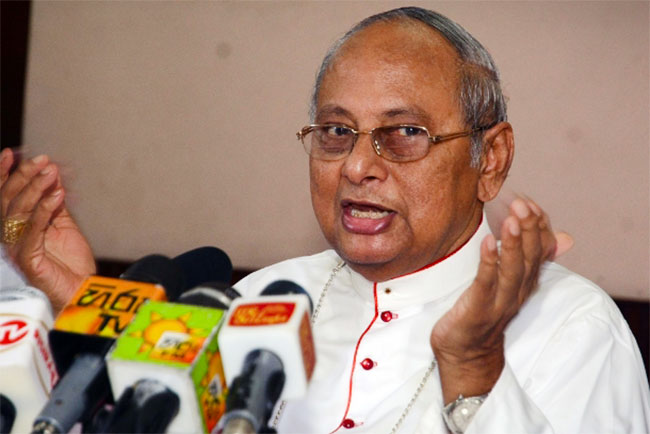
Archbishop of Colombo Malcolm Cardinal Ranjith reiterates demand for justice at a recent media briefing. The Church has sought the intervention of the Vatican as well as the UNHRC to pressure Sri Lanka over the Easter Sunday probe

Can Parliament, as an institution, absolve itself of the responsibility for tainted political parties? The House did nothing when the TNA recognised the LTTE as the sole representative of the Tamil speaking people. Both Parliament and the Election Department/Election Commission conveniently remained silent. Both institutions turned a blind eye when the TNA, on behalf of the LTTE, in blatant violation of the right to vote, ordered the Northern electorate to boycott the 2005 presidential election to ensure the defeat of Ranil Wickremesinghe as they thought it would be easier to prosecute the war successfully with Rajapaksa in power as he was unpopular with the West. May be the West, too, had a hand in that strategy for they, too, merely kept silent over TNA’s undemocratic demand to the Tamil electorate to boycott the vote. The TNA declared that the presidential poll was irrelevant therefore no point in the Tamil electorate exercising their franchise. But, the move was meant to ensure that normally pro-UNP majority of Tamils did not vote, thereby sealing candidate Ranil Wickremesinghe’s defeat and helping Mahinda Rajapaksa win. When the writer raised this issue with Kumaran Pathmanathan aka ‘KP’ in Aug. 2009, the one-time Chief LTTE procurer of weapons, too, declared that Rajapaksa’s victory would have created an environment conducive for an all-out war. Within three weeks after the 2005 presidential election, the LTTE resumed claymore mine attacks in the Jaffna peninsula. In January, 2006, the LTTE rammed suicide boats into a Fast Attack Craft off Trincomalee harbour. In late April 2006, the LTTE almost succeeded in assassinating Army Commander Lt. Gen. Sarath Fonseka. The Eelam war IV commenced in the second week of August 2006, just weeks after the Army neutralised the LTTE threat at Mavil-aru.

By Shamindra Ferdinando

A reference to the 2019 Easter Sunday carnage at the commencement of the 48th sessions of the Geneva–based United Nations Human Rights Council (UNHRC) was expected. Human Rights Commissioner Michelle Bachelet, in her oral update delivered on Sept.13 on the Situation in Sri Lanka dealt with the Easter Sunday massacre as revealed by Rev. Father Cyril Gamini Fernando, spokesperson for the National Catholic Committee for Justice (NCCJ).

The former Chilean President (2006-2010 and 2014-2018) Bachelet made two separate references to the 2019 Easter Sunday carnage. Let me reproduce them verbatim to ensure that The Island is not accused of trying to misinterpret facts.

Bachelet declared: “Despite various inquiries, the victims of the Easter Sunday bombings in 2019 and religious leaders continue to call urgently for truth and justice, and a full account of the circumstances that permitted those attacks.”

Referring to the Prevention of Terrorism Act (PTA), Bachelet said: “The Government has reaffirmed its intention to revisit the Act and established a Cabinet sub-committee for this purpose. However, I am deeply concerned about the continued use of the Act to arrest and detain people. Lawyer Hejaaz Hizbullah has now been detained for 16 months under the Act without credible evidence presented before a court. Likewise, Ahnaf Jazeem, a teacher and poet, has been detained without charge since May 2020. I urge an immediate moratorium on the use of the Act, and that a clear timeline be set for its comprehensive review or repeal.”

Bachelet conveniently refrained from stating why the one-time Attorney General’s Department Counsel Hizbullah (2005-2010) is in government custody. Bachelet was careful not to include Hizbullah’s arrest in the paragraph that dealt with concerns raised by the Catholic Church as regards the investigation into the heinous crime. In fact, the UK-led self-appointed Sri Lanka Core Group at the UNHRC on more than one occasion raised Hizbullah’s detention without making reference to the Easter Sunday carnage.

Now that the Catholic Church has declared that it had no option but to seek the intervention of the Vatican and UNHRC to pressure the government over the Easter Sunday investigation, Malcolm Cardinal Ranjith should explain his stand on the detention of lawyer Hizbullah in connection with the Easter carnage.

The Criminal Investigation Department (CID) arrested Hizbullah on April 14, 2020. The lawyer was charged on March 3, 2021.

Why did Bachelet make reference to Hizbullah’s arrest without directly naming him as an Easter Sunday suspect? Did UNHRC conduct its own inquiries before taking up Hizbullah’s issue at the 48th session?

Although Sri Lanka Core Group had referred to Hizbullah in its statements (44th, 45th, and 47th sessions) previously, Bachelet, in her statements to the council, had never mentioned the lawyer by name before the 48th session. May be Bachelet is simply prostituting her independence like so many UN big shots on matters of Western interests. No wonder, one of the first things that the Iraqi rebellion against the US-led invasion of that country did was to blow up the UN compound in Baghdad!

Sri Lanka Core Group comprises Germany, Canada, North Macedonia, Malawi, Montenegro, and the United Kingdom.

Obviously, both Bachelet and the Core Group have taken the Sri Lanka civil society (read Western backed NGOs’) stand on the lawyer. A number of civil society organisations made public statements on behalf of Hizbullah though the government insists on the lawyer’s involvement with extremists. Defence Secretary General Kamal Gunaratne in the run-up to the Geneva sessions declared that the government had irrefutable evidence as regards Hizbullah’s role in the suicide attacks blamed on the now proscribed National Thowheed Jamaat (NTJ) and other organisations with similar ideology.

Those who stood for him have described the lawyer as a minority rights advocate and legal counsel for Muslim victims of human rights violations. Amnesty International is among the groups that expressed concerns over Hizbullah’s arrest. The lawyer, held under the PTA, has handled litigation before the Labour Tribunals and Magistrate’s Courts to the Supreme Court.

Let us, however, not forget a very important fact about AI. It corroborated a fantastic piece of ‘evidence’ after the Iraq’s invasion of Kuwait in which a weeping teenager told the US Congress how she witnessed the invading Iraqi army pulling premature babies from their incubators in a Kuwaiti hospital. Later it came to light that she was merely acting from a prepared script and she was none other than the daughter of Kuwait’s then ambassador to Washington. And she was nowhere near the action. Her performance would have easily beaten Bush/Blair’s Weapons of Mass Destruction script.

Truth certainly is a first casualty when states go into war, but what about so-called neutral umpires like AI when they too make truth a casualty?

The European Parliament’s June 10, 2021 Resolution on Sri Lanka referred to Hizbullah. The lawyer seemed to be blessed with sufficient support both here and abroad to move even the UN system. The UNHRC taking up the Easter Sunday issue should be a matter for serious concern. The UNHRC meets thrice a year. With the Vatican, too, taking an active interest in the controversial investigation, UNHRC and Sri Lanka’s self-appointed Core Group are likely to keep it on the Geneva agenda.

SLPP in quandary over MS

 The Church accuses the SLPP government of turning a blind eye to the recommendations made by the Presidential Commission of Inquiry the (PCoI). In spite of repeatedly assuring the Church of transparent investigation and judicial process, free of political interference, the Church is furious over what it calls the the government’s failure to act on the PCoI report. The bone of contention is alleged attempts to save former President Maithripala Sirisena and the then head of State Intelligence Service (SIS) Senior DIG Nilantha Jayawardena.

Before taking up the PCoI’s specific recommendations pertaining to the former President and the Senior DIG, now turned state witness and in charge of the Central Province, it would be pertinent to name members of the PCoI appointed by Sirisena on Sept 22, 2019. Senior DIG Jayawardena received appointment as Senior DIG, East, in early January 2020 in the wake of the last presidential election.

Supreme Court judge Janak de Silva (Chairman), Court of Appeal judge Nishshanka Bandula Karunaratne, retired Supreme Court judges Nihal Sunil Rajapaksha and A. L. Bandula Kumara Atapattu and former Secretary to the Ministry of Justice W. M. M. R. Adhikari. H. M. P. Buwaneka Herath functioned as the Secretary to the Commission.

 The PCoI handed over its final report to President Gotabaya Rajapaksa on Feb 1, 2020. The first and second interim reports were handed over to President Gotabaya Rajapaksa on December 20, 2019 and on March 02, 2020 respectively.

In spite of President Rajapaksa no sooner after assuming office inquiring from Malcolm Cardinal Ranjith whether he wanted to suggest a new member or two to the PCoI, the Archbishop declined the opportunity for obvious reasons.

Rev Father Cyril Gamini Fernando has declared that there couldn’t be any justifiable reason for the refusal on the part of the government to implement the PCoI recommendations.

Rev. Fernando described the appointment of a six-member Committee, headed by Minister Chamal Rajapaksa to study the PCoI recommendations as well as the report of the Sectoral Oversight Committee on National Security submitted to Parliament, as political intervention meant to derail the process.

The six-member committee comprised ministers Chamal Rajapaksa, Johnston Fernando, Udaya Gammanpila, Ramesh Pathirana, Prasanna Ranatunga and Rohitha Abeygunawardena.

Rev Father Fernando declared they were quite horrified by Attorney-at-Law Harigupta Rohanadeera’s revelation that Senior DIG Jayawardena, named by the PCoI, would be a state witness. Rohanadeera made the declaration in his capacity as the Director General, Legal Affairs, President’s Office.

Rohanadeera was on Hiru ‘Salakuna,’ a live weekly programme telecast on Mondays. Obviously, those in authority hadn’t given due consideration to their own report, the Church spokesperson said, vowing to pursue a campaign for justice.

The Island sought a clarification from those closely following the case. The writer was told that Senior DIG Jayawardena would be a prosecuting witness in respect of indictments filed in cases to be heard beginning next month. But, in respect of cases pertaining to negligence, the Senior DIG wouldn’t be there as a prosecution witness.

SLPP troubled by key recommendations

The PCoI declared that there is criminal liability on the part of former President Sirisena for failing in his duties and responsibilities. The PCoI alleged Sirisena’s failure exceeds mere civil negligence. On the basis of evidence gathered, the PCoI recommended that the Attorney General consider criminal proceedings against the former President under any suitable provision in the Penal Code (PCoI Final Report, Vol. 1, p 265).

This recommendation, the first in a series of references, posed quite a political challenge as the former President Sirisena is now a member of the ruling SLPP parliamentary group. As the leader of the SLFP, the main constituent of the SLPP, judicial or otherwise measures against Sirisena who returned to Parliament from his home base of Polonnaruwa at the last parliamentary election can place the SLPP-SLFP relationship in jeopardy. The SLFP parliamentary group headed by Sirisena consists of 14 members, including the leader. Of the 14, 12 successfully contested on the SLPP ticket, one entered on the SLPP National List (Dr. Suren Ragavan) and one entered on the SLFP ticket.

The issue is whether the SLPP-SLFP partnership can survive if the Attorney General moves court against the former President. The Church is unlikely to take that factor into consideration as it steps up pressure on the SLPP administration. The government will find itself in an extremely difficult situation. Similarly, the UNHRC, too, faces a dicey situation. On one hand, Geneva wants Sri Lanka to go the whole hog against perpetrators of the Easter Sunday attacks. And on the other hand, it is seriously concerned about lawyer Hizbullah held over the Easter Sunday carnage. The UNHRC, too, is also in a dilemma.

Deputy Solicitor General Dileepa Peiris is on record as having compared the role of Hizbullah to that of the late Anton Balasingham, British national of Sri Lankan origin, who functioned as the LTTE’s ideologue until his very end.

The government parliamentary group comprises 145 members. The SLPP leadership is aware that their relationship with the SLFP is on thin ice against the backdrop of pressure to move against the former President. The SLPP does not want to lose the SLFP’s support at this moment.

The PCoI also recommended criminal proceedings under any suitable provision in the Penal Code (PCoI Final Report, Vol 1, pages 287-288) in respect of Senior DIG Jayawardena.

The government seems largely reluctant to implement the recommendations or delve into certain observations made by the five-member expert P CoI. Interestingly, the Church, in a missive dated July 12, 2021, addressed to President Rajapaksa, has questioned the rationale in the PCoI conveniently failing to make any specific recommendation in respect of the then Premier Ranil Wickremesinghe in its final findings, thereby literally alluding to possible bias on the part of PCoI vis-à-vis the UNP Leader.

To be fair by the PCoI it clearly pointed out Wickremesinghe’s lax approach towards Islam extremism, which deprived the then administration of an opportunity to take tangible counter measures. The PCoI asserted the UNP leader’s failure facilitated the Easter Sunday carnage (PCoI Final Report, Vol 1, pages 276-277). The Church declared: “Our view is that there should be additional investigations on this matter. We need not stress that there on that fact, Wickremesinghe, in spite of his holding special powers under the 19th Amendment, followed a soft approach. It is, in our view, a serious act of irresponsibility and neglect of duty.”

Links between suicide bombers and political parties

A wider investigation is required to find out the actual links between the Easter Sunday attackers and political parties. The SJB has repeatedly demanded justice for the Easter Sunday victims. But, Vanni District MP Rishad Bathiudeen, leader of the All Ceylon Makkal Congress (ACMC), now in judicial custody, remains with the main Opposition party. The SJB demands implementation of the PCoI recommendations but has chosen to remain silent on Bathiudeen. The PCoI has recommended criminal proceedings against Bathiudeen under any suitable provision of the Penal Code whereas reference was also made to his brother, Riyaj Bathiudeen now also back in custody.

It would be pertinent to mention that Riyaj who had been taken into custody was clandestinely released by the CID under controversial circumstances. The release coincided with some members of the ACMC voting for the 20th Amendment passed by the Parliament in Oct 2020.

A majority in the SLPP demanded an inquiry from President Gotabaya Rajapaksa and Premier Mahinda Rajapaksa into Riyaj’s release. The then Attorney General, too, sought an explanation from the CID. The government never revealed why Riyaj was released. However, he was taken back into custody later following a growing outcry over his abrupt release.

The ACMC leader has served in the cabinet of Mahinda Rajapaksa (2020-2015) and President Maithripala Sirisena (2015-2019). The incumbent government cannot ignore accusations that during Rishad Bathiudden’s time as the Trade and Commerce Minister of MR and MS cabinet, the politician supported the Colossus copper factory at Wellampitiya managed by the family of two of the Easter Sunday suicide bombers, Imsath Ahmed Ibrahim and Ilham Ahmed Ibrahim and their father, Mohamed Ibrahim, the founder of Colombo-based Ishana Exports, which describes itself on its website as the ‘largest exporter of spices from Sri Lanka since 2006.’

The JVP never really explained the circumstances Mohamed Ibrahim ended up on their National List at the 2015 parliamentary election. Ibrahim is in custody.

Colossus management had direct access to the highest Offices in the land. During the Yahapalana administration, the Colossus sought supply of copper from the Presidential Secretariat. Interestingly, defeated UPFA lawmaker Shantha Bandara had been the recipient of the Colossus letter at the Presidential Secretariat. Shantha Bandara is now a member of the ruling SLPP. Bandara represents the Kurunegala District.

2019 presidential election

Defence Secretary Gen. Kamal Gunaratne and Rohanadeera recently countered accusations that the 2019 Easter attacks were meant to benefit SLPP candidate Gotabaya Rajapaksa. ‘Salakuna’ anchor Chamuditha Samarawickrema raised the issue with Rohanadeera, who pointed out that the results of the 2018 Feb Local Government polls indicated the ground situation at that time. Gen. Gunaratne declared at a recent meeting that there was absolutely no basis for such accusations and it was a despicable attempt to tarnish President Gotabaya Rajapaksa.

Academic Dr. Rajan Hoole’s ‘Sri Lanka’s Easter Tragedy: When the Deep State gets out of its Depth,’ discussed the circumstances leading to the Easter carnage. Hoole shed light on the complex web of secrets/situations/relationships that led to the Easter carnage. Dr. Hoole, who authored ‘The Arrogance of Power: Myths, decadence and murder,’ in January 2001, blamed the State elements for the attack. Dr. Hoole is unambiguous in his accusation that those who backed SLPP candidate Gotabaya Rajapaksa created an environment to deprive the Muslims of an opportunity to vote at the Nov 2019 presidential election. The author asserted that attempt failed while making reference to the plantation Tamils being disenfranchised in 1949, consequent to the 1948 Citizenship Act.

In Chapter 4, Dr. Hoole briefly discussed the possibility of the failure on the part of the now proscribed NTJ to secure representation in Parliament at the August 2015 general election. Had the NTJ succeeded in securing a foothold in Parliament, the Easter Sunday carnage might not have happened, Dr. Hoole asserted, declaring that the NTJ adopted an aggressive strategy, in the wake of the electoral failure. Dr. Hoole based his quite controversial assessment on an electoral agreement, involving the NTJ, M.L.A.M. Hizbullah of the UPFA (United People’s Freedom Alliance) and Abdul Rahuman and Shibly Farook (both members of SLMC-Sri Lanka Muslim Congress, a constituent of the UNP-led coalition).

Dr. Hoole likened the attempt made by Kattankudy-born Zahran Hashim to have some of his nominees, in Parliament, to that of Prabhakaran’s successful arrangement with R. Sampanthan of the TNA. In terms of the agreement finalised in 2001, the TNA acknowledged the LTTE as the sole representative of the Tamils, two years after the high-profile assassination of TULF lawmaker, Neelan Thiruchelvam, in 1999.

President Sirisena had no qualms in accommodating defeated M.L.A.M. Hizbullah in Parliament on the UPFA National List. Hizbullah was among over half a dozen defeated UPFA candidates, accommodated on its National List. National List MP Hizbullah functioned as the Batticaloa political lord until he resigned in January 2019 to pave the way for President Sirisena loyalist, Shantha Bandara, to enter Parliament (The man who helped Colossus procure scrap copper from the state at a nominal price usually reserved for craftsmen and cottage industrialists). Hizbullah was named the Eastern Province Governor. At the time of the Easter attacks, Hizbullah served as the Eastern Province Governor and Chairman of the controversial Batticaloa Campus (Pvt) Limited.

In a report presented to the Parliament Sectoral Sub-Committee on Higher Education and Human Resources, the scandalous politician identified himself as Dr. M.L.A.M. Hizbullah. In spite of failing to get elected from the Batticaloa District with NTJ backing, did Hizbullah serve the interests of Zahran Hashim?

Whatever the political parties may say, both major political alliances, the SLPP and the SJB are tainted. There is no point in denying the fact that the way the TNA continues to politically suffer due to its disgraceful alliance with the LTTE sometime ago, other political parties and alliances experience difficulties as a result of their relationship with Zahran’s group.