Wednesday, 17 November 2021

Fresh look at CFA, ect., finalised by UNP

 SPECIAL REPORT : Part 394
Published

  
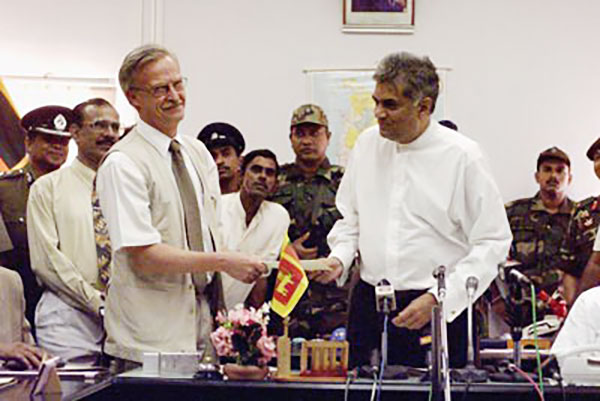
Jon Westburg the then Norwegian Ambassador in Colombo, shaking hands with Ranil Wickramasinghe after signing the CFA on Feb. 22, 2002.

Ranil declares US energy deal illegal

By Shamindra Ferdinando

UNP leader Ranil Wickremesinghe, over the last weekend, declared the much disputed Framework Agreement (FA) with the US Company New Fortress Energy illegal.

 National List MP Wickremesinghe, who had served as the Prime Minister on several occasions emphasised: “any agreement that violated the country’s laws is illegal. This agreement has violated the laws of the country. Therefore, it is illegal.

Raising a privilege issue in Parliament the day after Basil Rajapaksa, in his capacity as the Finance Minister, delivered the Budget for 2022, Wickremesinghe explained that the FA violated the Provisions of the Parliament (Powers and Privileges) Act and its Standing Orders.

 The UNP Leader urged Speaker Mahinda Yapa Abeywardena to declare that the FA had violated the powers, privileges and immunity of Parliament.

Lawmaker Wickremesinghe’s declaration should be examined taking into consideration his conduct as the Premier during the 2001-2004 and 2015-2019 periods.

Did Wickremesinghe, in his capacity as the Premier, follow the advice he gave the Sri Lanka Podujana Peramuna (SLPP) in respect of the FA with the company listed in the NASDAQ? Did Wickremesinghe consult Parliament or the Cabinet of Ministers before finalising contentious agreements, like the CFA that he signed with the LTTE, in total secrecy, or the treacherous motion moved against one’s own country in Geneva? Wickremesinghe, during his premiership never bothered, to consult Parliament or discuss the issues at hand with relevant stakeholders.

Perhaps, Wickremesinghe felt that his party can exploit the growing crisis over the FA with the US enterprise. Having being reduced to just one National List slot in the Parliament, following the 2020 parliamentary election, the beleaguered UNP leader will simply do anything to gain some political mileage. Wickremesinghe’s stand on this matter should be examined against the backdrop of a section of the government, led by three Cabinet Ministers, namely Vasudeva Nanayakkara, Wimal Weerawansa and Udaya Gammanpila, declaring the deal inimical to the country.

Let me discuss the Norway, arranged Ceasefire Agreement (CFA) between the Government of Sri Lanka and the Liberation Tigers of Tamil Eelam (LTTE) on Feb 21, 2002. The then Premier disregarded Parliament. The UNP leader didn’t bother to properly consult the armed forces top brass. Their concerns weren’t heeded. Instead, Norway prepared the CFA, taking into consideration the LTTE’s concerns. The one-sided agreement facilitated the LTTE’s despicable project. The LTTE swiftly moved into armed forces held areas, where the group violated the CFA at will. In fact, the CFA facilitated the despicable terror project.

Wickremesinghe gave the go ahead for the 99-year-lease on the strategic Hambantota harbour in 2017 under controversial circumstances. Did Wickremesinghe consult Parliament before co-sponsoring an accountability resolution at the Geneva-based United Nations Human Rights Council (UNHRC) or entering into ‘Comprehensive Partnership’ agreement with Japan, both in Oct 2015?

Former ministers, Mahinda Samarasinghe (now Sri Lanka’s Ambassador in Washington), Dayasiri Jayasekera (State Minister) and Sarath Fonseka (MP) in response to queries raised by the writer acknowledged that the Cabinet never formally approved co-sponsorship of the Geneva resolution. Wickremesinghe never contradicted what his ministers’ said.

It would be pertinent to mention that on the eve of the CFA, the Navy and the Sea Tigers fought two battles off Mullaithivu. The Sea Tigers triggered the battle by engaging two Fast Attack Craft (FACs) off Chalai. The Navy had to call in Katunayake-based jets in support of the units under attack off the northern coast. The UNP never considered the real threat posed by the LTTE. In fact, the top leadership slept as the LTTE flexed its muscles. The rapid build-up of firepower, within range of the strategic Trincomalee harbour, threatened to overwhelm the armed forces. The LTTE went to the extent of assassinating the then Foreign Minister Lakshman Kadirgamar on the night of August 12, 2005 at his heavily fortified Bullers Lane residence.

UNP strategy

 The UNP never took the then President Chandrika Bandaranaike Kumaratunga into confidence. She was never properly briefed nor her consent obtained before Wickremesinghe signed the CFA. On behalf of the LTTE, the late Velupillai Prabhakaran signed the document prepared in Oslo. Prof. G.L. Peiris, the then top minister in Wickremesinghe’s administration, declared President Kumaratunga skipped Cabinet on two consecutive sittings just before the signing of the CFA therefore she couldn’t receive briefing as regards the provisions of the CFA. Wickremesinghe secured Cabinet approval on Feb. 20, 2002. However, Presidential Spokesman the late Janadasa Peiris, declared the President didn’t attend the Cabinet meet on Feb 20 as she was told that nothing significant was going to take place (Kept away ‘as nothing important was to be discussed’-The Island, March 1, 2002).

Prof. Peiris led the government peace negotiating team, whereas the late Anton Balasingham, a British national of Sri Lankan origin, managed the LTTE team. The talks collapsed in April 2003 after six rounds, at overseas venues, as the LTTE abruptly quit the negotiating table as part of its overall strategy as it launched an unprecedented initiative to build up a formidable political base.

In line with that strategy, a coalition of Tamil political parties, called Tamil National Alliance (TNA) recognised the LTTE as the sole representative of the Tamil speaking people. The TNA remained committed to the LTTE’s separatist project until the very end.

Now that MP Wickremesinghe has declared that the New Fortress Energy deal violated the Provisions of the Parliament (Powers and Privileges) Act and its Standing Orders, wouldn’t it be interesting to examine how Wickremesinghe finalised the CFA.

Dr. John Gooneratne, who had been with the government Peace Secretariat, from its inception in January 2002 to May 2006, explained serious shortcomings in the CFA over a year after the conclusion of the conflict in May 2009. Appearing before the Lessons Learnt and Reconciliation Commission (LLRC) on Sept. 15, 2010, Dr. Gooneratne revealed that four key matters, proposed by the government, weren’t included in the CFA. (A) There had been no reference to the requirement to use the CFA to pave the way for talks to find a negotiated settlement. (B) Specific reference to the prohibition of unlawful importation of arms, ammunition and equipment was not included. (C) Although the LTTE was allowed to engage in ‘political work’ in government controlled areas, other political parties weren’t given access to areas under the LTTE control (D) Forcible conscription of personnel to the LTTE’s fighting cadre was also not added to the list of prohibited activities.

Dr. Gooneratne, a veteran career diplomat, faulted the then UNP government as well as the Norwegians for being hasty in their approach. Dr. Gooneratne said: “What lessons can we learn from this experience? Firstly, negotiating on such security and military matters should have been a more inclusive format than by just the party in power. Secondly, in negotiating documents such as the CFA, thoroughness should be the standard, and not just the speed.”

One-time Norwegian peace envoy to the Sri Lankan peace process, Erik Solheim claimed that he drafted the CFA, signed by Wickremesinghe and Prabhakaran. Solheim said so in an interview with Dr. Kumar Rupesinghe, one of the beneficiaries of the Norwegian project (Negotiating Peace in Sri Lanka: Efforts, Failures and Lessons – Volume II edited by Dr. Rupesinghe – first published in February 2006).

Asked by Dr. Rupesinghe to explain the circumstances under which the CFA came into being, Solheim said that having had extensive discussions with LTTE theoretician, Anton Balasingham as well as ministers, G. L. Peiris (SLPP Chairman and Foreign Minister) and Milinda Moragoda (Sri Lanka’s High Commissioner in New Delhi), he drafted a new proposal. That process had taken about two months. Prof. Peiris nor former Minister Moragoda had ever questioned Solheim’s assertions.

Need for proper negotiating mechanism

 During the yahapalana administration (2015-2019) the US negotiated ACSA (Access and Cross Servicing Agreement), SOFA (Status of Forces Agreement) and MCC (Millennium Challenge Corporation) Compact with Sri Lanka. Did Wickremesinghe and then President Maithripala Sirisena consult Parliament, or the Cabinet of Ministers, regarding the three agreements?

 President Sirisena, in his capacity as the Defence Minister authorised the ACSA. The President had the tacit support of the UNP. The government never disclosed the finalisation of the ACSA until the writer raised the issue with President Sirisena at a media briefing held at the President’s House. Having repeatedly vowed not to allow the UNP to enter into agreements with the US, at the expense of the country’s national security, President Sirisena had no option but to admit his role in authorising ACSA.

The SLFP leader, now a member of the SLPP parliamentary group, quietly allowed the finalisation of the ACSA in early August 2017. The ACSA, first signed by the then Defence Secretary Gotabaya Rajapaksa, during Mahinda Rajapakas’s first tenure as the President, received Sirisena’s approval, though he subsequently vowed any agreement, inimical to Sri Lanka, wouldn’t be allowed as long as he enjoyed executive powers. This declaration was made at a meeting with editors of national newspapers and senior representatives of both the print and electronic media. When the writer sought a clarification regarding the ACSA, Sirisena acknowledged the finalisation of the agreement, in the first week of August 2017. The UNP never found fault with Sirisena for giving the go ahead for the ACSA finalisation. As far as the yahapalana policy, vis-à-vis the US, both Sirisena and Wickremesinghe took one stand though sometimes, Sirisena tried to distance himself from Wickremesinghe’s Geneva policy.

When Sri Lanka entered into ACSA way back in 2007, the first Rajapaksa administration didn’t bother to consult the government parliamentary group or Parliament.

Talks on SOFA were suspended later. But the possibility of the US taking it up can never be ruled out whereas Sri Lanka abandoned the MCC project on the recommendations made by the Gunaruwan Committee.

Lanka-Singapore trade agreement

 Controversy surrounds the circumstances in which the yahapalana administration entered into the Sri Lanka – Singapore Free Trade Agreement (SLSFTA) on Jan. 23 2018. The agreement was brought into operation with effect from 1 May 2018. Sirisena who had been present at the signing of the agreement in Colombo, declared in Dec of the same year that it was rushed without proper consent of stakeholders. Sirisena said so after receiving a report prepared by retired economics Professor W.D. Lakshman, who studied the agreement. The UNP and the SLFP should be ashamed of the way they handled trade negotiations with Singapore where disgraced Central Bank Governor Arjuna Mahendran secured refuge in early 2018. Professor Lakshman succeeded Mahendran’s successor Dr. Indrajith Coomaraswamy soon after the 2019 presidential poll. Did the yahapalana leaders consult cabinet of ministers or Parliament as regards SLSFTA?

 UNP MP Wickremesinghe owes the country an explanation as to how SLSFTA came into being. Did MP Wickremesinghe follow the advice he recently gave the SLPP in respect of the New Fortress Energy deal?

Successive governments have been utterly irresponsible in finalising key agreements with foreign governments. There cannot be a better example than the deal on the Hambantota port. One-time Ports and Shipping Minister Arjuna Ranatunga recently discussed the failure on the part of the country to adopt a common stand in matters of national importance. Ranatunga said so when the writer sought his opinion on the controversy over the Colombo Port City Economic Commission Bill enacted in last Oct and the 99-year leasing of the Hambantota port to the Chinese.

Ranatunga compared the handing over of the Hambantota port to China, in July 2017, with the Colombo Port City project to be managed in terms of the Colombo Port City Economic Commission Act.

The former lawmaker said that he gave up the Ports and Shipping Ministry as he didn’t want to endorse the disputed agreement under any circumstances.

Ranatunga contested the Gampaha district, on the UNP ticket, at the last general election, but couldn’t win like all other party candidates, barring for a solitary National List seat, which Wickremesinghe grabbed though it should have rightfully gone to John Amaratunga, who was on top of the party’s National List or at least to one of those National List nominees.

 Ranatunga pointed out that the Port City Project, too, had been under the purview of the ports and shipping ministry. But the yahapalana administration, following consultations with him, brought the Port City project under the then Megapolis Minister Patali Champika Ranawaka’s purview.

Ranatunga was replaced as Ports and Shipping Minister by SLFP Vice President and Kalutara District MP Mahinda Samarasinghe.

The former World Cup winning national cricket captain emphasised that he gave up the ministry after the yahapalana government rejected a proposal prepared in consultation with the ministry and the Sri Lanka Ports Authority (SLPA). It was discarded by those bent on pursuing an agenda inimical to Sri Lanka, he charged.

The then SLFPer Samarasinghe finalised the agreement on July 29, 2017.

Former minister Ranatunga said that he was quite surprised by the rejection of his proposal as he presented a sensible solution which addressed concerns of both countries. Ranatunga said that he didn’t want to remain as the Ports and Shipping Minister at any cost.

Acknowledging some support provided by the then Cabinet colleague Dr. Wijeyadasa Rajapakse PC, as he struggled to thwart a plan inimical to the country, Ranatunga claimed that the Joint Opposition (SLPP now) backed the deal on the Hambantota port. Ranatunga pointed out that some tend to conveniently forget both the Hambantota and Port City projects were initiated during the previous Rajapaksa administration.

The Hambantota port project was initiated in 2007 at the height of the war, whereas the Port City got underway in late 2014.

Appreciating the investments made by China in Sri Lanka, over a period of time, Ranatunga stressed that the country couldn’t afford to enter into agreements detrimental to its interests. The former minister urged lawmakers, both opposed to the project as well as those backing, it to be cautious in their approach.

 Noting that the Bar Association of Sri Lanka (BASL) had been among those who petitioned the Supreme Court against the Colombo Port City Economic Commission Bill, Ranatunga said that the handling of the Hambantota port agreement revealed how the country was being manipulated. “In spite of the Hambantota port coming under the purview of the Ports and Shipping Ministry, it didn’t really have a say. That is the undeniable truth,” Ranatunga said.

The former MP questioned the rationale in reclaiming land adjacent to the Galle Face Green at such a huge cost as the project could have been set up in some other suitable location.

Ranatunga said that he was not aware of the current status of the cases filed against the Hambantota port. Among those who filed cases was the then MP Vavudeva Nanayakkara. However, none of the 19 petitioners who moved the Supreme Court against the Colombo Port City Economic Commission Bill, including BASL, conveniently failed to figure in the legal challenge thrown against the Hambantota port deal.

Ranatunga said due to the failure on the part of Parliament to take remedial measures the country seemed to be repeating mistakes. The former minister regretted the overall failure to address contentious issues, such as major foreign investment which might threaten the country’s stability. The government and the main Opposition should bear the responsibility for both Hambantota and Port City projects as they proceeded with both.

Wednesday, 10 November 2021

Visit to Moscow amid US travel ban

 SPECIAL REPORT : Part 393

Published

  
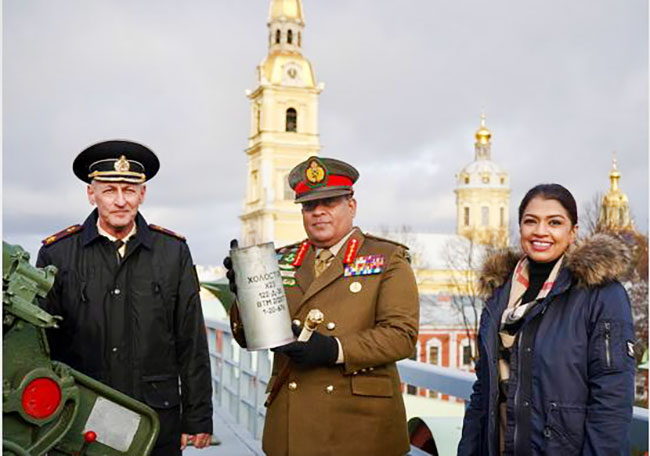
General Shavendra Silva and wife Sujeewa Nelson at the Mikhailovskaya Military Artillery School(pic courtesy Ministry of Defence of the Russian Federation)

By Shamindra Ferdinando

General Shavendra Silva’s recently concluded visit (Oct 23 to Oct 30) to Russia should be examined against the backdrop of an unprecedented travel ban by the United States on the Sri Lanka Army Commander over hearsay war crimes accusations, including extrajudicial killings, during the last phase of the Vanni offensive.

Sri Lanka brought the war to a successful conclusion on the morning of May 19, 2009, on the banks of the Nanthikadal lagoon, despite a chorus of ‘expert’ opinion generated by the West over the years claiming that the country’s armed forces were incapable of defeating the LTTE and they had literally elevated the Tigers to a mythical and invincible status.

Combined Sri Lankan armed forces, however, conducted a relentless campaign, over a period of two years and 10 months, until Velupillai Prabhakaran was trapped in the one-time LTTE stronghold Mullaitivu. Prabhakaran was killed the day after the then General Sarath Fonseka’s Army declared the end of the war, on May 18, 2009. The Vijayabahu Infantry Regiment (VIR) was credited with the killing of Prabhakaran and recovery of his body more or less intact.
The US, one of the worst violators of human rights in many conflict zones, in the world, imposed a politically-motivated travel ban on General Silva, the first General Officer Commanding (GOC) of the much-celebrated 58 Division (formerly Task Force I).

Having launched offensive operations in early Sept 2007, from the Western front, the area popularly known as the Mannar rice bowl, the TF 1 troops fought their way northwards, captured Pooneryn (late Nov 2008) and then turned eastwards, crossed the Kandy-Jaffna A9 road, at Paranthan, and in quick succession stormed enemy defences at Elephant Pass and also brought Kilinochchi South under their control by early January 2009. With the fall of Kilinochchi, the Army stepped up offensive action leading to the final confrontation with Prabhakaran on May 19, 2009 in the environs of the Nanthikadal lagoon.

It must be noted here that Fonseka’s Army changed overall tactics in the northern and eastern theatres. The enemy simply had no answer to several fighting formations advancing on its bases and troops causing havoc, deep inside enemy held territory.

It would be pertinent to mention that the Army-raised TF 1 comprising two infantry Brigades on August 31, 2007, at Irattaperiyakulam camp under the leadership of the then Brigadier Chagie Gallage who carried out the first successful mission which resulted in the liberation of Silavathurai.

Earlier in April of that year, men Gallage led, captured the Thoppigala base of the Tigers, which some thought was impregnable. After its capture, ironically, then Opposition Leader Ranil Wickremesinghe tried to denigrate the victory as just the capture of a rock outcrop. We can recall that when Brig. Gallage went to announce the capture of the Tiger Jungle base at Toppigala he drove his own jeep like an ordinary soldier with a staff officer next to him also dressed like an ordinary soldier, but the media that had converged at his base close to the Black Bridge Batticaloa were not aware of the important if not symbolic achievement till it was announced over the TV and radio that night.In fact, Gallage spearheaded the Eastern campaign except the action at Mavilaru, conducted by the then Brigadier Prasanna Silva.

While TF 1 was steadily advancing from the Mannar Rice Bowl, Brig. Gallage suffered a heart attack in the Vanni west, Gallage had to undergo emergency surgery in Colombo. Fonseka brought in Shavendra Silva to command TF 1. The Army never revealed at that time military strategist Gallage suffered a heart attack on Oct 22, 2007, the day the LTTE mounted a commando-style raid on the Anuradhapura air base. Because of the calamity at the air base, Gallage had to be taken by chopper to Sigiriya air base and then flown to Ratmalana air base in a fixed aircraft. The rest is history.

Army Chief blacklisted

The US blacklisted Gen. Silva close on the heels of Commander-in-Chief of the Russian Ground Forces, General Oleg Salyukov’s five-day visit to Colombo in early Feb 2020 on the invitation of his Sri Lankan counterpart the then Lieutenant General Shavendra Silva. General Salyukov extended an invitation to General Silva to visit Russia though the eruption of Covid-19 epidemic prevented him from leaving the country as he was appointed as the head of the Task Force appointed to prevent the spread of the pandemic.

General Silva’s wife, Sujeewa Nelson accompanied him on his second foreign visit since the imposition of the US travel ban. Their first overseas visit was in March 2021 to Islamabad on the invitation of the country’s all-weather friend Pakistan. General Silva and Sujeewa Nelson were invitees at Pakistan’s national military parade. A section of the foreign media condemned and disputed Pakistan’s invitation to General Silva on the basis of him being among those accused of war crimes.

Having solidly defended Sri Lanka at the Geneva-based United Nations Human Rights Council (UNHRC), both Pakistan and Russia have absolutely no qualms in inviting General Silva. Both countries voted against anti-Sri Lanka resolutions spearheaded by the West moved in Geneva.

The timing of the US ban underscored the Superpower’s intention to meddle in local politics. The announcement was made between the last presidential election held in mid-November 2019 and the parliamentary polls in August 2020. It would be pertinent to mention that the parliamentary polls, scheduled for April 25, 2020, had to be put off to August due to the Covid-19 eruption. The UNP suffered a very heavy defeat with the over 70 year-old party that had 106 MPs in Parliament (2015-2019) being reduced to a solitary National List slot.

Most probably the US never expected the then Maj. Gen. Silva to receive an opportunity to command the Sri Lanka Army. Had that happened, the US wouldn’t have had to blacklist the highly decorated soldier. Obviously, the UNP-led government and the then President Maithripala Sirisena didn’t agree on how to deal with Silva.

The failed constitutional coup in late Oct 2018 ruined the political relationship between President Sirisena and Premier Ranil Wickremesinghe. Therefore, no one would have been surprised by the yahapalana leaders’ disagreement on the Army Commander’s appointment.

President Sirisena appointed the distinguished ground combat commander as the 23rd Commander of the Army on August 18, 2019. Maj. Gen. Silva was also elevated to the rank of Lieutenant General effective the same date. Had efforts to deprive Silva of the top position succeeded, the US wouldn’t have had to play politics with the Sri Lankan military by imposing a controversial travel ban on him. Or had the Presidency been in the hands of the UNP it would have appointed one of its uniformed ‘yes’ men as the new Army Commander and definitely not one who helped to defeat the most ruthless terror outfit in the world.

Whatever the reasons, the stand taken by President Sirisena, the Commanding-in-Chief of the armed forces as well as the Defence Minister should be appreciated.

Following wartime Defence Secretary Gotabaya Rajapaksa’s triumph at the Nov 2019 presidential election, Silva was promoted to the rank of a 4-star General on Dec 28, 2020. With the retirement of Admiral Ravi Wijegunaratne on Dec 31, 2019, Gen. Silva was named the Chief of Defence Staff. Six weeks later the US categorised General Silva as a war criminal.

Denigration of an Army Chief

Why did the US categorise General Silva a war criminal well over a decade after the conclusion of the war? Let me remind the reader that Silva, in 2010, received the appointment as Deputy Permanent Representative of Sri Lanka to the United Nations, in New York. Silva is the one and only serving military officer in Sri Lanka’s history to be promoted to an ‘Ambassadorial’ rank in the country’s Foreign Service. Most importantly, why on earth the US found it necessary to declare Silva a war criminal having backed the war-winning General Sarath Fonseka’s candidature at the 2010 January presidential election.

In fact, the US played a significant role in building up a UNP-led coalition that included the Tamil National Alliance (TNA) in support of Fonseka. War crimes accusations against the Army seemed ridiculous against the backdrop of all predominantly Tamil speaking electoral districts in the North and the East voting overwhelmingly for Fonseka. But, incumbent President Mahinda Rajapaksa polled 1.8 mn votes more than Fonseka. The silly Opposition blamed Fonseka’s defeat on what the late JVP leader Somawansa Amarasinghe called a computer jilmart.

When the then government arrested Fonseka under controversial circumstances and was sentenced, the US intervened on the retired General’s behalf despite then US Ambassador Patricia Butenis having named Fonseka a war criminal along with the Rajapaksa brothers, Mahinda, Basil and Gotabaya. Butenis assertion is in the public domain thanks to secret Wiki Leaks. Butenis’ cable sent just weeks before the January 2010 presidential election underscored duplicitous US strategy.

Ten years after the 2010 presidential election, US Secretary of State Mike Pompeo tweeted: “I am designating Shavendra Silva making him ineligible for entry into the US due to his involvement in extrajudicial killings during Sri Lanka’s Civil War. The US will not waver in its pursuit of accountability for those who commit war crimes and violate human rights.”

Designation of the Army Chief took place soon after Pompeo declared the US looked forward to deepening ties with Sri Lanka. How did the US expect to improve ties by blacklisting a hugely popular Army Chief?

In a previous statement, Pompeo said that allegations of gross human rights violations against Shavendra Silva had been documented by the United Nations and other organisations. US sanctions barred both Silva and his immediate family members from entering the US.

 “The Government of Sri Lanka takes strong objection to the imposition of travel restrictions on Lieutenant General Silva and his immediate family members by the Government of the United States, based on independently unverified information,” the Foreign Ministry said in a statement.

Lanka responds to US

Sri Lanka’s Ambassador in Washington Rodney Perera declared that the US decision hadn’t been based on independently verified information, but on the much-disputed OISL Report of 2015 and accusations propagated by various other organisations.

Ambassador Perera urged the US to verify the authenticity of its sources of information. Ambassador Perera said so addressing the American Foreign Service Association Club in Washington D.C. The gathering included several former U.S. Ambassadors and senior officials who served in Colombo.

Commenting on the inclusion of the family members of the Army Commander on the blacklist, Ambassador Perera declared: “Even though we are now in the 21st Century, even members of his family who have not been accused of any wrongdoing, have been subjected to a collective punishment reminiscent of the practice in medieval Europe.”

The career diplomat assured Sri Lanka would remain strongly engaged on this issue with the United States to have it review its decision. The assurance was given about a week after the US blacklisted the much decorated soldier. What have we done since then to disapprove unsubstantiated war crimes allegations against General Silva? In fact, the despicable project against the Commander of the Army is nothing but an affront to the country. Parliament never really took up the Western powers’ campaign against the war-winning military here. During Karu Jauasuriya’s tenure as the Speaker, the UNP politician never bothered to take it up with Western diplomats. One shouldn’t be surprised over that, as his party betrayed the military by co-sponsoring an accountability resolution on Oct.01, 2015. However, the failure on the part of incumbent Speaker Mahinda Yapa Abeywardena to speak on behalf of the military when foreign diplomats called on him, cannot be justified.

Before General Silva undertook the visit to Russia, Chief of Indian Army Staff General Manoj Mukund Naravane was here. In spite of India being a US ally, New Delhi went ahead with its Army Chief’s visit to Colombo. Naravane had been here with the Indian Peace Keeping Force during its deployment in terms of the Indo-Lanka Accord and had been based in Trincomalee. Now, the issue is how is it that those countries demanding action against the Sri Lankan military for eradicating terrorism on its soil are silent on India’s accountability issues here. Unfortunately, Sri Lanka lacked the political will to present its case properly before the international community.

Failure on the part of successive Sri Lankan governments to address accountability issues since the end of the conflict has underscored utter irresponsibility on the country’s part. Against that pathetic background, the Russian invitation extended to Gen. Silva is of paramount importance.

 Considered to be one of the highest honours, presented in recent times, the formal and elegant Guard of Honour parade with four squads of the Russian Land Forces, together with a Russian Army band distinctively featured the significance and the recognition the Russian Land Forces attach to the visiting Sri Lankan Army Chief.

General Silva after formal honours was ushered to pay floral tribute to the monument at Alexandrovsky Garden of Moscow Kremlin where the Tomb of the Unknown Soldier stands.

During General Shavendra Silva’s stay in the Russian Federation, he visited the Moscow Higher Combined Arms Command School and met its Commandant, Major General Roman Binyukov, Division Commander of the 4th Guards Tank Division in Naro-Fominsk and the Commandant at Mikhailovskaya before he visited the Military Artillery Academy, Military Medical Academy and several other places of military and tourist attractions.

Saliyapura bombshell

The writer earlier mentioned the change of command of the TF 1 in Oct 2007 following Gallage’s predicament, but what is of far more importance is what he said at Saliyapura Gajaba Regimental headquarters in the first week of Sept 2018 as his farewell speech when he retired from the service after an illustrious military career, much of it having spent leading combat troops. Gajaba veteran General Gallage didn’t mince his words when he questioned how having served the Army for well over 30 years he was compelled to retire being categorised as a war criminal. Why did Gallage have to say that? Gallage had sought a visa in Sept 2016 to visit his brother living in Australia. He wanted to visit Australia from Dec. 2016 to January 2017. Gallage’s brother, an Australian citizen of Sri Lankan origin, had visited Colombo especially to make representations to the Australian HC.

Following that meeting the Australian department of Immigration and Border Protection issued a report titled ‘Potential Controversial Visitor’ citing war crimes and crimes against humanity as reasons for denying Gallage a visa.

In the absence of specific accusations against Gallage, Australia found fault with him for giving leadership to the 59 Division after the conclusion of the war. In other words, those who commanded fighting formations during the war (Divisions 58, 59, 57, 53, 55 et al) on the Vanni front and after can be humiliated. Gallage’s is a case in point.

Interestingly, the Army celebrated its 72 anniversary at the Saliyapura base last Oct with the participation of President Gotabaya Rajapaksa formerly of the Gajaba Regiment. In his speech at Saliyapura, Rajapaksa, who retired having achieved Lieutenant Colonel’s rank (1971-1992), acknowledged shortcomings on the part of his government. The government should examine the aptness of its response to war crimes accusations. President Rajapaksa made reference on Nov 6 to Sri Lanka having to face Geneva accusations though in a different context.

Designation of the Army Chief should be examined taking into consideration overall war crimes accusations directed at Sri Lanka. How can the government forget the US declined to issue a visa to Field Marshal Sarath Fonseka and the circumstances?

 Haven’t those in authority observed how Canada and Italy rejected retired Air Force Commander Air Marshal Sumangala Dias as Sri Lanka’s top diplomatic envoy?

British Conservative politician Lord Naseby in an interview with this writer in late Sept 2019 questioned Sri Lanka’s response to the accountability issue (Naseby disappointed in Lanka’s collective failure to use ‘Gash reports’ for its defence-Sept 25, 2019, The Island.’

Why didn’t Sri Lanka continue to refrain from effectively using British cables that had been obtained by Lord Naseby after near a three-year legal battle and wartime US Defence Advisor Lt. Colonel Lawrence Smith’s taking a view 100 percent contrary to the US and its allies as regards the accountability issue, at the 2011 Colombo Defence seminar? Nothing can be as important as the US official’s statement exclusively reported by The Island as it was made just two months after the much debated highly controversial Darusman report’s release. The split in the war-winning team with Fonseka’s entry into politics in late 2009, too, also contributed to Sri Lanka’s overall failure. Instead of countering lies, the first Rajapaksa administration squandered millions of USD in foolish image building projects.

Sri Lanka’s relations with the world should be examined in the context of Quad strategies and new trilateral security partnership AUKUS under which Australia would get a fleet of nuclear-powered submarines for the first time and Sri Lanka’s strong partnership with China. The ongoing controversy over Sri Lanka moving the Colombo Commercial Court against top Chinese fertiliser company, its local agent and the People’s Bank to stop payment for carbonic fertiliser consignment shouldn’t be allowed to ruin relations between the two countries. Like Pakistan, the emerging world power China is an all-weather friend, whose continuing support to Colombo is essential. Therefore, the issue at hand should be dealt carefully taking into consideration all factors. But, under no circumstances, should corruption be allowed to undermine Lanka-China relations.

Wednesday, 3 November 2021

Govt. erupts over US energy deal, crisis threatens SLPP’s near 2/3 majority

 SPECIAL REPORT : Part 392

Published

  
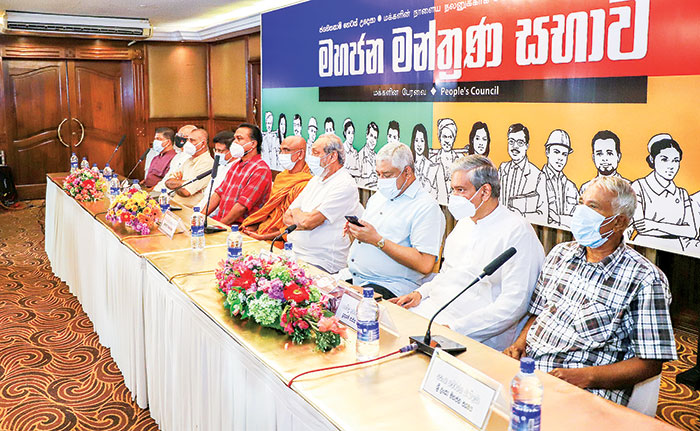
Rebel SLPP lawmakers and Ven. Athureliye Rathana, MP of 'Ape Jana Bala Pakshaya' at last Friday's meet at Solis hall

By Shamindra Ferdinando

The top government leadership last Thursday night (28) made a last ditch attempt to thwart an influential section of ruling party lawmakers from going ahead with the planned public meeting at the Solis Hall, Pitakotte, against the controversial energy deal with the US-based New Fortress Energy.

The meeting, held at the main hall of Temple Trees, with the participation of President Gotabaya Rajapaksa, Prime Minister Mahinda Rajapaksa, Finance Minister Basil Rajapaksa and Chief Government Whip Dinesh Gunawardena, failed to convince the dissident members. In spite of the Prime Minister’s Office declaring that a consensus had been reached on how to address the issue at hand, the rebel group went ahead with their meeting.

Of the 145-member Sri Lanka Podujana Peramuna (SLPP) parliamentary group, the following members, Industries Minister Wimal Weerawansa (leader, National Freedom Front/Colombo district), Energy Minister Udaya Gammanpila (leader, Pivithuru Hela Urumaya/Colombo district), Water Supply Minister Vasudeva Nanayakkara (leader, Democratic Left Front/Ratnapura district), SLFP General Secretary and State Minister Dayasiri Jayasekera (Kurunegala district), LSSP General Secretary Prof. Tissa Vitharana (National List), National Congress leader A.L.M. Athaulla (Digamadulla district), United People’s Party leader Tiran Alles (National List) and Yuthukama civil society group leader Gevindu Cumaratunga (National List) participated at the launch of a public protest campaign. All of them had been present at last Thursday’s Temple Trees over three-hour long inconclusive discussion that actually appeared to have aggravated the situation.

In addition to them, Ven. Athureliye Rathana thera, MP, represented the Ape Jana Bala Pakshaya at Friday’s meet at Pitakotte. National List lawmaker Ven. Rathana, facing possible expulsion from parliament, over a dispute with his party, in spite of frequent participation at SLPP events, is not a member of the government parliamentary group. Interestingly, Ven. Galagodatte Gnanasara, recently named as the head of the Presidential Task Force (PTF), assigned to make recommendations in respect of the ‘One Country, One Law’ project, is widely believed to be a frontrunner for the Ape Jana Bala Pakshaya National List slot. The Ven thera’s new status has deeply disappointed the Muslim community, with Justice Minister Ali Sabry, PC, declaring his intention to quit the justice portfolio.

In the absence of the sole Communist Party member in Parliament, Weerasumana Weerasinghe, their General Secretary Geeganage Weerasinghe joined the head table. When the writer sought a clarification from lawmaker Weerasinghe as regards his absence at the vital meeting, he assured his commitment to the protest campaign. “I had to attend a previously organised event,” the Matara District lawmaker said, adding that he represented the party at Thursday’s meeting at Temple Trees.

At Friday’s meeting, the rebel group declared that it wouldn’t accept the US energy deal, under any circumstances. The group, in no uncertain terms, alleged the brazen manipulation of Cabinet procedures, in respect of the energy deal with the US Company. One-time JVP firebrand Weerawansa, on behalf of the group, emphasised that their effort was to save the government and not in any way promote the bankrupt Opposition. The dissident group alleged that the agreement would create, what Minister Gammanpila called, a permanent US monopoly in the supply of gas to Sri Lanka. The MPs vowed that they wouldn’t give up their opposition to the deal for perks and privileges.

While former President Maithripala Sirisena, who attended the meeting at Temple Trees, was represented by Dayasiri Jayasekera, Mahajana Eksath Peramuna (MEP) leader and Chief Government Whip Dinesh Gunawardena, and Ceylon Workers representative Jeevan Thondaman, MP, weren’t present, though they attended the Temple Trees meet.

SLPP remains in control

In spite of the latest crisis, triggered by the rebel group that included the SLFP, the second largest party in the ruling coalition (14 members), the dominant power SLPP retains the most powerful group in Parliament. The SLPP group, in the government parliamentary grouping, comprises 117 members and strongly remains committed to the incumbent government at least for now.

The only exception is Dr. Wijeyadasa Rajapakha, PC, who broke ranks with the SLPP over the Colombo Port City Economic Commission Bill, in May, 2021. However, the one-time Justice Minister refrained from voting against the Bill, though he appeared for the Chief Incumbent of the Narahenpita Abhayaramaya, the Ven. Muruththettuwe Ananda, in the fundamental rights case against the Bill. Minister Weerawansa’s NFF consists of six members and is the third largest group therein. Although Dr. Rajapaksha didn’t join Friday’s meet, he is very likely to support the cause. Ven. Muruththettuwe Ananda delivered anusasana at the commencement of the event.

Did the top SLPP leadership anticipate the SLFP, NFF, PHU, and several other political parties taking a common stand on the US energy deal? The crisis couldn’t have erupted at a worse time for the government, struggling on several fronts, ahead of the presentation of Budget 2022, on Nov 12. The government shouldn’t take the developing situation lightly. Over two dozen lawmakers, many of whom zealously rallied the nation behind Rajapaksas after they suffered the shock defeat at the January 2015 Presidential election, taking a contrary view to that of the SLPP, as regards the US energy deal, should be a matter of serious concern. In other words, the government’s near two-thirds majority is at risk. Unless the SLPP reaches some sort of consensus with its constituents as soon as possible, the overall government strategy can be undermined. It would be a grave blunder, on the government’s part, to go ahead with its plans, regardless of the growing opposition, within the parliamentary group.

Many an eyebrow was also raised over the presence of SLPP lawmaker Attorney-at-Law Premanath Dolawatte with the rebels, as he once called himself a lawyer for the Rajapaksas.

The public is quite likely to be concerned about the rebel group’s declaration that the US energy deal would betray the country’s future. Would this crisis undermine the much-touted government promise to enact a brand new Constitution? The SLPP’s predicament, due to a section taking a public stand on a contentious foreign and economic policy matter, should be examined against the backdrop of the Jathika Sanvidhana Ekamuthuwa (JSE) seeking Court of Appeal intervention as regards the US energy deal. Dr. Gunadasa Amarasekera, who threw his weight behind Gotabaya Rajapaksa, during a high profile campaign for the one-time Defence Secretary to secure the SLPP candidature, for the 2019 presidential election, spearheaded the JSE petition against the highly questionable energy deal.

Another one time major SLPP backer Ven. Elle Gunawansa, joining hands with Archbishop of Colombo Malcolm Cardinal Ranjith, to move the Supreme Court against the US deal, should be a matter for concern to the government.

Minister Weerawansa questions brazen manipulation of cabinet procedure in controversial New Fortress deal.

SLPP constituent taking neutral stand

However, the MEP refrained from taking a public stand either way on the New Fortress deal. The rebels gathered at the Solis Hall, whereas the Chief Government Whip Dinesh Gunawardena and his son, Yadamini, of the SLPP National List, took that time to pay courtesy calls on the Chief Prelates of the Asgiriya and Malwatte Chapters. MEP leader Gunawardena, who served as the first Foreign Minister under President Gotabaya Rajapaksa, in August this year, was made to switch portfolios with Foreign Minister Prof. G.L. Peiris, who is also the Chairman of the SLPP.

The MEP parliamentary group consists of Dinesh Gunawardena and Yadamini. The MEP has largely refrained from being part of the group that initially took up a public stand against the move to go ahead with the previous government’s plan to involve India and Japan in the East Container Terminal (ECT). Subsequently, the group defended member Gammanpila when the SLPP demanded his immediate resignation over the increase in fuel prices in the second week of June this year. As anticipated, political eruption over the US energy deal is likely to be far worse than previous disputes.

The SLPP onslaught, directed at Minister Weerawansa, over his call for President Gotabaya Rajapaksa to play an active role in the party, cannot be ignored. Weerawansa recently reiterated his call for President Rajapaksa’s direct involvement in the political decision-making process. Weerawansa’s stand has caused quite a serious issue in the SLPP and the latest developments are likely to cause further deterioration.

Obviously, whatever the consequences, both sides are not in a position to take a step backward. Outgoing US Ambassador Alaina B. Teplitz, who intervened on behalf of New Fortress Energy, and swiftly brought about the agreement, paid a courtesy call on President Gotabaya Rajapaksa, at the Presidential Secretariat, the day before the rebel onslaught. Can the agreement be rescinded? Is there a remedy for the political crisis, caused by the Cabinet decision that had been quite interestingly titled ‘Investments into the West Coast Power (Private) Limited (WCPL) to reduce the Cost of Electricity Generation?’ Who actually prepared that Cabinet memorandum, dated Sept.06, 2021, that had been adopted through fraudulent means? And, most importantly, what can the rebels do in case the government went ahead with the Project irrespective of consequences? Would Sri Lanka be compelled to honour the agreement, whatever the fallout? The answer might be in the hands of the highest courts in the land as several petitions challenging the deals are already pending before them.

The rebels’ claim that the Cabinet approval hadn’t been secured properly should be examined, taking into consideration the Cabinet memorandum that revealed Secretary to the Treasury S.R. Attygalle entered into the agreement on July 07, 2021, in line with Cabinet approval, granted on July 05, 2021. In terms of the framework agreement with New Fortress Energy, listed in the NASDAQ: (i), the US company will receive 40 percent of WCPL shares held by the Treasury for USD 250 mn (ii) execution of the terminal project (floating storage regasification unit, mooring system and the pipelines) and (iii) supply of liquefied natural gas.

At the centre of this developing drama no doubt is the Finance Minister Basil Rajapaksa, a dual Sri Lankan/US citizen being the its prime mover. The SLPP that made quite a uproar over Singaporean Arjuna Mahendran helping to stage broad daylight robberies of the central Bank twice during the previous yahapalana regime as the Governor of the Central Bank, has nothing to shield it if the courts uphold the challenges to the more or less secret deals.

Political, financial imbroglio

A catastrophic political dispute, over the energy deal, with the US, has placed the government in an extremely difficult position, at a time a spate of other issues continue to undermine the ruling coalition. The whole gamut of issues should be examined against the backdrop of the much-deteriorated financial situation. The government seems satisfied with the Central Bank’s response to Moody’s Investors Service (Moody’s) further downgrading Sri Lanka. Expressing ‘strong displeasure’ on the recent assessment, the Central Bank declared: “Once again, Moody’s irrational rating action with regard to Sri Lanka comes a few days before a key event, namely the announcement of the Government Budget for 2022, and this apparent hastiness and the view expressed during discussions with Moody’s analysts that the nature of the Budget is irrelevant to the financing plans of the Government clearly demonstrates the lack of understanding of such analysts.”

The US deal has dealt a severe blow at a time the government is struggling to cope up with growing farmers’ protests against the shortage of fertiliser and agro-chemicals, unprecedented dispute with China over the refusal to accept a consignment of alleged contaminated carbonic fertiliser and remit payment that led to the blacklisting of the People’s Bank, controversy over the mode of payment for liquid nano-nitrogen fertiliser, ordered from India, continuing protests against the inordinate delay in implementing the Presidential Commission of Inquiry (PCoI) recommendations, in respect of the 2019 Easter Sunday carnage, failure to reverse accountability process, initiated by the Geneva-based United Nations Human Rights Council, Indian push for the full implementation of the 13th Amendment, enacted in Nov 1987, in line with the Indo- Lanka Accord, of July 29,1987, Pandora Papers revelations pertaining to former PA and UPFA lawmaker Nirupala Rajapaksa and her husband Thirukumar Nadesan, shocking corruption charges in respect of the payment of over Rs 4 bn to a Chinese company given the Gin-Nilwala project during the previous Rajapaksa administration, dismissal of several high profile cases filed by the Attorney General and the Commission to Investigate Allegations of Bribery or Corruption (CIABOC), shortage of essential food items, including rice etc.

There is no point in denying the fact that the public stand taken by the SLPP rebel group, as regards the US energy deal, has severely undermined the government. In fact, the allegations, pertaining to the manipulation of the Cabinet process, should attract the attention of Parliament. Parliamentary watchdog committees, COPE (Committee on Public Enterprises), COPF (Committee on Public Finance) and COPA (Committee on Public Accounts) should pay attention to the rebel accusations.

Now that three Cabinet ministers have publicly challenged the Cabinet process, they owe the country an explanation as to how the group would proceed, whatever the outcome of the judicial response be to cases filed in the Supreme Court and the Court of Appeal. The cash-strapped government is experiencing a very fluid political situation.

Strategic political miscalculation

Perhaps, it would be pertinent to recall the political developments, in July 2014, that set the stage for the 2015 political change. The crisis began after lawmaker Wimal Weerawansa invited the convener of the Movement for Just Society, the late Ven. Maduluwawe Sobitha thera, to discuss far reaching constitutional reforms, including the abolition of the executive presidency.

At the conclusion of the talks, Ven. Sobitha, spearheading a high profile campaign against the executive presidency and Weerawansa, agreed to continue their discussion. The media gave wide coverage to the unexpected. Weerawansa flexed his muscles, ahead of the Uva Provincial Council poll. Weerawansa, the then Construction, Engineering Services, Housing and Common Amenities Minister, warned the then President Mahinda Rajapaksa’s government to meet his demands or face the consequences. Weerawansa threatened to throw his weight behind Ven. Sobitha’s campaign, unless the SLFP accepted his demands, meant to bring in far reaching constitutional reforms. Among Weerawansa’s other demands had been an immediate halt to, what was called, the South African initiative meant to help the post-war national reconciliation process and the cancellation of the foreign investigative mechanism to inquire into accountability issues. The SLFP simply ignored Weerawansa’s demands.

Having caused a debilitating setback, Weerawansa threatened to go it alone, at the last Uva Provincial Council poll, in September, 2014. At the eleventh hour, Weerawansa’s NFF contested Badulla district, on its own, while contesting the Moneragala district on the UPFA ticket.

Subsequently, Weerawansa distanced himself from Ven. Maduluwawe Sobitha, while the like-minded Jathika Hela Urumaya (JHU) teamed up with Ven. Maduluwawe Sobitha. Their alliance quickly gained ground, in spite of President Mahinda Rajapaksa’s efforts to reach an understanding with the influential monk, in the run-up to the January 8, 2015, presidential poll. Ven. Maduluwawe Sobitha and Ven. Athureliye Rathana thera, on behalf of the JHU, spearheaded a campaign that undermined the SLFP-led administration.

The Maithripala Sirisena seeing a chance to be king exploited Weerawansa’s attacks on the SLFP, and the Rajapaksa family, in the run-up to the 2015 presidential poll. Ven. Maduluwawe Sobitha played a critical role in the formation of an alliance that brought an end to President Rajapaksa’s rule. Weerawansa, as well as JHU stalwart Udaya Gammanpila, who switched his allegiance to the former President, accused those Buddhist monks, backing Maithripala Sirisena, of being involved in a foreign-led conspiracy to divide the country, on ethnic lines. Obviously, the Sinhala electorate didn’t take them seriously. The country overwhelmingly voted Maithripala Sirisena into power.

The then General Secretary of the Communist Party and senior minister, D.E.W. Gunasekera strongly opposed an early presidential poll. Having realised the President was hell-bent on securing a third term, two years before the scheduled date, Gunasekera, along with his colleagues, senior Minister Prof. Tissa Vitharana, and Minister Vasudeva Nanayakkara, urged Rajapaksa not to call an early poll.

Unfortunately, the former President had been convinced of a comfortable victory, regardless of poor showing at the Uva Provincial Council poll. The President’s astrologer, Sumanadasa Abeygunawardena, predicted an easy win for the twice President , while several other astrologers echoed Abeygunawardena, who held two lucrative posts as Director of Independent Television Network (ITN) and the National Savings Bank (NSB). The astrologers cheated the SLFP leadership in style. Both state-run and private television stations, as well as the print media, gave them time and space to hoodwink the masses. They did it in style.

DEW Gunasekera, Nanayakkara and Vitharana almost in unison briefed the former President regarding the danger in having an early election. Regrettably, their plea, made in early October, 2014, was ignored.

Constituents of the SLPP should initiate a genuine discussion among them without further delay or be prepared to face the consequences as in 2015.