Tuesday, 21 September 2021

Easter Sunday imbroglio!

 SPECIAL REPORT : Part 386
Published

   
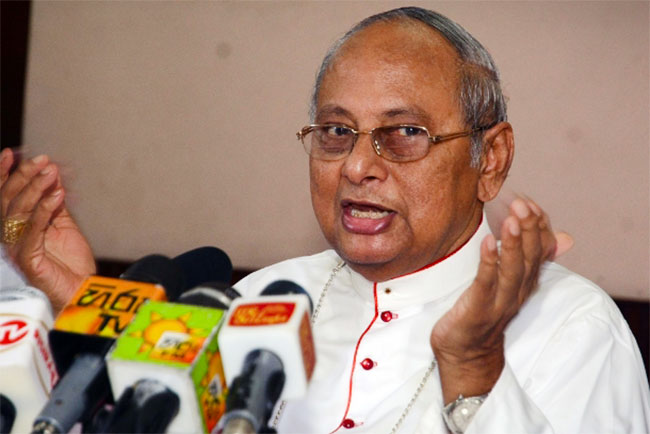
Archbishop of Colombo Malcolm Cardinal Ranjith reiterates demand for justice at a recent media briefing. The Church has sought the intervention of the Vatican as well as the UNHRC to pressure Sri Lanka over the Easter Sunday probe

Can Parliament, as an institution, absolve itself of the responsibility for tainted political parties? The House did nothing when the TNA recognised the LTTE as the sole representative of the Tamil speaking people. Both Parliament and the Election Department/Election Commission conveniently remained silent. Both institutions turned a blind eye when the TNA, on behalf of the LTTE, in blatant violation of the right to vote, ordered the Northern electorate to boycott the 2005 presidential election to ensure the defeat of Ranil Wickremesinghe as they thought it would be easier to prosecute the war successfully with Rajapaksa in power as he was unpopular with the West. May be the West, too, had a hand in that strategy for they, too, merely kept silent over TNA’s undemocratic demand to the Tamil electorate to boycott the vote. The TNA declared that the presidential poll was irrelevant therefore no point in the Tamil electorate exercising their franchise. But, the move was meant to ensure that normally pro-UNP majority of Tamils did not vote, thereby sealing candidate Ranil Wickremesinghe’s defeat and helping Mahinda Rajapaksa win. When the writer raised this issue with Kumaran Pathmanathan aka ‘KP’ in Aug. 2009, the one-time Chief LTTE procurer of weapons, too, declared that Rajapaksa’s victory would have created an environment conducive for an all-out war. Within three weeks after the 2005 presidential election, the LTTE resumed claymore mine attacks in the Jaffna peninsula. In January, 2006, the LTTE rammed suicide boats into a Fast Attack Craft off Trincomalee harbour. In late April 2006, the LTTE almost succeeded in assassinating Army Commander Lt. Gen. Sarath Fonseka. The Eelam war IV commenced in the second week of August 2006, just weeks after the Army neutralised the LTTE threat at Mavil-aru.

By Shamindra Ferdinando

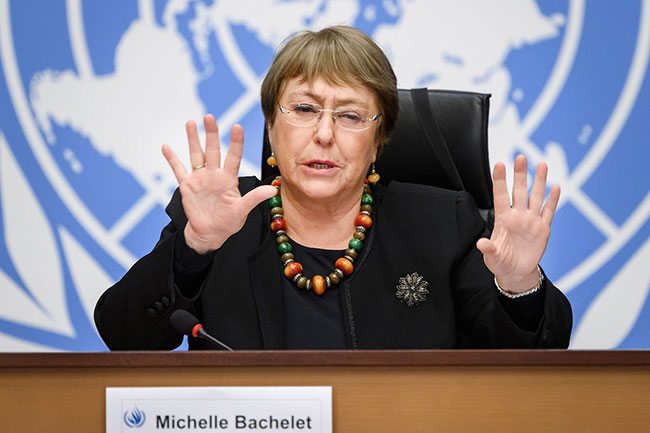
A reference to the 2019 Easter Sunday carnage at the commencement of the 48th sessions of the Geneva–based United Nations Human Rights Council (UNHRC) was expected. Human Rights Commissioner Michelle Bachelet, in her oral update delivered on Sept.13 on the Situation in Sri Lanka dealt with the Easter Sunday massacre as revealed by Rev. Father Cyril Gamini Fernando, spokesperson for the National Catholic Committee for Justice (NCCJ).

The former Chilean President (2006-2010 and 2014-2018) Bachelet made two separate references to the 2019 Easter Sunday carnage. Let me reproduce them verbatim to ensure that The Island is not accused of trying to misinterpret facts.

Bachelet declared: “Despite various inquiries, the victims of the Easter Sunday bombings in 2019 and religious leaders continue to call urgently for truth and justice, and a full account of the circumstances that permitted those attacks.”

Referring to the Prevention of Terrorism Act (PTA), Bachelet said: “The Government has reaffirmed its intention to revisit the Act and established a Cabinet sub-committee for this purpose. However, I am deeply concerned about the continued use of the Act to arrest and detain people. Lawyer Hejaaz Hizbullah has now been detained for 16 months under the Act without credible evidence presented before a court. Likewise, Ahnaf Jazeem, a teacher and poet, has been detained without charge since May 2020. I urge an immediate moratorium on the use of the Act, and that a clear timeline be set for its comprehensive review or repeal.”

Bachelet conveniently refrained from stating why the one-time Attorney General’s Department Counsel Hizbullah (2005-2010) is in government custody. Bachelet was careful not to include Hizbullah’s arrest in the paragraph that dealt with concerns raised by the Catholic Church as regards the investigation into the heinous crime. In fact, the UK-led self-appointed Sri Lanka Core Group at the UNHRC on more than one occasion raised Hizbullah’s detention without making reference to the Easter Sunday carnage.

Now that the Catholic Church has declared that it had no option but to seek the intervention of the Vatican and UNHRC to pressure the government over the Easter Sunday investigation, Malcolm Cardinal Ranjith should explain his stand on the detention of lawyer Hizbullah in connection with the Easter carnage.

The Criminal Investigation Department (CID) arrested Hizbullah on April 14, 2020. The lawyer was charged on March 3, 2021.

Why did Bachelet make reference to Hizbullah’s arrest without directly naming him as an Easter Sunday suspect? Did UNHRC conduct its own inquiries before taking up Hizbullah’s issue at the 48th session?

Although Sri Lanka Core Group had referred to Hizbullah in its statements (44th, 45th, and 47th sessions) previously, Bachelet, in her statements to the council, had never mentioned the lawyer by name before the 48th session. May be Bachelet is simply prostituting her independence like so many UN big shots on matters of Western interests. No wonder, one of the first things that the Iraqi rebellion against the US-led invasion of that country did was to blow up the UN compound in Baghdad!

Sri Lanka Core Group comprises Germany, Canada, North Macedonia, Malawi, Montenegro, and the United Kingdom.

Obviously, both Bachelet and the Core Group have taken the Sri Lanka civil society (read Western backed NGOs’) stand on the lawyer. A number of civil society organisations made public statements on behalf of Hizbullah though the government insists on the lawyer’s involvement with extremists. Defence Secretary General Kamal Gunaratne in the run-up to the Geneva sessions declared that the government had irrefutable evidence as regards Hizbullah’s role in the suicide attacks blamed on the now proscribed National Thowheed Jamaat (NTJ) and other organisations with similar ideology.

Those who stood for him have described the lawyer as a minority rights advocate and legal counsel for Muslim victims of human rights violations. Amnesty International is among the groups that expressed concerns over Hizbullah’s arrest. The lawyer, held under the PTA, has handled litigation before the Labour Tribunals and Magistrate’s Courts to the Supreme Court.

Let us, however, not forget a very important fact about AI. It corroborated a fantastic piece of ‘evidence’ after the Iraq’s invasion of Kuwait in which a weeping teenager told the US Congress how she witnessed the invading Iraqi army pulling premature babies from their incubators in a Kuwaiti hospital. Later it came to light that she was merely acting from a prepared script and she was none other than the daughter of Kuwait’s then ambassador to Washington. And she was nowhere near the action. Her performance would have easily beaten Bush/Blair’s Weapons of Mass Destruction script.

Truth certainly is a first casualty when states go into war, but what about so-called neutral umpires like AI when they too make truth a casualty?

The European Parliament’s June 10, 2021 Resolution on Sri Lanka referred to Hizbullah. The lawyer seemed to be blessed with sufficient support both here and abroad to move even the UN system. The UNHRC taking up the Easter Sunday issue should be a matter for serious concern. The UNHRC meets thrice a year. With the Vatican, too, taking an active interest in the controversial investigation, UNHRC and Sri Lanka’s self-appointed Core Group are likely to keep it on the Geneva agenda.

SLPP in quandary over MS

 The Church accuses the SLPP government of turning a blind eye to the recommendations made by the Presidential Commission of Inquiry the (PCoI). In spite of repeatedly assuring the Church of transparent investigation and judicial process, free of political interference, the Church is furious over what it calls the the government’s failure to act on the PCoI report. The bone of contention is alleged attempts to save former President Maithripala Sirisena and the then head of State Intelligence Service (SIS) Senior DIG Nilantha Jayawardena.

Before taking up the PCoI’s specific recommendations pertaining to the former President and the Senior DIG, now turned state witness and in charge of the Central Province, it would be pertinent to name members of the PCoI appointed by Sirisena on Sept 22, 2019. Senior DIG Jayawardena received appointment as Senior DIG, East, in early January 2020 in the wake of the last presidential election.

Supreme Court judge Janak de Silva (Chairman), Court of Appeal judge Nishshanka Bandula Karunaratne, retired Supreme Court judges Nihal Sunil Rajapaksha and A. L. Bandula Kumara Atapattu and former Secretary to the Ministry of Justice W. M. M. R. Adhikari. H. M. P. Buwaneka Herath functioned as the Secretary to the Commission.

 The PCoI handed over its final report to President Gotabaya Rajapaksa on Feb 1, 2020. The first and second interim reports were handed over to President Gotabaya Rajapaksa on December 20, 2019 and on March 02, 2020 respectively.

In spite of President Rajapaksa no sooner after assuming office inquiring from Malcolm Cardinal Ranjith whether he wanted to suggest a new member or two to the PCoI, the Archbishop declined the opportunity for obvious reasons.

Rev Father Cyril Gamini Fernando has declared that there couldn’t be any justifiable reason for the refusal on the part of the government to implement the PCoI recommendations.

Rev. Fernando described the appointment of a six-member Committee, headed by Minister Chamal Rajapaksa to study the PCoI recommendations as well as the report of the Sectoral Oversight Committee on National Security submitted to Parliament, as political intervention meant to derail the process.

The six-member committee comprised ministers Chamal Rajapaksa, Johnston Fernando, Udaya Gammanpila, Ramesh Pathirana, Prasanna Ranatunga and Rohitha Abeygunawardena.

Rev Father Fernando declared they were quite horrified by Attorney-at-Law Harigupta Rohanadeera’s revelation that Senior DIG Jayawardena, named by the PCoI, would be a state witness. Rohanadeera made the declaration in his capacity as the Director General, Legal Affairs, President’s Office.

Rohanadeera was on Hiru ‘Salakuna,’ a live weekly programme telecast on Mondays. Obviously, those in authority hadn’t given due consideration to their own report, the Church spokesperson said, vowing to pursue a campaign for justice.

The Island sought a clarification from those closely following the case. The writer was told that Senior DIG Jayawardena would be a prosecuting witness in respect of indictments filed in cases to be heard beginning next month. But, in respect of cases pertaining to negligence, the Senior DIG wouldn’t be there as a prosecution witness.

SLPP troubled by key recommendations

The PCoI declared that there is criminal liability on the part of former President Sirisena for failing in his duties and responsibilities. The PCoI alleged Sirisena’s failure exceeds mere civil negligence. On the basis of evidence gathered, the PCoI recommended that the Attorney General consider criminal proceedings against the former President under any suitable provision in the Penal Code (PCoI Final Report, Vol. 1, p 265).

This recommendation, the first in a series of references, posed quite a political challenge as the former President Sirisena is now a member of the ruling SLPP parliamentary group. As the leader of the SLFP, the main constituent of the SLPP, judicial or otherwise measures against Sirisena who returned to Parliament from his home base of Polonnaruwa at the last parliamentary election can place the SLPP-SLFP relationship in jeopardy. The SLFP parliamentary group headed by Sirisena consists of 14 members, including the leader. Of the 14, 12 successfully contested on the SLPP ticket, one entered on the SLPP National List (Dr. Suren Ragavan) and one entered on the SLFP ticket.

The issue is whether the SLPP-SLFP partnership can survive if the Attorney General moves court against the former President. The Church is unlikely to take that factor into consideration as it steps up pressure on the SLPP administration. The government will find itself in an extremely difficult situation. Similarly, the UNHRC, too, faces a dicey situation. On one hand, Geneva wants Sri Lanka to go the whole hog against perpetrators of the Easter Sunday attacks. And on the other hand, it is seriously concerned about lawyer Hizbullah held over the Easter Sunday carnage. The UNHRC, too, is also in a dilemma.

Deputy Solicitor General Dileepa Peiris is on record as having compared the role of Hizbullah to that of the late Anton Balasingham, British national of Sri Lankan origin, who functioned as the LTTE’s ideologue until his very end.

The government parliamentary group comprises 145 members. The SLPP leadership is aware that their relationship with the SLFP is on thin ice against the backdrop of pressure to move against the former President. The SLPP does not want to lose the SLFP’s support at this moment.

The PCoI also recommended criminal proceedings under any suitable provision in the Penal Code (PCoI Final Report, Vol 1, pages 287-288) in respect of Senior DIG Jayawardena.

The government seems largely reluctant to implement the recommendations or delve into certain observations made by the five-member expert P CoI. Interestingly, the Church, in a missive dated July 12, 2021, addressed to President Rajapaksa, has questioned the rationale in the PCoI conveniently failing to make any specific recommendation in respect of the then Premier Ranil Wickremesinghe in its final findings, thereby literally alluding to possible bias on the part of PCoI vis-à-vis the UNP Leader.

To be fair by the PCoI it clearly pointed out Wickremesinghe’s lax approach towards Islam extremism, which deprived the then administration of an opportunity to take tangible counter measures. The PCoI asserted the UNP leader’s failure facilitated the Easter Sunday carnage (PCoI Final Report, Vol 1, pages 276-277). The Church declared: “Our view is that there should be additional investigations on this matter. We need not stress that there on that fact, Wickremesinghe, in spite of his holding special powers under the 19th Amendment, followed a soft approach. It is, in our view, a serious act of irresponsibility and neglect of duty.”

Links between suicide bombers and political parties

A wider investigation is required to find out the actual links between the Easter Sunday attackers and political parties. The SJB has repeatedly demanded justice for the Easter Sunday victims. But, Vanni District MP Rishad Bathiudeen, leader of the All Ceylon Makkal Congress (ACMC), now in judicial custody, remains with the main Opposition party. The SJB demands implementation of the PCoI recommendations but has chosen to remain silent on Bathiudeen. The PCoI has recommended criminal proceedings against Bathiudeen under any suitable provision of the Penal Code whereas reference was also made to his brother, Riyaj Bathiudeen now also back in custody.

It would be pertinent to mention that Riyaj who had been taken into custody was clandestinely released by the CID under controversial circumstances. The release coincided with some members of the ACMC voting for the 20th Amendment passed by the Parliament in Oct 2020.

A majority in the SLPP demanded an inquiry from President Gotabaya Rajapaksa and Premier Mahinda Rajapaksa into Riyaj’s release. The then Attorney General, too, sought an explanation from the CID. The government never revealed why Riyaj was released. However, he was taken back into custody later following a growing outcry over his abrupt release.

The ACMC leader has served in the cabinet of Mahinda Rajapaksa (2020-2015) and President Maithripala Sirisena (2015-2019). The incumbent government cannot ignore accusations that during Rishad Bathiudden’s time as the Trade and Commerce Minister of MR and MS cabinet, the politician supported the Colossus copper factory at Wellampitiya managed by the family of two of the Easter Sunday suicide bombers, Imsath Ahmed Ibrahim and Ilham Ahmed Ibrahim and their father, Mohamed Ibrahim, the founder of Colombo-based Ishana Exports, which describes itself on its website as the ‘largest exporter of spices from Sri Lanka since 2006.’

The JVP never really explained the circumstances Mohamed Ibrahim ended up on their National List at the 2015 parliamentary election. Ibrahim is in custody.

Colossus management had direct access to the highest Offices in the land. During the Yahapalana administration, the Colossus sought supply of copper from the Presidential Secretariat. Interestingly, defeated UPFA lawmaker Shantha Bandara had been the recipient of the Colossus letter at the Presidential Secretariat. Shantha Bandara is now a member of the ruling SLPP. Bandara represents the Kurunegala District.

2019 presidential election

Defence Secretary Gen. Kamal Gunaratne and Rohanadeera recently countered accusations that the 2019 Easter attacks were meant to benefit SLPP candidate Gotabaya Rajapaksa. ‘Salakuna’ anchor Chamuditha Samarawickrema raised the issue with Rohanadeera, who pointed out that the results of the 2018 Feb Local Government polls indicated the ground situation at that time. Gen. Gunaratne declared at a recent meeting that there was absolutely no basis for such accusations and it was a despicable attempt to tarnish President Gotabaya Rajapaksa.

Academic Dr. Rajan Hoole’s ‘Sri Lanka’s Easter Tragedy: When the Deep State gets out of its Depth,’ discussed the circumstances leading to the Easter carnage. Hoole shed light on the complex web of secrets/situations/relationships that led to the Easter carnage. Dr. Hoole, who authored ‘The Arrogance of Power: Myths, decadence and murder,’ in January 2001, blamed the State elements for the attack. Dr. Hoole is unambiguous in his accusation that those who backed SLPP candidate Gotabaya Rajapaksa created an environment to deprive the Muslims of an opportunity to vote at the Nov 2019 presidential election. The author asserted that attempt failed while making reference to the plantation Tamils being disenfranchised in 1949, consequent to the 1948 Citizenship Act.

In Chapter 4, Dr. Hoole briefly discussed the possibility of the failure on the part of the now proscribed NTJ to secure representation in Parliament at the August 2015 general election. Had the NTJ succeeded in securing a foothold in Parliament, the Easter Sunday carnage might not have happened, Dr. Hoole asserted, declaring that the NTJ adopted an aggressive strategy, in the wake of the electoral failure. Dr. Hoole based his quite controversial assessment on an electoral agreement, involving the NTJ, M.L.A.M. Hizbullah of the UPFA (United People’s Freedom Alliance) and Abdul Rahuman and Shibly Farook (both members of SLMC-Sri Lanka Muslim Congress, a constituent of the UNP-led coalition).

Dr. Hoole likened the attempt made by Kattankudy-born Zahran Hashim to have some of his nominees, in Parliament, to that of Prabhakaran’s successful arrangement with R. Sampanthan of the TNA. In terms of the agreement finalised in 2001, the TNA acknowledged the LTTE as the sole representative of the Tamils, two years after the high-profile assassination of TULF lawmaker, Neelan Thiruchelvam, in 1999.

President Sirisena had no qualms in accommodating defeated M.L.A.M. Hizbullah in Parliament on the UPFA National List. Hizbullah was among over half a dozen defeated UPFA candidates, accommodated on its National List. National List MP Hizbullah functioned as the Batticaloa political lord until he resigned in January 2019 to pave the way for President Sirisena loyalist, Shantha Bandara, to enter Parliament (The man who helped Colossus procure scrap copper from the state at a nominal price usually reserved for craftsmen and cottage industrialists). Hizbullah was named the Eastern Province Governor. At the time of the Easter attacks, Hizbullah served as the Eastern Province Governor and Chairman of the controversial Batticaloa Campus (Pvt) Limited.

In a report presented to the Parliament Sectoral Sub-Committee on Higher Education and Human Resources, the scandalous politician identified himself as Dr. M.L.A.M. Hizbullah. In spite of failing to get elected from the Batticaloa District with NTJ backing, did Hizbullah serve the interests of Zahran Hashim?

Whatever the political parties may say, both major political alliances, the SLPP and the SJB are tainted. There is no point in denying the fact that the way the TNA continues to politically suffer due to its disgraceful alliance with the LTTE sometime ago, other political parties and alliances experience difficulties as a result of their relationship with Zahran’s group.

Tuesday, 14 September 2021

War crimes:

 SPECIAL REPORT : Part 385

Published


UN going the whole hog

By Shamindra Ferdinando

The newly formed Civil Society Platform (CSP) on Monday (13) dealt with entire range of accountability issues and the re-imposition of a state of emergency on the pretext of addressing food distribution. The media received the comprehensive statement endorsed by 30 organisations, and 36 individuals, soon after the Geneva-based United Nations Human Rights Council (UNHRC) declared its intention to go ahead with fresh investigation, as mandated at the 46th session.

The hard-hitting CSP statement should be examined against the backdrop of a dialogue between a new collective of civil society activists, grouped as Sri Lankan Collective for Consensus (SLCC). The civil society appears to be divided over their strategy in respect of President Gotabaya Rajapaksa’s government. However, UN Rights Chief, Michelle Bachelet, one-time Chilean President, in her hard-hitting statement, at the onset of the 48th session, made reference to the meeting President Gotabaya Rajapaksa had with SLCC on August 3. That is a quite a development. But, nothing has changed in Geneva and the war-winning country is on the UN agenda.

A recent statement, issued by the Executive Director of the National Peace Council (NPC), Dr. Jehan Perera, on behalf of SLCC, dealt with several contentious issues.

The statement issued, subsequent to a meeting the group had with newly appointed Foreign Minister Prof. G.L. Peiris, raised the following issues: the declaration of State of Emergency, Cabinet of Ministers giving the go ahead for the Legal Draftsman to prepare ‘NGO legislation,’ continuing harassment of NGOs, abolition/amendments to the Prevention of Terrorism Act (reference was made to those who had served the LTTE and the 2019 Easter Sunday carnage suspects), implementation of the 13th Amendment to the Constitution, and holding of long-delayed Provincial Council polls, land issues in the Northern and Eastern Provinces, language issue, hate speech and misuse of the ICCPR Act, step-motherly treatment of Tamil-speaking people, by denying them participation at national events, and targeting of the Muslim community.

The above litany, however, sounds only too familiar and the chorus is the same. They have packaged themselves under the new name SLCC, but being backed by the West, have been pushing the same agenda for decades. The CSP is no different. No one ever bothered to ask for an explanation from the TNA for recognising the LTTE as the sole representative of the Tamil-speaking people, in 2001, thereby paving the way for the Eelam War IV a couple of years later. Similarly, no one ever inquired into the clandestine relationship between UN Colombo and the LTTE. Geneva is also silent about the origins of Sri Lanka terrorism (Indian intervention).

As happened in Afghanistan, with the now infamous independent media of the West, which unquestioningly only pushed the narrative of the military industrial complex of mainly the US and the UK, for decades, have now suddenly metamorphosed into finally questioning what went wrong, only after all their lies about Afghanistan and elsewhere began to crumble overnight. Interestingly, they are pointing fingers at everyone else, except at themselves, for not having done the job as an objective media. Theirs has been, for quite some time, an embedded media that cheered on the military industrial complex and the Wall Street. May be there, too, it was all due to filthy lucre.

Prof. Peiris, who had served as the Foreign Minister during the then President Mahinda Rajapaksa’s second term (2010-2015), received the same ministry on Aug 16. The academic, who once headed the government delegation for Oslo-arranged talks with the Liberation Tigers of Tamil Eelam (LTTE), has assured the SLCC of the government’s readiness to work with the civil society.

The SLCC statement, headlined ‘Promise of a fresh approach for resolving national issues’, at the onset, insisted that the discussions the group so far had with President Gotabaya Rajapaksa, the then Foreign Minister Dinesh Gunawardena, Finance Minister Basil Rajapaksa, Justice Minister Ali Sabry, Youth and Sports Minister Namal Rajapaksa, Regional Cooperation State Minister Tharaka Balasuriya and Foreign Secretary Admiral Jayanath Colombage failed to yield the desired results. So they still want the pound of flesh paid for by the West and nothing less?

Prof. Peiris seems confident that the government’s interaction with the civil society can be utilised in their dialogue with the international community, whereas the SLCC assured the new administration of its support to address concerns among the international community. However, their support would depend on the government’s readiness to address the issues raised by them.

In addition to Dr. Perera, who had represented Sri Lanka at the Geneva-based United Nations Human Rights Council (UNHRC), in March 2018, on the invitation of the late Foreign Minister Mangala Samaraweera, several other prominent civil society activists joined the discussion with the government. It would be pertinent to mention that the SLCC has quite justly accepted that it did not represent, what it called, the larger civil society and recognised themselves as a group of individuals, drawn from multiple sectors of society, religion, academia and non-governmental organisations, dedicated to a country established on the high sounding ‘ideals of pluralistic coexistence, human rights and justice’, but found nowhere in the world, especially not among the self-appointed good guys of the West. Just look at how they still treat their Blacks, especially by their famed law enforcers.

The SLCC comprises (1)Ven. Kalupahana Piyaratana Thera – Inter religious Alliance National Unity, Chairman, Human Development Edification Centre working for peace Reconciliation and Ecology for more than 25 years. Peace activist for more than two decades (2) Bishop Asiri Perera – Retired Bishop/President of Methodist Church (3) Rev. Fr. C.G. Jeyakumar – Parish Priest Ilavalai and Lecturer at the Jaffna Major Seminary, Human Rights Activist (4) Dr. Joe William – Founder member and Chairman of National Peace Council, Director, Centre for Communication Training and Convenor, Alliance for Justice (5) Prof. T. Jayasingam – Director NPC, former Vice Chancellor of Eastern University and former member, Public Service Commission of the Eastern Provincial Council (6) Prof. Kalinga Tudor Silva – Professor Emeritus Dept of Sociology, University of Peradeniya (7) Dr. Dayani Panagoda – Social Activist, former director of Secretariat for Coordinating the Peace Process and Lecturer, former member of the Official Languages Commission (8) Ms. Visaka Dharmadasa – Peace Activist, Chair of Association of War Affected Women (9) Dr. Jehan Perera – Executive Director of NPC (10) Dr. P. Saravanamuttu – Founder and Executive Director, Centre for Policy Alternatives (11) Hilmy Ahamed – Vice President, Muslim Council of Sri Lanka, Civil activist with 35 years of communicating on issues of Peace and Justice, Chairman of Young Asia Television (12) Sanjeewa Wimalagunarathna – Former Director of Secretariat for Coordinating Reconciliation Mechanisms (13) Rohana Hettiarachchi – Executive Director PAFFREL (14) Javid Yusuf – Former Ambassador to Saudi Arabia, former Principal, Zahira College and Founder member and Governing Council member, National Peace Council NPC (15) Varnakulasingham Kamaladas – President, STA Solidarity Foundation, Vice President Batticaloa-Ampara Hindu Temples Federation, former President of Inland Association of Non-Governmental Organisations (INAYAM) Batticaloa, and (16) Ms. Sarah Arumugam – Human Rights Lawyer.
SLCC responds

Dr. Perera emphasized that they were prepared to work with any party to achieve genuine post-war national reconciliation.

The livewire behind the NPC Dr. Perera responded swiftly to several questions posed to him regarding the latest civil society initiative.

(1) The Island: Did the SLCC reach consensus with what it called ‘wider Sri Lanka civil society’ regarding the dialogue you are having with the SLPP administration?

SLCC:

No, we did not. SLCC is a loose collection of individuals drawn from civil society organisations that have reconciliation and peace building aims in their work. We have no one leader or office-bearers. Each of us is part of other networks where we have discussed the stands we take. But we do not speak as their representatives. Our common position is commitment to a united Sri Lanka that is founded on ideals of pluralistic coexistence, human rights and justice.

(2) The Island: When did you set up the SLCC?

SLCC:

We could say it was on June 23, 2021. That was the day we decided on our name. This followed two earlier consultations, organised by the Association of War Affected Women (AWAW), which were held in Kandy, to have an in depth discussion on the lessons learnt through our reconciliation process. We felt there was a need for a group, such as ours.

(3) The Island: Did you have discussions with the TNA (Tamil National Alliance) or other Tamil parties, represented in Parliament, regarding the current initiative?

SLCC:

We have not met with the TNA as yet, though we plan to meet them, and other parties, too. Earlier on we met with Charitha Herath of the SLPP, leader of the DPF Mano Ganesan, General Secretary of the SJB, Ranjith Madduma Bandara. More recently we met with Leader of the Opposition Sajith Premadasa. We had arranged for a meeting with the Chairman of the National Movement for Social Justice, Karu Jayasuriya, but this was postponed and we hope to have it soon.

(4) The Island: Who decides the agenda?

SLCC:

Agendas of the meetings are decided by consensus, prior to the meeting, based on the need and the responsibilities of those whom we meet. Usually, following a self-introduction, we present the issues highlighted in the memorandums we have submitted.

(5) The Island: You represent the NPC, Dr. Pakiasothy Saravanamuttu represents the CPA and all others in the SLCC are members of various civil society groups. Do the SLCC members represent those organisations in the ongoing dialogue?

SLCC:

Those in the SLCC are mostly heads of organisations, who will naturally be in line with the positions of their organisations in any discussions on principle or decisions arrived at. But they are here as members in their personal capacities.

(6) The Island: Did the SLCC ever discuss these issues with the late Mangala Samaraweera?

SLCC:

No, we did not.

(7) The Island:

On the basis of BHC cables (Jan-May 2009), Lord Naseby, in Oct 2017, challenged the massacre claim of 40,000 on the Vanni east front as mentioned in the Darusman report. In June 2011, US Embassy staffer, Lt Col Smith, at the 2011 Defence Seminar, in Colombo, denied war crimes accusations (weeks after the release of Darusman report).

(8) The Island: Did government representatives or the SLCC referred to/discussed/raised the need to examine the BHC cables during discussions?

SLCC:

We limited our discussion to issues that we presented in our memorandums to them with a view to be forward looking. This included the Office of Missing Persons and its work. We did not discuss the death toll, at the end of the war, or issues of war crimes.

Contentious issues

Some of them had been involved in previous peace initiatives, including the Oslo project, finalised in Feb 2002. The SLCC has essentially pursued issues that had been taken up by a section of the international community (those who voted for Geneva resolutions or conveniently abstained) both during the conflict and after. Let me reproduce the SLCC’s stand on three key issues verbatim as mentioned in a memorandum handed over to Prof. Peiris.

Prevention of Terrorism Act:

Until the promised amendment of the Prevention of Terrorism Act, to cease using this law to detain people and to expedite the release of those taken into custody, under its draconian provisions, either on bail or totally where there is no legally valid evidence to justify their continued detention, especially when they have not even been charged. This applies to both long term LTTE prisoners and more recent Muslim prisoners with only a peripheral relation to the Easter Sunday bombings.

Provincial Councils:

Improve the implementation of the 13th Amendment and expedite the holding of provincial council elections so that the ethnic minorities may enjoy a measure of self-governance in the areas where they predominate.

Targeting of Minorities:

The issue of Muslims being targeted continues to fester in proposed legislation regarding personal law, the continuing refusal to permit burial of Covid victims, except in a single designated location and the imprisonment, without trial, of a large number of Muslim persons, following the Easter bombings. All communities need to feel that they have been fairly consulted and treated without discrimination for national reconciliation to become a reality.

The 13th Amendment is quite a contentious issue, especially against the backdrop of India stepping up pressure over its implementation. The government is in a quandary as regards the much delayed Provincial Council polls. Today, the government, the Opposition, the civil society and the international community had conveniently forgotten the origins of the Sri Lankan imbroglio. Clandestine Indian intervention long before the July 1983 riots, most probably precipitated by the then 20th Century Fox JRJ openly flirting with the idea of giving the Trincomalee deep harbour to the US. The subsequent building up of terrorist power, leading to the forcible deployment of the Indian Army in Northern and Eastern regions, in July 87, paved the way for the 13th Amendment. Sri Lanka almost disintegrated.

Unfortunately, successive governments quite clearly failed to examine the current situation in a proper perspective. There had never been a genuine attempt to set the record straight. The incumbent government, too, pathetically failed to address accountability issues properly. Dr. Perera’s response to The Island query, based on Lord Naseby’s challenge and Lt. Colonel Smith’s denial of war crimes accusations six years before, revealed the failure on the government’s part to recognise the threat facing the country’s unitary status. Prof. Peiris and the SLCC owed the public an explanation how they discussed matters, including Office of Missing Persons, or OMP, leaving the primary accusation that the military killed 40,000 Tamil civilians on the Vanni east front. That is the charge Sri Lanka continues to face in Geneva, though Prof. Peiris’s predecessor, Dinesh Gunawardena, declared, in the Feb-March 2020, sessions, the government’s decision to quit the 2015 resolution. In fact, Sri Lanka is now facing a new investigation and actions so far taken by the incumbent government seems insufficient. As long as HRC turns a Nelsonia eye to all the grave crimes the West has committed and continuing to commit, from Palestine to Libya, Iraq, Syria, etc., how can we expect any fairplay from it. Maybe Minister Gunawardena played the only card there, we could have played, considering the ground realities.

The rationale in seeking the support of the civil society should be studied, taking into consideration the government’s failure to revisit accountability issues. Instead, having repeatedly promised the electorate in the run-up to the 2019 presidential and 2020 parliamentary polls, a robust defence at Geneva, the government appeared to have accepted the agenda, pursued by Ranil Wickremesinghe and the late Mangala Samaraweera.

The Sirisena-Wickremesinghe government established the OMP, in August 2016, less than a year after the signing of the Geneva resolution. The OMP came into being under controversial circumstances with the then Joint Opposition (now SLPP) accusing the Sirisena-Wickremesinghe government of jeopardising national security. Today, the incumbent government has accepted responsibility for taking forward the much maligned and controversial Geneva process, much to the disappointment of those who genuinely believed an attempt would be made to reverse the project.

Key architects of the yahapalana project are in the current Parliament. Ranil Wickremesinghe is the solitary UNP MP. The former PM entered Parliament on the National List whereas Maithripala Sirisena returned from his home base Polonnaruwa after having contested the last general election on the SLPP ticket. Sirisena’s SLFP is the second largest constituent with 14 lawmakers, including one National List MP. As regards the accountability issue, the government seems to be moving in a direction contrary to the much publicised promises made.

In the absence of cohesive Sri Lanka response to Geneva threat, interested parties, such as the Human Rights Watch (HRW) and Amnesty International, have been freely bashing Sri Lanka. Massive foreign funding to the civil society lobby here and various other outfits are meant to ensure they follow the dictates of their sponsors. Often repeated claims that they refrained from taking government funding should be examined taking into consideration how these groups pursued Western interests and those of various other parties.

Pawns of Peace: Evaluation of Norwegian peace efforts in Sri Lanka (1997-2009)

, released in 2011, two years after the eradication of the LTTE, provided an insight into foreign funding for a particular purpose. The Norwegian study dealt with funding provided to various peace merchants assigned the task of propagating the inevitability of a negotiated settlement in the absence of military muscle to bring the war to a successful conclusion. For Norwegians funding for such initiatives had never been a problem. Sri Lanka is a case in point. They lavishly spent on the dicey Sri Lanka project on the basis that the LTTE cannot be defeated militarily, the then government has no option but to accept a deal even at the expense of the country’s territorial integrity and sovereignty.

The Norwegian report revealed the funding of Sri Lankan outfits to the tune of USD 28 (NOK 210 mn) mn during the conflict. The recipients included Dr. Kumar Rupesinghe’s Foundation for Coexistence (largest single beneficiary with USD 6 mn during 2004-2008 period), the then Minister Milinda Moragoda’s MMIPE for humanitarian demining, Sarvodaya, Sewalanka (its former head Harsha Kumara Navaratne, an original extremely talented breakaway from Sarvodaya and now a member of the Human Rights Commission will soon relinquish office to take over Lanka mission in Canada as HC), Sareeram Sri Lanka National Foundation, Hambantota District Chamber of Commerce, One-Text Initiative, the National Anti-War Front also led by Dr. Kumar Rupasinghe, the National Peace Council, the Center for Policy Alternatives, the Forum of Federations and the People’s Peace Front.

The Norwegians also provided funding to the TRO (Tamil Rehabilitation Organization) an LTTE front organisation. The Norwegians went to the extent of providing funding to the then LTTE Peace Secretariat though it knew the group was rapidly preparing to resume hostilities. When Norwegian funding of LTTE front organisations drew strong condemnation, they funded the setting up of a Buddhist academy in Kandy in addition to reconstruction of Buddhist temples on the southern coast destroyed by Dec 2004 tsunami.

However, Prof. Peiris in a note recently submitted to diplomatic missions, based in Colombo, ahead of the 48 Geneva sessions, emphasised that the March 2021 resolution adopted by a divided vote hadn’t been accepted by Sri Lanka, rejected establishment of an external evidence gathering mechanism targeting Sri Lanka and questioned the rationale in spending meager financial resources on such a politically motivated Geneva initiative. The FM’s note dealt with progress made as regards port-war reconciliation with the focus on OMP operations, Office of Reparations, Office for National Unity and Reconciliation, Sustainable Development Goals, National Human Rights Commission, Presidential Commission of Inquiry, Accountability, PTA, Pardon to ex-LTTE cadres, Resettlement of IDPs, Releasing of Lands, engagement with the civil society (Prof. Peiris referred to the discussion President Gotabaya Rajapaksa had with SLCC on Aug 3, 2021) and International Human Rights and other Treaty Obligations and Engagement with the UN Special Procedures Mandate Holders.

Tuesday, 7 September 2021

Over a decade after triumph over LTTE, Lanka still troubled by Western agenda

 SPECIAL REPORT : Part 384

Published

  
Prof. G.L. Peiris with colleague, Dinesh Gunawardena at the Foreign Ministry on the day he succeeded the latter (pic courtesy FM)

By Shamindra Ferdinando

A reference was made as regards the role played by Japanese Special Envoy Yasushi Akashi in the Norway-led peace process during Ranil Wickremesinghe’s premiership (2001-2003) when Japanese Ambassador in Colombo Akira Sugiyama paid a courtesy call on Foreign Minister Prof. G.L. Peiris on August 20.

Having won the Dec 2001 violence- marred parliamentary election, UNP leader Wickremesinghe swiftly signed the one-sided Ceasefire Agreement (CFA) with the Liberation Tigers of Tamil Eelam (LTTE) in Feb 2002, obviously prepared by the Norwegians. Even the country’s Commander-in-Chief the then President Chandrika Kumaratunga was unaware of any of the CFA terms till it was signed. The UNP leader was in such a hurry he didn’t even bother to properly consult the military before the finalisation of the CFA. Wickremesinghe and the late Velupillai Prabhakaran signed the CFA, separately.

Don’t forget the UNPer finalised the so-called peace initiative, launched by Norway, in consultation with the then President Chandrika Kumaratunga. The late Foreign Minister Lakshman Kadirgamar, too, had been involved in that initiative.

What really matters is why former Co-Chairs, having pathetically failed in their high profile project, are now pursuing an agenda targeting Sri Lanka at the Geneva-based United Nations Human Rights Council (UNHRC). What did Sri Lanka do wrong to end up at the UNHRC agenda? Didn’t the US declare UNHRC a cesspit of political bias in June 2018? The then US Ambassador there Nikki Haley declared: “For too long the Human Rights Council has been a protector of human rights abuses and a cesspool of political bias.” By whatever standards, the US is one of the worst serious human rights violators with a murderous record both in and outside the US.

Prof. Peiris, who had served as the Foreign Minister during President Mahinda Rajapaksa’s second term (2010-2015) received the foreign affairs portfolio again during the recent Cabinet reshuffle.

Prof. Peiris succeeded Rohitha Bogollagama, who switched allegiance to Kumaratunga in Nov 2004, having entered Parliament on the UNP ticket. Bogollagama, who successfully handled foreign affairs during Eelam War IV, failed to retain his seat at the 2010 general election from the Colombo District with some of the other UPFA candidates openly ganging up against him on election platforms. He contested Colombo as SLFP Organiser for Kotte, having first entered Parliament in 2000, 2001 (general election due to dissolution caused by a dozen PA MPs switching sides) and finally 2004 from Kurunegala on the UNP ticket. ‘The day Mangala issued a warning to P’karan’ in last Wednesday’s online edition of The Island dealt with how Bogollagama received the foreign affairs portfolio in Feb 2007 in the wake of the unceremonious removal of the late Samaraweera over differences with the Rajapaksas. They differed sharply on the conduct of the military strategy though that was certainly not the only contentious issue. Prof. Peiris was also in the same Cabinet.

Prof. Peiris back at FM

President Gotabaya Rajapaksa has now brought back the one time top law academic to the Foreign Ministry at the expense of Dinesh Gunawardena, who received the Education Portfolio amidst the simmering controversy over teachers’ salary issue. Switching of portfolios took place on Aug. 16 at the Presidential Secretariat. The President’s Media Division (PMD) refrained from releasing pictures of ministers taking oaths before the President. There hadn’t been a previous instance of the PMD not releasing pictures/video footage.

A Foreign Ministry statement quoted Prof. Peiris as having told Ambassador Sugiyama of what he called valuable contribution made by Akashi, now 90, in the peace negotiations and reference was also made to the Japanese role in the post-war reconciliation process and human rights issues. Foreign Secretary Admiral Prof. Jayanath Colombage was also associated with Foreign Minister Peiris at the meeting.

It is a supreme irony that the US that dropped the world’s first two atomic bombs on two highly populated cities of Hiroshima and Nagasaki to force Japan to surrender when it was already virtually on its knees unable to stop the carpet bombing by the US Air Force of the country is now an ally of Washington ready to support whatever the Americans would bid it to do.

Having finished off the LTTE in May 2009, Sri Lanka has been struggling to explain the conduct of its armed forces for having crushed ‘the most ruthless terrorist organisation’ (termed by the American Federal Bureau of Investigation) in conventional battles against the wishes of the self-appointed international community that has committed far worse crimes in an array of countries.

It would be pertinent to mention that during the Wickremesinghe premiership Prof. Peiris served as Sri Lanka’s top negotiator in the Norway-facilitated talks with the LTTE. Japan enjoyed a special status in the Oslo-led peace process that collapsed in April 2003 in the wake of the LTTE quitting the negotiating table. After the assassination of Foreign Minister Lakshman Kadirgamar in August 2005 and the abortive bid to assassinate the then Army Commander Gen. Sarath Fonseka in late April 2006, fighting erupted in the North and East in August. Had the LTTE succeeded in eliminating the then Defence Secretary Gotabaya Rajapaksa in Dec 2006, the war could have taken a different turn.

Sri Lanka brought the war to a successful conclusion in May 2009. But over a decade after the eradication of terrorism, Sri Lanka remains on politically motivated Geneva agenda with the issue coming up again later this month.

The UNHRC in March this year adopted a new resolution on Sri Lanka. The Resolution 46/1, adopted on March 23, 2021, paved the way for a powerful new accountability process to collect, analyze, and preserve evidence of international crimes committed in Sri Lanka for use in future prosecutions.The so-called Core Group comprising the United Kingdom, Canada, Germany, Malawi, Montenegro, and North Macedonia that submitted the resolution received the backing of an overwhelming majority of the 47-member UNHRC. Altogether 22 Human Rights Council members voted for the resolution at the behest of the powerful US/UK, while 11 voted against, and 14 abstained. In spite of the longstanding close relationship between Japan and Sri Lanka, the former abstained. Japan had no alternative but to conveniently abstain as it couldn’t decide on its own on the politically sensitive matter. Japan followed the US vis-a-vis Sri Lanka at the UNHRC though the solitary Super Power quit the organisation. South Korea went a step further by voting for the resolution as Seoul couldn’t ignore US dictate.

Sri Lanka should realise the Comprehensive Partnership the two countries entered into in Oct 2015 (PM Shinzo Abe and Ranil Wickremesinghe signed the agreement in Tokyo) less than a week after the yahapalana administration betrayed the military in Geneva on Oct 1, 2015 didn’t matter as Quad member Japan is politically, economically and security-wise bonded with the US. Remember, how Abe reflected on U.S. President Barack Obama’s visit in 2016 to Hiroshima. The Japanese leader asserted: “The two enemies that fought immensely 71 years ago are now bonded by the heart.”

The ongoing confrontation between China and Quad comprising the US, Japan, India and Australia has brought Sri Lanka under further pressure due to the US-led alliance taking an extremely hostile stand as regards China-Sri Lanka relationship.

Prof. Peiris and Basil Rajapaksa, who received the Finance Portfolio a couple of weeks before the mini-Cabinet reshuffle met Colombo-based envoys representing major powers. Sri Lanka, now embroiled in a severe balance of payments crisis, needs the backing of the international community and the understanding of international lending agencies, particularly the IMF. The current crisis should be examined, sensibly, against the backdrop of the economic turmoil caused by the raging Covid-19 epidemic as it caused the total collapse of the vibrant tourism industry and nose dived remittances from our expatriate workers, both of which raked in billions of dollars annually to the country. However, the SLPP government and the Opposition shouldn’t forget the country could have faced the global pandemic much better if not for the ruination of the economy caused by unbridled waste, corruption, irregularities and negligence since independence by all counts. Those who represent the SLPP and the SJB in the current parliament cannot absolve themselves of the responsibility for the present state of the national economy. Energy Minister and attorney-at-law Udaya Gammanpila should be commended for publicly warning the government of dire consequences unless remedial measures were taken. The warning was given on June 13 in the wake of SLPP demanding Gammanpila’s resignation over the sharp increase in fuel prices announced on June 11. In spite of SLPP’s vow to bring down the price of fuel once Basil Rajapaksa received the finance portfolio the ruling party quietly suppressed the issue.

Thalpahewa clarifies

Foreign Ministry faces a daunting task in countering external challenges. Before dealing with current challenges let me mention career diplomat Chanaka Thalpahewa’s response to ‘India’s Vietnam moment, US pullout and Afghan dilemma with strapline UNP’s call to terminate diplomatic relations with Taliban questionable’ carried in August 25, 2021 online edition. Thalpahewa, who recently returned to the Foreign Ministry having served UN Habitat as head of the agency for Sri Lanka and the Maldives emphasized the pivotal importance of keeping in mind the origins of terrorism here. “There cannot be an ambiguity as regards the origins of Tamil terrorism here,” the author of Ashgate publication ‘Peaceful Intervention in Intra-State Conflicts: Norwegian Involvement in the Sri Lanka Peace Process’ Thalpahewa said. Having headed the Sri Lankan mission in London at the time of President Sirisena’s visit in early 2015 pointed out the declaration made by retired Vice Admiral G.M. Hiranandani regarding the Indian role in terrorism in Sri Lanka. VA Hiranandani authored a trilogy on the official history of the Indian Navy namely: Transition to Triumph (covering the period 1965 to 1975), Transition to Eminence (1976 to 1990), and Transition to Guardianship that covered the last decade of the twentieth century. The book that dealt with the 1976 to 1990 period confirmed the establishment of terrorist training camps in South India in 1981, two years before the first major LTTE attack on the Army in the Jaffna peninsula. The outspoken Foreign Service officer agreed with the writer’s assertion that India created an environment conducive for direct intervention here. Thalpahewa’s well researched book is a must read for those interested in knowing the truth as Sri Lanka is yet to set the record straight.

Today nuclear power India is part of the overall US strategy and like Japan is ready to counter the growing Chinese influence in the region. Here too it is an irony that the West that more or less treated India like a leper not too long ago and even attempted to break it up by lighting separatist fires across the great ancient country, from the 70’s now has become a lap dog of the US instead of holding her head high as the world’s second largest economic power before long, while Washington is self-relegating herself as a has been due to her profligacy and sheer arrogance.

Sri Lanka has been caught up in the battle between the US-led Quad and China for superiority and certainly a victim of circumstances due to its strategic positioning. The bone of contention is the increasing Chinese presence in Sri Lanka with Colombo International Container Terminals Ltd., (CICT), joint venture between China Merchants Port Holdings Company Limited and the Sri Lanka Ports Authority (SLPA), 99-year lease on the Hambantota port and the Colombo Port City being strategic investments.

Challenges faced by GR administration

Having succeeded Dinesh Gunawardena on Aug 16, Prof. Peiris received top envoys of India (skipped UK sponsored Geneva vote on Sri Lanka accountability resolution), China (voted against), US, EU, Russia (voted against), Japan (skipped), Pakistan (voted against), South Korea (voted for), Kuwait, Germany (voted for), the Netherlands (voted for), Australia, Turkey, Qatar, Norway, Vatican, Libya, UN and Italy (voted for). Unfortunately, Sri Lanka never managed to set the record straight as regards the accountability issue. Successive governments since the successful conclusion of the war in May 2009 squandered opportunities to vigorously present our case. The SLPP, too, has so far failed pathetically.

In the absence of a cohesive effort on Sri Lanka’s part, India stepped up pressure on Sri Lanka at the UNHRC with a strong reference to 13th Amendment to the Constitution forced down our throat during the Indian Army deployment in Sri Lanka’s Northern and Eastern province following the infamous ‘parippu drop’.

The UN and so-called Sri Lanka Core Group, in consultation with the Tamil National Alliance (TNA), one-time the LTTE’s sidekick worked overtime to harass Sri Lanka at Geneva. Successive governments, including the SLPP conveniently failed so far at least to officially inform the unbreakable relationship between the LTTE and the TNA until the very end. The TNA, having backed war-winning Army Commander Gen. Sarath Fonseka at the 2010 presidential election continues a despicable accountability agenda at the UNHRC. Of the five Sri Lanka Co-Group, three, namely the UK, Germany and Canada are major powers. The UK and Germany voted for the anti-Sri Lanka resolution whereas Canada backed it. Core Group bared its intentions when it raised the arrest of 2019 Easter Sunday carnage suspect Attorney-at-Law Hejaaz Hizbullah and retired Director, CID Shani Abeysekera at the UNHRC. The Foreign Ministry must examine the whole picture without being distracted by various events.

The UK is home to an influential segment of the Tamil Diaspora as well as former members of the LTTE, including Adele Balasingham, a high profile terrorist who may have been even aware of the May 1991 assassination of former Indian Prime Minister Rajiv Gandhi. Having repeatedly refused to help establish the truth by making available wartime UK diplomatic dispatches fromthe UK HC in Colombo, the UK continues to fool Sri Lanka by maintaining proscription of the LTTE in terms of the UK Terrorism Act No. 7 of 2000. The British action is meant to deceive Sri Lanka. The British ban is nothing but propaganda. Actually, the UK never restricted LTTE activity and throughout the war stood by Prabhakaran’s conventional fighting cadre. Sri Lanka Core Group members, the UK and France (voted for anti-Sri Lanka resolution) with the backing of the UN and the US made a last ditch bid in April 2009 to throw a lifeline to the LTTE. Had they succeeded, the current inoculation drive against the raging Covid-19 epidemic would have to be carried out in consultation with the LTTE. Hope, the people haven’t forgotten how the LTTE and Western powers exploited the post-tsunami situation to set up P-TOMS (Post-Tsunami Operational Management Structure) to share power with the LTTE.

Among the dignitaries, Prof. Peiris recently met included UN Resident Coordinator Hanaa Singer who has been absolutely pursuing a hostile agenda here. Having taken over the mission in Sept 2018, Singer quite clearly played politics here. She revealed her hand clearly on a number of occasions. Singer intervened on behalf of those demanding their right to bury Covid-19 victims. She went to the extent of writing to Premier Mahinda Rajapaksa over the cremation of COVID-19 victims’ bodies. Sri Lanka never properly challenged the UN mechanism used to collect information and the use of unverified data to move the 2015 accountability resolution. This Viceroy type behaviour of the UN big wigs here has been going on for far too long.

It was only the late Foreign Minister Lakshman Kadirgamar, who had the guts to tell the UN where to get off when an arrogant Norwegian who was posted here as the Resident Representative at around the beginning of the present millennium unilaterally decided to convert the UN compound in Colombo into a Tamil refugee camp soon after some serious military debacles in the North. It was obviously a premeditated attempt to create a problem situation here without there being any violence against Tamils anywhere in the South!

Those in power should be particularly ashamed for failing to challenge the confidentiality clause inserted by the UN that prevents the examination of UN (judicial or otherwise) data till 2031. We must be the only country prevented from seeing who our accusers are. All those countries voted for the resolution and abstained at the March 2021 session are involved in the plot against Sri Lanka though some did so reluctantly at the behest of the US.

In the wake of Gotabaya Rajapaksa’s triumph at the 2019 presidential election, Switzerland Embassy in Colombo with the support of political elements here staged an abduction of embassy employee Garnier Bannister Francis (formerly Siriyalatha Perera). Their project failed when President Rajapaksa thwarted the Swiss bid to evacuate Francis along with her family. The Swiss also provided political asylum to Inspector Nishantha de Silva of the CID and his family just before the trumped up abduction drama. Perhaps Prof. Peiris should take up these matters with the Swiss Ambassador when the latter pays a courtesy call on him.

Sri Lanka needs to tackle contentious issues. The country whoever is at the helm cannot turn a blind eye to contentious trumped up issues. The continuing failure on the part of the government to address the core issue raised by Lord Naseby pertaining to the veracity of the main allegation that 40,000 Tamils perished on the Vanni east front is quite baffling. Thanks to Lord Naseby’s revelation in Oct 2017 regardless of the continuing humiliation at Geneva, the world knows how the UK suppressed authentic diplomatic cables that cleared Sri Lanka of war crimes. Lord Naseby fought a near three-year legal battle to secure a section of the cables. The UK’s efforts to suppress such information are understandable as whoever in power, voters of Sri Lankan Tamil origin there cannot be antagonized. But Sri Lanka’s failure to present her case properly is much worse. The UPFA/SLPP failure on the human rights front is perhaps far worse than the UNP’s betrayal of armed forces at the UNHRC in 2015.

Sri Lanka’s disgraceful letdown should be examined against the US Defence Advisor Lt. Col. Lawrence Smith’s bombshell revelation in June 2011 that Sri Lanka military didn’t perpetrate war crimes. Perhaps, the Foreign Ministry should revisit the accountability issue again against the backdrop of the NATO pullout from Afghanistan last month that reminded us of Indian withdrawal from Sri Lanka in 1990.