Tuesday, 8 February 2022

Current political crisis through the eyes of ex-Ambassador to Myanmar

 SPECIAL REPORT : Part 406
Published

  
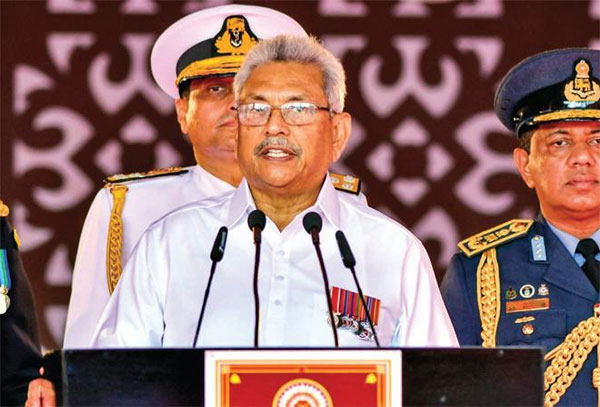
President addressing the nation on Feb.4, 2022

By Shamindra Ferdinando

Prof. Nalin de Silva has questioned the absence of a ‘mechanism’ to implement President Gotabaya Rajapaksa’s strategies. The academic, in his regular piece in Sinhala posted online on Feb 5 discussed the limitations against the backdrop of President Rajapaksa’s address to the nation on Independence Day.

In another commentary, posted online the following day, Prof. de Silva explained that the Feb 5 article should be also examined along with views expressed on January 31 and Feb 2. Essentially, Prof. de Silva compared the system now in place with that of President Ranasinghe Premadasa (1989-1993). Prof. de Silva argued that Premadasa, in spite of securing the presidency without the backing of political elites, was able to take control of the mechanism required to implement his strategies whereas Rajapaksa so far couldn’t. Prof. de Silva declared that President Rajapaksa’s failure to have a system of his own is nothing but a tragedy.

It would be pertinent to mention that Prof. de Silva, in mid-September 2021, quit the ambassadorial position that he received, courtesy the Sri Lanka Podujana Peramuna (SLPP) administration. Having presented the Letter of Credence to Myanmar President Win Myint on 01 Sept. 2020 at the Presidential palace in Nay Pyi Taw, Prof. de Silva served for a year. The outspoken academic returned home after having received treatment for Covid-19 infection.
Declaring that he gave up the diplomatic posting as he found it difficult to continue there especially after being treated for Covid-19, Prof. de Silva emphasised that his resignation was not in any way connected with a wave of resignations at the time.

Since Prof. de Silva quit his Myanmar assignment, there had been so many resignations. Perhaps the most serious of them all is Dr. P.B. Jayasundera’s exit in mid-January 2022. Punchi Banda Wijesundera, or PBJ, resigned as Secretary to the President under controversial circumstances. The writer dealt with the issue and the troubles experienced by the Rajapaksa administration in ‘Can Dr. PBJ alone be blamed for the current crises?’ in last week’s Midweek column.

It would be pertinent to mention that Prof. de Silva, in March 2021, indicated his desire to resign in the wake of prolonged detention of a group of Sri Lankan fishers detained in Myanmar. Unfortunately, a section of the media quite pathetically failed to comprehend de Silva’s message.

By the time Prof. de Silva quit his ambassadorial post in Sept 2021, President Gotabaya Rajapaksa had brought in Prof. G.L. Peiris, who is also the Chairman of the SLPP, as his Foreign Minister in place of Dinesh Gunawardena, leader of the Mahajana Eksath Peramuna (MEP).

There had never been so many resignations during a two-year period of any previous administration. Prof. de Silva’s resignation should be examined against the backdrop of his role in promoting wartime Defence Secretary as the SLPP candidate at the 2019 presidential election. The academic had been one of the few who vigorously campaigned for Gotabaya Rajapaksa at a time the vast majority of those now holding positions weren’t so certain, whereas some objected to the Gajaba Regiment combat veteran’s entry into politics.

Another good speech

Prof. de Silva’s assessment of President Gotabaya Rajapaksa’s Independence Day address to the nation deliberated on an issue that had considerably weakened the government. Declaring that the President had delivered another good speech that dealt with the rights as well as the responsibilities of individuals and the responsibility on the part of the members of Parliament to behave, Prof. de Silva questioned the absence of an efficient mechanism to ensure the implementation of the President’s objectives.

Assuring his readiness to give proper leadership, the President requested ministers, parliamentarians and other politicians to act in an exemplary manner at all times. “If you set this example to the people, then the majority of the people will follow you,” the President’s Media Division quoted Gotabaya Rajapaksa as having said.

Prof.de Silva said in the absence of a much required mechanism to implement the President’s vision, such good views expressed by the leader has been restricted to just speeches. The controversial academic, known to fight tooth and nail for what he believes in, emphasised that his stance shouldn’t be considered in any way as the President is not honest against the backdrop of a lack of proper strategy implementing mechanism.

While speculating whether the President had been deprived of a mechanism as someone else controlled it or perhaps no one was in control, Prof. de Silva said that he tended to accept the second reason though some believed otherwise.

Reiterating that today no one exercised the exclusive control over the existing mechanism, Prof. de Silva asserted that though Gotabaya Rajapaksa served as the executive President, he didn’t have the power in Parliament. Did the academic express the belief, that the 145-member strong SLPP parliamentary group operated totally outside the President’s purview? Obviously, the academic made this assessment taking into consideration as he pointed out that the President was not the leader of any political party. Prof. de Silva expressed the view that though the people elected Gotabaya Rajapaksa as the President, he lacked political support due to him not being engaged in politics among the public. The former university mathematics don asserted that much touted political programme ‘Gama Samaga Pilisandarak’ could not be a substitute for grassroots level campaign involving the President.

Prof. de Silva did not mince his words when he declared the country was in deepening turmoil due to those in authority pulling in different directions. Making reference to public servants operating outside the purview of political leadership, the academic pointed out the absence of a consensus between Finance Minister Basil Rajapaksa and Central Bank Governor Ajith Nivard Cabraal, Agriculture Minister Mahindananda Aluthgamage not having control over ministry officials , Premier Mahinda Rajapaksa’s inability to rein in the Buddha Sasana ministry and the latter promoting the Netherlands’ interests. The former Ambassador declared that turmoil was endemic and certainly not restricted to the ministries and institutions mentioned above.

Prof. de Silva asked whether the President should accept responsibility for the current situation. The academic wondered whether the President no longer enjoyed the powers he had as the Defence Secretary during the war.

Prof. de Silva’s incisive comments in the wake of the President’s Independence Day address to the nation are a must read. The academic dealt with past Presidents, leaving out Dingiri Banda Wijetunga, who served assassinated leader Ranasinghe Premadasa’s remaining term. Let me translate really a thought provoking paragraph exactly the way Prof. de Silva commented on the incumbent President and his predecessors sans Wijetunga, who served as the President from May 1993 to Nov 1994. Chandrika Bandaranaike Kumaratunga succeeded him. Prof. de Silva said: “Is the President responsible for the current situation? The President seems to have been deprived of the powers he enjoyed as the Secretary, Ministry of Defence. Of all executive Presidents, JRJ abused powers badly. He postponed elections. He entered into the Indo-Lanka accord in spite of countrywide opposition. He obtained undated resignation letters from lawmakers. Only Premadasa hadn’t been scared of JRJ. Perhaps Gamini Dissanayake, too, hadn’t been intimidated by JRJ as GD felt he could be the President with Indian backing. Premadasa had the power to threaten JRJ at the latter’s Ward Place residence though he lacked the backing of political elites. How did Premadasa acquire such power?”

Prof. de Silva asserted that there hadn’t been a proper assessment or study of Premadasa. The academic propagated the hypothesis that both CBK and Ranil Wickremesinghe hadn’t been able to achieve what Premadasa did though both enjoyed Western backing in addition to their family support. Mahinda Rajapaksa accomplished some success though he couldn’t even come closer to Premadasa whereas Maithripala Sirisena failed to make any impression.

Prof. de Silva also dealt with the breaking up of the UNP, abortive bid to impeach Premadasa, formation of the Democratic United National Front (DUNF) by a dissident group led by ex-UNP powerful ministers Gamini Dissanayake and Lalith Athulathmudali and their subsequent assassinations, in separate incidents blamed on the LTTE and the failure on the part of Sajith Premadasa, in his capacity as the leader of the Samagi Jana Balavegaya (SJB), to follow in the footsteps of his illustrious father.

Comment on 13A

Even during his one year tenure as Sri Lanka’s top envoy in Myanmar, Prof. de Silva took a public stand on controversial issues. In January last year, just five months after taking over the Myanmar mission, Prof. Silva flayed India for its interference in Sri Lanka’s domestic affairs. In an open letter in Sinhala, also sent to The Island, Prof. de Silva questioned what he called Indian interventions in post-war Sri Lanka and a bid to exploit the Covid-19 pandemic.
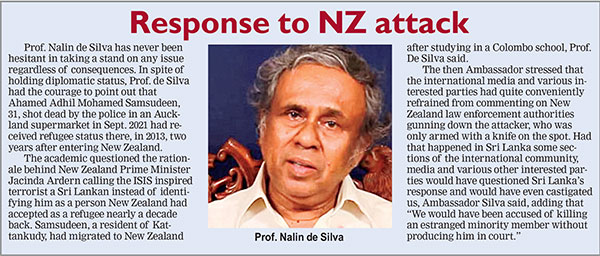
The then Ambassador asked whether India offered Sri Lanka Covid-19 vaccine in return for the full implementation of the 13th Amendment to the Constitution enacted in the late 80s at the behest of New Delhi though that piece of legislation is irrelevant today.

Referring to Indian External Affairs Minister Dr. S. Jaishankar’s visit to Colombo where he met President Gotabaya Rajapaksa, Opposition Leader Sajith Premadasa, TNA delegation and UNP leader Ranil Wickremesinghe, the academic questioned the Indian strategy. At the conclusion of the meetings, Dr. Jaishankar declared: “It is in Sri Lanka’s own interest that the expectations of the Tamil people for equality, justice, peace and dignity within a united Sri Lanka are fulfilled. That applies equally to the commitments made by the Sri Lankan government on meaningful devolution, including the 13th Amendment to the Constitution.”

Commenting on Sri Lanka’s efforts to procure Covid-19 vaccine, Jaishankar said, “We are now looking at post-Covid cooperation and I carry back with me Sri Lanka’s interest in accessing vaccines from India and I shared with the Foreign Minister, as Prime Minister Modi has said, India sees international cooperation in this area as its duty.”

Expressing serious concern over strong Indian presence in Colombo, ex-Ambassador de Silva queried whether the Indian External Affairs Ministry was situated in Colombo. The non-career diplomat also compared the effectiveness of the vaccine that could be obtained from India and serum available for those countries having the wherewithal to secure, store and implement the large scale vaccination campaign.

Ambassador de Silva, a vociferous supporter of ongoing local efforts to develop Sri Lankan remedy for Covid-19 epidemic, pointed out the failure on the part of the country as a whole to support domestic bids.

The strong patriot asked whether Dr. Jaishankar visited Colombo to inform the government of its readiness to provide vaccines and give priority to Sri Lanka. Pointing out that Sri Lanka would get some vaccines, though it lacked understanding of India’s requirement as it struggled to overcome Covid-19, Ambassador de Silva said that Sri Lanka should have sought an explanation from Dr. Jaishankar whether India didn’t have a local remedy.

Prof. de Silva launched a scathing attack over India’s call to further strengthen the Provincial Council system. The senior academic said: “Indian External Affairs Minister wants Sri Lanka to strengthen the Provincial Council system further. Why should we do that? The so-called Tamil problem had been solved. Even if the issue hadn’t been resolved, what right did India have to intervene in domestic issues? We have no issue in TNA leader R. Sampanthan, MP, and lawmaker M.A. Sumanthiran taking up residence at India House, situated opposite the University of Colombo. India cannot be allowed to meddle here to appease the likes of Sampanthan and Sumanthiran.”

Asserting the irrelevance of the so-called Tamil problem in the wake of the eradication of the LTTE military capability in May 2009 on the banks of the Nanthikadal lagoon, Ambassador de Silva said that the terrorist challenge could only have been neutralized through military means. In spite of those who had spearheaded the Jathika Hela Urumaya at its inception campaigning against the war effort, the military succeeded in eradicating the enemy’s conventional military capability for once and for all, the nationalist said.

Pointing out how Canada and the UK still facilitated those bent on dividing the country on ethnic lines by propagating a totally fabricated genocide that never happened; Ambassador de Silva alleged that the government hadn’t taken tangible measures to counter the enemy strategy.

Prof de Silva questioned how India expected Sri Lanka to fulfil what then President JR Jayewardene promised against the backdrop of New Delhi’s failure to disarm the LTTE in terms of the Indo-Lanka accord. Sri Lanka shouldn’t under any circumstances give into Indian demands as regards the 13th Amendment in return for a stock of Covid-19 vaccines, Ambassador de Silva said.

The former Mathematics don also discussed the continuing controversy over the alleged Memorandum of Cooperation (MoC) among Sri Lanka, India and Japan in respect of the East Container Terminal (ECT) at the Colombo harbour entered into by the yahapalana regime. The then Sri Lanka envoy in Myanmar urged the government to take the parliament and the public into confidence if it intended to finalise agreement on ECT

Following strong protests by port unions against giving ECT to India it was handed back to SLPA. Since then India’s Adani Group has secured the right to develop the West Container Terminal (WCT) of the Colombo Port. Adani has signed an agreement with the Sri Lanka Ports Authority (SLPA) and John Keells Holdings to develop the WCT. Valued at more than $700m, this build-operate-transfer (BOT) agreement is said to be the ‘largest’ foreign investment ever in Sri Lanka’s port sector. The agreement will remain valid for 35 years.

Sri Lanka finalised a dubious Yugadanavi deal soon after Prof. de Silva returned from Rangoon. The Yugadanavi deal has been challenged in the Supreme Court with three ministers taking the side of those who petitioned the SC against the Sept 17 agreement. The government has caused further controversy by entering into a fresh agreement with New Delhi in respect of the Trincomalee oil tank farm.

Academic de Silva, during his tenure in Rangoon also called for the abolition of the Provincial Councils. The declaration was made in the wake of some interested parties, including a section of the government pushing for PC polls. New Delhi has even raised the 13th Amendment at the UNHRC thereby underscored the pivotal importance of the high profile Gandhi era project from the 80s.

If the government is genuinely interested in achieving success at least during the remaining period as repeatedly assured by the SLPP as well as the President, let there be a reappraisal of the situation, proper assessment and tangible measures to address the issues at hand. The SLPP can begin by perusing Prof. de Silva’s analysis of the current political situation.

Wednesday, 2 February 2022

Can Dr. PBJ alone be blamed for current crises?

 SPECIAL REPORT : Part 405

Published

  
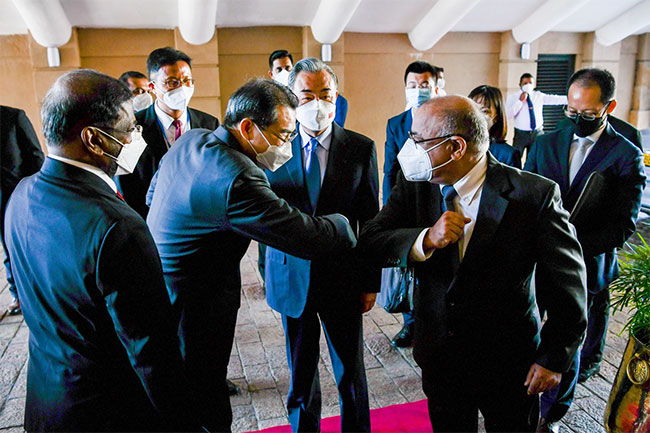
Dr. PBJ greets Chinese Assistant Foreign Minister, Wu Jianghao, a former Chinese Ambassador in Colombo, at the Presidential Secretariat over a week before he quit the top job. Chinese Foreign Minister Wang Yi looks on (Pics courtesy PMD)

By Shamindra Ferdinando

Declaring that every sector depended on the public service, the country’s Commander in Chief President Gotabaya Rajapaksa emphasised the responsibility on the part of the Secretaries to the Ministries to achieve given tasks. The President said so at the Presidential Secretariat on the morning of January 19 when Secretary to the Prime Minister Gamini Senarath, succeeded Dr. P.B. Jayasundera as Secretary to the President.

Among those present on the occasion were Dr. Jayasundera and Lalith Weeratunga, Senior Advisor to President Gotabaya Rajapaksa.

At the same time D.M. Anura Dissanayake, who had been the Secretary to the Irrigation Ministry, was brought in as Secretary to the Prime Minister. Both Senarath and Dissanayake are senior officers of the Sri Lanka Administrative Service (SLAS).

Once a longtime Treasury Secretary, Dr. Jayasundera tendered his resignation as the Presidential Secretary in the wake of criticism by some ministers of the government that he hadn’t been accessible, arrogant and was largely responsible for the current economic crisis. After Jayasundera’s resignation, President Gotabaya Rajapakasa during a luncheon meeting with a selected group of editors of national newspapers asserted that it was not fair to single out a person for criticism.

In spite of Dr. Jayasundera, in his resignation letter to the President stating that he would be leaving the Office on January 01, 2022, Senarath moved in much earlier as desired by the President. Some members of the Cabinet as well as those who backed the Sri Lanka Podujana Peramuna (SLPP) at the 2019 presidential and 2020 parliamentary polls resented Dr. Jayasundera’s role. Some alleged that Dr. Jayasundera wielded far greater power than members of the Cabinet. But, the issue at hand is whether it would be fair to blame the difficulties experienced by the government on one person?

At the height of the crisis caused by the global epidemic Covid-19, Dr. Jayasundera caused controversy in May 2020 when he requested public servants to contribute half, a week or a day’s pay from their May salaries.

Dr. Jayasundera made the request in his capacity as the Secretary to the President and the head of the public service. Dr. Jayasundera declared that the Budget deficit could be reduced if the public sector agreed to the pay cut.

In his letter to the President, informing him of the decision to forgo his May 2020 salary and allowances, Dr. Jayasundara pointed out that the monthly wage bill of the Government was about Rs.80 bn and if the government corporations, Banks and Universities are added, it’s closer to Rs. 90 to Rs.100 bn.

The Opposition attacked as usual for the sake of opposing both Dr. Jayasundera and the government over the former’s call for a salary cut. Both the Samagi Jana Balavegaya (SJB) and the Janatha Vimukthi Peramuna (JVP) strongly criticised Dr. Jayasundera’s move whereas the government defended it.

Dr. Jayasundera’s proposal meant to reduce the Budget deficit that hadn’t been implemented should be re-examined against the backdrop of the government announcement of the Rs 229 bn relief package for the public sector. Didn’t such a costly political decision further undermine the cash-strapped government? Did the government consult Dr. Jayasundera regarding the relief package offered at a time the government was struggling to cope up with an extremely messy financial situation?

Fertiliser controversies

Dr. P.B.J. strongly opposed the government seeking the IMF’s intervention. Throughout the crisis, the then Secretary to the President asserted firmly that there is no requirement for the government to involve the IMF. The former Treasury Chief remained convinced of their strength to meet the challenge even after the Governor of the Central Bank W.D. Lakshman was asked to go.

In the run-up to his resignation Dr. Jayasundera was embroiled in the simmering controversy over the opening of an account at the Town Hall branch of the People’s Bank to facilitate the import of nano-fertiliser from India. The accusations pertaining to the deal were made in Parliament on Oct 22, 2021 by JVP lawmaker Vijitha Herath. The scandal revolved around approximately US$ 1.2 mn being transferred to the private bank account of Mohan Perera and G. M. Weerasinghe of ‘United Farmers Trust Limited’ as payment for nano-fertiliser from India.

The JVPer alleged that Dr. Jayasundera ordered the People’s Bank to open a separate private account at its Town Hall Branch under the name ‘United Farmers Trust Limited’. The then Secretary to the President not only strongly denied the accusations, he requested an inquiry by the Criminal Investigation Department (CID). Although both print and electronic media prominently reported MP Herath’s accusations, the investigation targeted Mahinda Illeperuma, the editor of Aruna. The CID summoned him for questioning.

The role of Gamini Senarath, too, has been questioned also by the JVP over his alleged involvement in the import of carbonic fertiliser from China. The JVP raised the issue as the top person managing Chelina Capital Corporation, the local agent of Qingdao Seawin Biotech Chinese Company, happened to be a close relative of Senarath, who promptly denied accusations while offering to assist authorities in case of an investigation. Senarath emphasised that in spite of a relative of his being involved in the transaction he hadn’t been part of it.

Agriculture Minister Mahindananda Aluthgamage is on record as having assured Parliament that both transactions were above board. It would be pertinent to mention that the government paid dearly for its hasty and inconceivable decision to ban fertiliser and agro-chemicals. The move triggered protests in many districts. Emergency import of carbonic fertiliser ended up in controversy finally with the government having to pay USD 6.7 mn to Qingdao Seawin Biotech under controversial circumstances. China compelled Sri Lanka to pay in spite of the carbonic fertilizer load being rejected on the grounds it allegedly contained harmful bacteria, a charge strongly denied by China. Did Dr. Jayasundera play any role in introducing carbonic fertiliser and the subsequent decision to procure carbonic fertiliser from China and then place an order for Indian nano-fertiliser?

The government suffered a debilitating setback due to its controversial decision to introduce carbonic farming in such a hasty fashion forced obviously by the then imminent foreign exchange crisis caused by the collapse of the vital tourism sector and expatriate worker remittances on top of having to meet so many exigencies caused by the pandemic, at the expense of commercial agriculture.

National Freedom Front (NFF) leader Wimal Weerawansa over the last weekend issued a dire warning over food security. Weerawansa, in no uncertain terms, urged the government to reverse its decision on fertiliser and agro-chemicals. Interestingly, Weerawansa, who had teamed up with colleagues, Vasudeva Nanayakkara and Udaya Gammanpila against the highly controversial Yugadanavi deal, is the first cabinet minister to publicly warn the government of an impending food shortage.

Can the government ignore Weewawansa’s warning against the backdrop of the sacking of Agriculture Secretary Prof. Udith K. Jayasinghe in late December, 2021 and stripping Susil Premjayantha of his ministerial portfolio less than two weeks later?

Resignations, sackings galore

Gamini Senarath (seated) on his desk on the first day as Secretary to the President. Senior Advisor Lalith Weeratunga and Dr, PBJ with Senarath
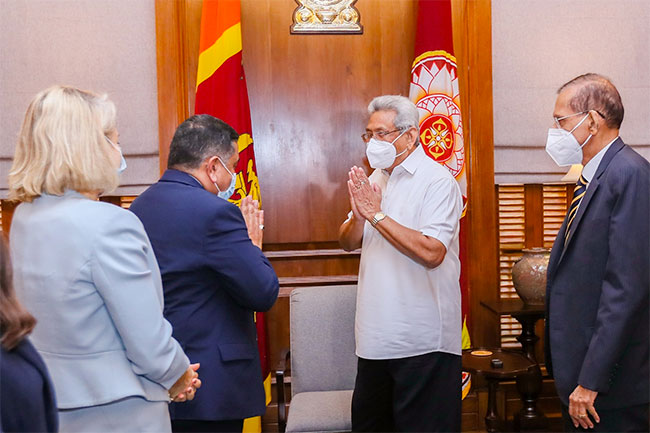
There had been so many resignations, sackings, appointments at different levels since Agriculture Secretary retired Maj. Gen. Sumedha Perera was unceremoniously removed from his position in Feb 2021. News First on Feb 23 quoted the war veteran as having said: “I have informed the Secretary to the President, on Monday 15th February that I am relieved from duties due to unforeseen circumstances. However I have not tendered my resignation as yet nor have I been in communication with H.E the President regarding the matter as published by certain media outlets.”

Maj. Gen. Perera told The Island that he resigned from the post. Perera was later offered the post of Secretary Wildlife which he declined. Since then three others, who had held the post of Agriculture Secretary were replaced under controversial circumstances. The government replaced Maj. Gen. Perera with Rohana Pushpakumara. Several months later, one-time Chairman of the Paddy Marketing Board Dr. Jatal Mannamperuma was brought in as the Agriculture Secretary following Pushpakumara’s resignation. Mannaperuma declined to specify why he quit suddenly. Mannamperuma’s departure brought in Prof. Jayasinghe. Following the academic’s sacking over the issuing of a dire warning of an impending food shortage, the government named D.M.L.D. Bandaranayake as the Agriculture Secretary.

Before the President sacked Prof. Jayasinghe, the latter on the instructions of Agriculture Minister Mahindananda Aluthgamage removed former Ministry of Agriculture Advisor Prof. Buddhi Marambe. The government found fault with Prof. Marambe, who had been the Chairman of the Policy Planning Committee of the Ministry of Agriculture for being critical of the carbonic policy. Aluthgamage also removed the former Registrar of Pesticides Dr. J.A. Sumith.

The crisis in the Agriculture Ministry undermined the government. Unfortunately, the government never really understood the problem or at least tried to discuss the issues at hand earnestly. Minister Weerawansa’s warning over the collapse of commercial agriculture and food security being at risk shouldn’t be ignored. The overall failure of the government project that finally compelled the government to allocate as much as Rs 40 bn to pay compensation cannot be discussed without taking into consideration how Shashendra Rajapaksa, State Minister of Promoting the Production, Regulating the Supply of Organic Fertiliser, and Paddy and Grains, Organic Foods, Vegetables, Fruits, Chilies, Onion and Potato Cultivation; Promoting, Seed Production and Advanced Technology Agriculture handled the challenging task. Did Shashendra Rajapaksa fail to achieve government objectives? What would the future of that particular ministry be against the backdrop of Weerawansa’s call to review the overall agriculture policy?

Urgent policy review is required if the government sincerely expects to make a difference on the ground. Accusations that Maha season suffered due to the farming community being deprived of both fertiliser and agro-chemicals should be examined taking into consideration the failure on the part of the government to import carbonic fertiliser and sufficient stocks of nano fertilizer from India. In spite of the government rescinding the ban on agro-chemical imports, required stocks weren’t brought in much to the dismay of the farming community.

Perhaps, the balance of payments crisis hindered the government attempts to make emergency purchases of agro-chemicals. With the commencement of Yala season just weeks away, the government must move quickly on the contentious issue of flawed agriculture policy.

Importance of consistency

Many eyebrows were raised when the government removed former Army Chief General Daya Ratnayake from the post of Chairman SLPA in late June 2021. Ratnayake must have antagonised the powers that be for him to be removed and moved to the Industries Ministry as its Secretary. Ratnayake, who served as the Commander of the Army after the conclusion of the war never, went public as to why he was removed, unceremoniously.

Another move that quite surprised many was Maj. Gen. M.D.S.P. Niwunhella’s appointment as the Commissioner General of Essential Services (CGES) on August 31, 2021 and then doing away with price control leaving medicine as the only item under supervision. At the time Maj. Gen. Niwunhella received the appointment, he served as the senior officer in charge of President Gotabaya Rajapaksa’s security. The Gajaba Regiment officer continues to do so whereas his appointment as CGES was allowed to lapse.

Sri Lanka’s primary liquid gas supplier Litro has been embroiled in controversy not only due to gas–related explosions but the change of its Chairman and Chief Executive Officer Anil Koswatte last July. Koswatte’s removal took place amidst accusations of him blocking the Auditor General from performing his legitimate responsibilities. The Litro controversy received much public attention in the wake of Viyathmaga activist Theshara Jayasinghe, who replaced Koswatte was himself removed last month to pave the way for Renuka Perera, the Administrative Secretary of the SLPP to take over the well paid job.

President Gotabaya Rajapaksa however thwarted that move because of obvious internal and external intrigues there. That resulted in Renuka Perera being appointed Milco Chairman, at the expense of civil society group Yuthukama activist Lasantha Wickremasinghe.

Yuthukama played a significant role in SLPP presidential election candidate Gotabaya Rajapaksa’s campaign. The government compensated Lasantha Wickremasinghe by appointing him as Chairman, Ceylon Fertiliser. Wickremasinghe declined the appointment. The Yuthukama activist was to replace Janath Sri Vidanage.

Some of the other interesting developments were Justice Minister Ali Sabry’s offering to quit his portfolio over the appointment of Ven. Galagodaatte Gnanasara, a convict who had received a presidential pardon during the Yahapalana administration, as the head of ‘One Country, One Law’ Task Force. The President settled the issue by amending the relevant gazette, thereby diluting the scope of the Task Force.

The developments in the run up to the Yugadanavi deal finalised on the night of Sept 17, 2021, too, attracted public attention. Basil Rajapaksa entered Parliament on the SLPP National List to take over the finance portfolio, replace CEB Chairman Vijitha Herath with onetime Power Ministry Secretary M.C. Ferdinando from retirement, and shift Dullus Ahahapperuma from Power Ministry to Media. One-time UNP Minister Gamini Lokuge with a tarnished past having headed its once notorious union Jathika Sewaka Sangamaya (JSS), was brought in as the Power Minister.

Now, Ferdinando has resigned following the appointment of Additional General Manager (Corporate Strategy), Eng. (Dr.) D.C.R. Abeysekera of the Corporate Strategy Division as the new Ceylon Electricity Board (CEB) General Manager. Abeysekera succeeded another resurrected retiree Dr. Susantha Perera.

President Gotabaya Rajapaksa intervened in the wake of the Ceylon Electricity Board Engineers Union (CEBEU) protest campaign against Dr. Perera’s controversial appointment ignoring the designated successor as per CEB’s established rules. The government cannot ignore the fact that Yugadanavi deal has been challenged in the Supreme Court with a section of the cabinet of ministers too supporting the challenge.

Chaos

The government should have been mindful of diplomatic appointments it made during the past two years. Canada and Italy refusing to accept retired Air Marshal Sumangala Dias as Sri Lanka’s top envoy therein over unsubstantiated accountability issues underscored the responsibility on the part of the government as well as the Parliamentary High Posts Committee to be cautious, especially in the face of undercurrents created by the West led by the US against our security forces for crushing the world’s most ruthless terrorist outfit against their sinister wishes.

The government is in chaos. The recent shocking revelation that Prime Minister Mahinda Rajapaksa’s Parliamentary Affairs Secretary former UPFA lawmaker Udith Lokubandara stole over Rs 40 mn from the Premier’s account highlighted the pathetic situation. Lokubandara, who had served as the private secretary to Mahinda Rajapaksa (2015-2020) received the appointment as his Parliamentary Affairs Secretary after the last parliamentary election. The former MP’s act underlines the need to be extremely cautious in accommodating people regardless of their status or connections.

Wednesday, 26 January 2022

How Quad strategy to contain China affects Sri Lanka

 SPECIAL REPORT : Part 404

Published

   
President Rajapaksa greets Lord Ahmad while FM Prof. Peiris and BHC Hulton look on. In the wake of the Lord British Human Rights Minister's visit, the BHC announced funding through the Conflict, Stability, and Security Fund (CSSF) to address what the British called 'legacies of conflict, promote human rights and build cohesion across all communities through programme funding of up to £3.7m in 2022/23' pic courtesy PMD

By Shamindra Ferdinando

The Japanese Embassy in Colombo on the afternoon of January 19 organised a joint media briefing at Sasakawa Hall with the participation of Sri Lankan Foreign Minister Prof. G.L. Peiris to announce plans for the 70th anniversary commemoration of the establishment of diplomatic relations between the two countries. Among those who addressed the media, in addition to twice Foreign Minister Prof. Peiris, were Foreign Secretary Admiral Prof. Jayanath Colombage and Japanese Ambassador in Colombo Mizukoshi Hideaki.

Prof. Peiris served as the External Affairs Minister (2010-2015) and was re-appointed in August 2021.

The current status of Sri Lanka-Japan relations cannot be discussed without taking into consideration the alignment or, more appropriately, the ganging up of certain Western powers and their allies against the People’s Republic of China whose relationship with Sri Lanka has irked the US-led grouping. Let me, briefly mention three other recent events/developments, namely visits undertaken here by the UK Minister of State for South Asia, the United Nations and the Commonwealth Lord Tariq Ahmad and the Speaker of the National Assembly of the Republic of Korea, Park Byeong-Seug and a sudden shocking Canadian Travel Advisory primarily targeting Sri Lanka’s efforts to revive tourism, before examination of Sri Lanka-Japan diplomatic relations.

Japan, Korea, the UK and Canada are part of the US-led coalition against China. There is absolutely no ambiguity in their stand. In line with their overall strategic objectives, they pursue an agenda inimical to war-winning Sri Lanka at the Geneva-based United Nations Human Rights Council (UNHRC). Unfortunately overwhelmed by their well-rehearsed chorus, backed by their International NGO hacks, Sri Lanka lacked political will at least to set the record straight. Over 12 years after the successful conclusion of the war against the Liberation Tigers of Tamil Eelam (LTTE) despite all odds arraigned against us, Sri Lanka remains entangled in a well-coordinated so-called accountability process meant to undermine the country. Continuing humiliation of the war-winning armed forces is part of their overall strategy.

Three years after the war (March 2012), a resolution targeting Sri Lanka was adopted at the UNHRC. Twenty four countries voted against Sri Lanka, 15 for the country, whereas eight abstained. India voted against Sri Lanka. The UK, Japan and Korea didn’t represent the UNHRC at that time. Sri Lanka’s current Ambassador in Washington Mahinda Samarasinghe led the government delegation.

The UNHRC membership is based on equitable geographical distribution. Seats are distributed as follows: African States 13 seats, Asia-Pacific States 13 seats, Latin American and Caribbean States eight seats, Western European and other States seven seats and Eastern European States six seats.

At the March 2014 session, the UNHRC adopted a resolution that paved the way for the HRC Chief, who is obviously a part of the conspiracy against countries like Sri Lanka targeted by the self-appointed international community of the West, to undertake a comprehensive investigation into alleged serious violations and abuses of human rights and related crimes ostensibly against both parties in Sri Lanka. But in actual fact it is only Colombo that they are targeting! While the Tiger military/terror machine was vanquished on the banks of the Nanthikadal lagoon in May 2009 by the security forces, those like the TNA that backed the LTTE terror machine to the hilt, until the very end, continue to be the darlings of the West. The resolution was adopted thanks to the Western clout with 23 countries in favour, 12 against and 12 abstentions. Korea and the UK voted in favour, whereas India and Japan abstained.

Korea and the UK again voted in favour of the anti-Sri Lanka resolution at the March 2021 session whereas Japan and India abstained. Korea and the UK were among 22 countries which denounced Sri Lanka. Eleven countries opposed the resolution while the rest abstained. Those who skipped the vote included New Delhi and Tokyo. The March 2021 resolution empowered the HRC Chief to collect and store information that could lead to international criminal proceedings.

Moving beyond Comprehensive Partnership

In between the second (March 2014) and third resolutions (March 2021), Sri Lanka co-sponsored a resolution (Oct 2015) against her own armed forces. Within a week after the Geneva betrayal, the then Prime Minister Ranil Wickremesinghe entered into a Comprehensive Partnership Agreement (CPA) with Japan. The signing took place in Tokyo on Oct 6, 2015. The then Japanese Premier Shinzo Abe signed on behalf of Japan. The CPA has to be considered against the backdrop of Tokyo being part of ‘Quad’ (Quadrilateral Security Dialogue) comprising the US, India, Australia and Japan arrayed against China.

Ambassador Hideaki’s predecessor Akira Sugiyama last November called for further expansion of Japan – Sri Lanka ties beyond the CPA between the two countries on the eve of his departure from Colombo having concluded his term.

At his farewell meet with Prof. Peiris Ambassador Sugiyama has said that 70th anniversary celebrations would be a fitting occasion to enhance existing CPA to a further height.

In spite of tremendous pressure, South Korea has refrained from joining Quad as Seoul obviously does not want to antagonise China, its major trading partner. In the context of North and South Korean relations, Seoul cannot under any circumstances take a hostile stand against China, though South Korea being home to a strong US military presence. However, tiny Sri Lanka is not so lucky. Therefore, Sri Lanka shouldn’t expect South Korean support at the UNHRC. Seoul contributed to Sri Lanka’s humiliation both at the 2014 and 2021 sessions. In case, the US-UK alliance pushed for further action against Sri Lanka at the UNHRC this year, would South Korea be able at least to abstain in view of the 45th anniversary of formalising diplomatic ties with Sri Lanka.

Would South Korea ultimately end-up in Quad? The US led alliance is keen to bring Sri Lanka under its domain though China, too, appears to be well positioned here to enhance its influence. Chinese Foreign Minister Wang Yi‘s recent whistle-stop visit to Colombo underscored how serious the Chinese took their project here. Sri Lanka should carefully examine the Quad approach as well as how individual countries responded to Colombo’s relationship with Beijing. Having allowed Chinese flagship project here, the Colombo Port City from the reclaimed sea, Sri Lanka cannot envisage an environment free of a string of Chinese presence here. In spite of pressure exerted by Western powers and India, Sri Lanka cannot adopt policies at the expense of China, an all-weather friend like Pakistan.

Sri Lanka faces a daunting challenge in balancing its relations with China and the US-led alliance that included India. Economically weak Sri Lanka can be exploited by both camps. The current dispensation as well as the Opposition should be mindful of their designs. Regardless of political differences, political parties represented in Parliament should seek consensus on foreign policy and related matters. A few corrupt politicians and officials shouldn’t be allowed to make personal gains at the expense of national interest. That is the stark and ugly truth.

UK’s agenda

Following Lord Tariq Ahmad’s meeting with President Gotabaya Rajapaksa at the Presidential Secretariat, the PMD (Presidential Media Division) issued a statement titled ‘Sri Lanka’s progress over human rights highly commendable….’ That statement quoted Ahmad as having declared at the meeting attended by Prof. Peiris and British High Commissioner in Colombo Sarah Hulton that Sri Lanka’s programme to empower human rights was making great strides. The PMD quoted him further that Sri Lanka would be able to resolve all issues pertaining to human rights by moving forward with a pragmatic approach to strengthen it. The PMD quoted President Gotabaya Rajapaksa as having requested Lord Ahmad to provide an opportunity for discussions with the UK-based Diaspora. According to the PMD statement the President has assured the UK that his government aimed to solve all issues faced by Sri Lankans and create an environment where all Sri Lankans could live as one people.

However, Lord Ahmad in a short video issued at the end of his visit which he described as incredible three days certainly did not give any indication to support the PMD declaration as regards Sri Lanka’s progress on human rights.

First of all, the government should keep in mind that the UK, a member of the current UNHRC and the leader of the Sri Lanka Core Group at Geneva, wouldn’t do anything to ease pressure on Sri Lanka, especially ahead of the forthcoming Geneva session. Having succeeded the US as Sri Lanka Core Group leader, the UK relentlessly pursued Sri Lanka on the basis of unsubstantiated war crimes allegations. In spite of repeated calls by Lord Naseby to consider wartime (January-May 2009) UK High Commission dispatches from Colombo as part of the overall efforts to ascertain the truth, the UK has refused to do so.

We have to recall the fact that the UK became a great power not through sheer hard work the way the modern China has done. In fact it was one of the first narco-states dealing in opium, which brought China to its knees. It always plundered much of the world by a policy of divide and rule of its subjects as in Sri Lanka. And the problems here are without doubt the result of that policy, which favoured especially the minority Tamils over others. The same problems can be seen even in places like Burma to this day, where insurgencies are still engineered/financed mainly by the West. We will not go into India because the servile Premier Modi having got a seat at the head table of the Western camp and blinded by its glitter obviously often can’t see beyond his nose. Indians often forget how they were treated like lepers by the West till the collapse of the Soviet Union and how everything possible was done to undermine it and even to break it up.

Lord Naseby following over a two-year legal battle with his government in Oct 2017 disclosed a section of the dispatches from Colombo. The rest of the dispatches hadn’t been released on the basis their disclosure would undermine UK’s relations with Sri Lanka. During Dinesh Gunawardene’s tenure as the Foreign Minister, the UK turned down Sri Lanka’s request to submit the relevant documents to the UNHRC. President Rajapaksa brought in Prof. Peiris as his Foreign Minister last August.

Obviously the UK suppressed diplomatic cables sent by its wartime Defence Attaché Lt. Colonel Anthony Gash from the British High Commission, Colombo, because they ran counter to the claims made by the western bloc as regards Sri Lanka at the UNHRC.

Having visited Jaffna and Trincomalee, in addition to his meetings in Colombo, Lord Ahmad, in his video message made reference to human rights defenders and civil society representatives. The UK Human Rights Minister declared while he discussed a broad range of issues, including education, environment, investment opportunities as well as economy with government leaders, human rights defenders and members of the civil society shared with him the challenges faced by them.

It would be pertinent to ask whether any of those categorised as human rights defenders and civil society at least privately requested the British High Commission intervention in the wake of the LTTE using civilian human shield on the Vanni (east) front in 2009. The TNA leader R. Sampanthan, MP, who declared the LTTE as the sole representative of the Tamil speaking people way back in 2001 was among those who met Lord Ahmad. Lawmaker Sampanthan never ever bothered to speak on behalf of those who had been trapped on the Vanni East front though he raised accountability issues at the end of the war.

The British, too, never sought at least an explanation from those who cooperated with the LTTE’s agenda. If the British are keen for reconciliation and justice for what had happened in the past as stressed by Lord Ahmad in his video message, the UK cannot ignore its own role in the once India-run separatist project.

The UK allowed the LTTE absolute freedom of movement in its territory where millions of Sterling Pounds were raised to procure weapons. The LTTE had its so-called International Secretariat in London at the time it assassinated former Indian Premier Rajiv Gandhi in May 1991, over a year after New Delhi ended its military mission in Sri Lanka. One-time British High Commission employee Anton Stanislaus Balasingham, in spite of being the theoretician of a murderous organisation, enjoyed the status as a British citizen until his demise in Dec 2006. The UK had no issue with Balasingham’s British citizenship even after the assassination of the then Foreign Minister Lakshman Kadirgamar in August 2005. The terrorist was allowed to operate freely. The late Balasingham’s wife, Adele, in spite of having promoted the LTTE’s despicable cause and even privy to the assassination of Gandhi by a female suicide bomber still lives there. When Lord Ahmad talked of the past, obviously he was only referring to alleged atrocities committed by the Sri Lankan military.

UK pursuing hostile strategy

The recent BBC reportage on Sri Lanka underscores continuing British hostility towards Sri Lanka. In spite of China being one of the major trading partners of the British, the latter in line with overall US-fashioned policy takes a hostile view of Sri Lanka’s relationship with China. The UK spearheaded efforts to set up a special investigation targeting Sri Lanka following the March 2021 Geneva session. Lord Ahmad’s recent visit and his promise to come back here again very soon wouldn’t change a thing. The British would continue to undermine Sri Lanka essentially for two reasons (i) Sri Lanka-China relationship and influential Tamil Diaspora relationship with all British political parties.

Regardless of Sri Lanka’s Opposition, Western powers ensured the setting up of high profile special investigation (Sept 2021 to Sept 2022) against the country to complete the encirclement of Sri Lanka at the UNHRC. The investigation is now underway. Did Sri Lanka at least raise the issue during Lord Ahmad’s recently concluded visit here? Sri Lanka shouldn’t expect fair play under any circumstances. The special investigation, too, will justify previous unsubstantiated accusations. Hope, the current dispensation, particularly the Foreign Ministry hadn’t conveniently forgotten how the yahapalana government co-sponsored a resolution against the war-winning armed forces on the basis of accusations that weren’t examined in a court of law. What really intrigued the public is the UN declaration that the identity of those who made accusations would be covered by confidentiality clauses for a 20-year period. As the declaration has been made in March 2011, Sri Lanka wouldn’t have an opportunity to know its accusers or at least whether they existed till 2031. Even then they have left a provision to extend that confidential clause for a further period. Where is the rule of law in all that, though always mouthed by the West of its virtues like a parrot?

Let me get back to the investigation led by a Senior Level Advisor in terms of the UNHRC dictate. Declaring that the UNHRC expected the Senior Legal Advisor to have (verbatim) experience in international criminal justice and/or criminal investigations and prosecutions to coordinate the team and oversee an information and evidence collection strategy; the development of a central repository to consolidate, preserve and analyse information and evidence; coordinate the processes of reviewing and sharing of information with national authorities for universal jurisdiction and extraterritorial jurisdiction cases and other accountability purposes in line with relevant United Nations guidelines; develop accountability strategies and engage with accountability mechanisms including specialised investigators, prosecutors, judges, and other legal practitioners both for information sharing purposes, to promote accountability and advise on the development of accountability strategies; and liaise with other parts of OHCHR, other independent mechanisms and the UN system to ensure a coordinated approach”

It is not too difficult to understand where we are heading. It would be the responsibility of the current dispensation to set the record straight in Geneva and New York without further delay. The Tamil National Alliance (TNA) participated in an abortive political project to elect war-winning Army Commander the then Gen. Sarath Fonseka as the President at the 2010 presidential poll should be officially made known in Geneva and New York. The fact that Fonseka comfortably won electoral districts with Tamil speaking majority, too, should be part of Sri Lanka’s defence. Shouldn’t Sri Lanka ask those shedding crocodile tears for war victims why the Tamil speaking people, including those living in the Vanni who suffered dearly voted for the man whose Army was accused of killing over 40,000 Tamils?