Tuesday, 15 March 2022

National Voters’ Day celebration amidst economic chaos, deepening political uncertainty

 SPECIAL REPORT : Part 411
Published

  
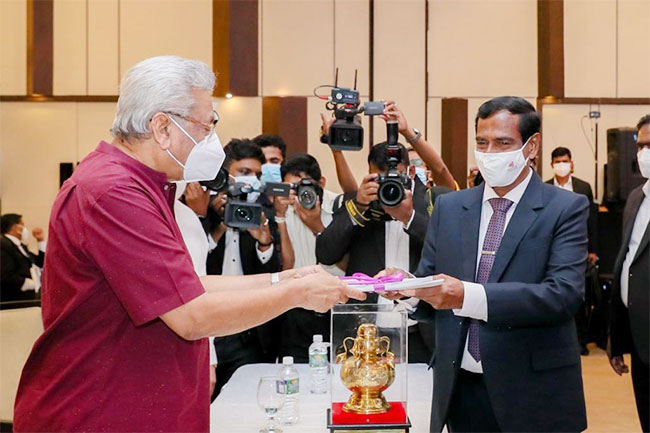
EC Chairman Punchihewa handing over their proposals to President Gotabaya Rajapaksa, at the Galadari Hotel. The President Rajapaksa, in spite of contesting the last presidential election on the SLPP ticket, is not a member of that political party.(Pic courtesy PMD)

Poor response from political parties

By Shamindra Ferdinando

Nimal Punchihewa, soft spoken Chairman of the Election Commission (EC), didn’t mince his words when he underscored the loss of public confidence as well as overall disappointment in the electoral system last week. Punchihewa stressed the need for far reaching changes in the electoral system while reiterating the EC’s proposals meant to improve and discipline utterly corrupt and wasteful electoral processes. The continuing failure on the part of Parliament to address the grievances of the electorate would be catastrophic and may pose a threat to political stability, he warned.

Attorney-at-Law Punchihewa said so at the ‘National Celebration of Voters’ held at the Galadari Hotel, Colombo, on March 11, the first such event since the establishment of the independent EC in terms of the 19th Amendment to the Constitution.

The House enacted the 19th Amendment, in early 2015, with an overwhelming 2/3 majority. However, the present five-member EC, headed by Punchihewa, came into being in Dec 2020 in terms of the 20th Amendment to the Constitution, enacted in October of the same year, repealing the trouble ridden 19th Amendment, especially when it came to members of so-called independent commissions, some of whom behaved as if they were a law unto themselves. At least one lawyer, in one such commission had the audacity to attack the Opposition in a partisan way outside his ambit.

Punchihewa, one-time public servant and civil society activist, explained the remedial measures that could be taken to address deficiencies and limitations in the electoral system.

The EC Chairman also discussed the need for punitive measures against offending lawmakers, regardless of their standing in society and the contentious issue of campaign funding. The EC Chief pointed out how both external and internal elements could influence political parties through campaign funding.

Punchihewa, who had served the previous EC, too, cannot be unaware of the way then US Secretary of State John Kerry’s boastful public declaration in 2016 how they funded Sri Lanka’s Opposition at the 2015 national elections (presidential and parliamentary polls in January and August, 2015, respectively) and similar stunts in several other countries.

The EC never inquired into the matter of the US interference in Lankan polls after openly boasting of it, even though the issue was raised both in and outside Parliament. The writer personally raised the US interference with the previous three- member EC, headed by Mahinda Deshapriya, but the outfit always side-stepped the issue. Even the European Union Election Observation Mission sidestepped the issue when the matter was raised at a media briefing held at the Colombo Hilton.

President Gotabaya Rajapaksa, Premier Mahinda Rajapaksa, Speaker Mahinda Yapa Abeywardena, Chief Government Whip Dinesh Gunawardena, Foreign Minister Prof. G.L. Peiris, who is also the Chairman of the ruling Sri Lanka Podujana Peremuna (SLPP) and Punchihewa’s predecessor, Mahinda Deshapriya, were among those in the audience. Deshapriya now serves as the Chairman of the Delimitation Committee. The EC attracted criticism during Deshapriya’s tenure as the outfit’s Chairman with the controversial recognition of the now main Opposition Samagi Jana Balavegaya (SJB) in early 2020 being one of the major controversies. The breakaway UNP faction won 54 seats, including seven National List slots at the expense of the UNP at the Aug 2020 general election. The UNP was reduced to just one National List member that was also filled months, after the lapsing of the stipulated time, to fill National List slots.
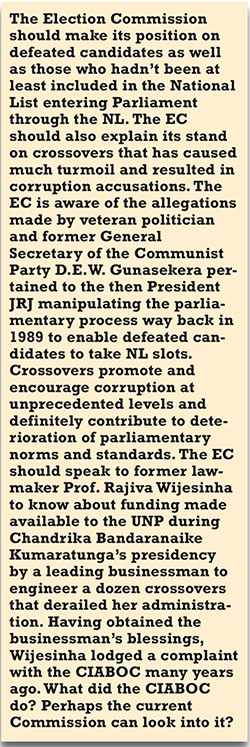
Punchihewa dealt with the EC’s one-year progress since its appointment in terms of the 20th Amendment to the Constitution and the way forward for a better democracy after Saman Sri Ratnayake, Commissioner General of the Election Commission, greeted the invitees. Reference was made to the absence of Opposition Leader and leader of the Samagi Jana Balavegaya (SJB) Sajith Premadasa. SJB members were not seen though the UNP Chairman and former Minister Vajira Abeywardena, attended the event.

Punchihewa, one-time EC’s Director General, Legal, emphasised the urgent need to introduce, what he called, quite a lot of amendments to existing laws to achieve the desired results. Attorney General Sanjay Rajaratnam, PC, was among the invitees. Perhaps, the EC should have invited Auditor General W.P.C. Wickramaratne, whose officers have, over the years, exposed how lawmakers, Secretaries to the Ministries, senior officials and some sections of the public sector, caused the revenue losses to the government, running into billions of rupees.

Education Minister Dinesh Gunawardena recently acknowledged, at the Public Petitions Committee, the failure on their part to implement recommendations of parliamentary watchdog committees. Chairman of the Committee on Public Enterprises (COPE) Prof. Charitha Herath, too, has on several occasions pointed out lapses in the law contributed to the deterioration of public finances. But, the powers that be have chosen to turn a blind eye.

In a way, Punchihewa’s statement is nothing but condemnation of the utterly corrupt political party system that has ruined the country. But, the EC should also work closely with the Auditor General, if the Commission is seriously interested in, the much-touted ‘system change.’ Corruption has become a way of public life with the Parliament, responsible for enactment of new laws and ensuring financial discipline, has pathetically failed in its responsibilities. The situation is so bad and appears to be out of control, the Parliament has become a mere spectator as the parliamentary system of governance continues to promote waste, corruption and irregularities by not taking remedial measures. The reports issued by the Committee on Public Enterprises (COPE), the Committee on Public Accounts (COPA) and the Committee on Public Finance (COPF) reveal corruption at every level.

The event at Galadari could have been held without high tea as well as wholly unnecessary dance performances at a time the vast majority of voters, regardless of the candidate and the party they voted for at the last presidential and parliamentary elections in Nov 2019 and Aug 2020, respectively, were struggling to make ends meet.

Although 15 political parties/groups represented the current Parliament, only a few were present on the occasion. The Sri Lanka Freedom Party (SLFP), the Janatha Vimukthi Peramuna (JVP), the Tamil National Alliance (TNA) as well as the Sri Lanka Muslim Congress (SLMC) were very conspicuous by their absence. General Secretary of the Democratic Left Front and Water Supply Minister Vasudeva Nanayakkara, in spite of breaking ranks with the government over the SLPP’s economic policy, sat with SLPP leaders whereas his rebellious former ministerial colleagues, Wimal Weerawansa and Udaya Gammanpila too were notable absentees. Nanayakkara along with Weerawansa and Gammanpila backed the fundamental rights petitions against the Yugadanavi deal (sale of 40 percent of Treasury owned shares of the power station to the US-based New Fortress Energy along with the controversial move to hand over a monopolistic position on supplying of LNG). The Supreme Court, however, dismissed the petitions. The SC didn’t give an order but stated the submissions were considered and leave to proceed refused. The SC didn’t give reasons at all though the case was heard for several days. When making submissions AG Rajaratnam said that the court should maintain harmony with the executive.

It would be pertinent to recall the devastating accident at an insecticide plant in India in the 80s.

On December 3, 1984, about 45 tonness of the dangerous gas methyl isocyanate escaped from an insecticide plant that was owned by the Indian subsidiary of the American firm Union Carbide Corporation. The gas drifted over the densely populated neighbourhoods around the plant, killing thousands of people immediately and creating panic as tens of thousands of others attempted to flee the area. The final death toll was estimated to be between 15,000 and 20,000. Some half a million survivors suffered respiratory problems, eye irritation or blindness, and other maladies, resulting from exposure to the toxic gas; many were awarded compensation of a few hundred dollars

(Britannica). And for some inexplicable reasons the Indian Supreme Court upheld that pittance of a compensation package! Indian Chief Justice at the time P.N. Bhagawati, when he came to Sri Lanka as a champion of peace about a decade ago, a cheeky Lankan journalist asked him about that controversial decision of the Indian Supreme Court and he got virtually tongue tied and avoided answering the question.

A House in turmoil

Can political chaos be addressed through electoral reforms and constitutional amendments? Has the EC really examined the current crisis and how political uncertainty, in addition to waste, corruption and irregularities, contributed to the overall deterioration of the country’s financial status and unprecedented instability.
A few hours after the end of the National Voters’ day celebration, the government announced an inevitable increase in diesel and petrol prices. It would be pertinent to mention that India, too, now exercise the right to intervene here by way of revising fuel prices. Lanka India Oil Company (LIOC) that set up base here in 2003, is affiliated to Indian Oil Corporation Limited that comes under the purview of its Ministry of Petroleum and Natural Gas.

One-time distinguished career diplomat Hardeep Singh Puri, who had served the Indian High Commission in Colombo during the volatile1984-1988 period when Indian-trained terrorists waged war against Sri Lanka, is India’s Minister of Petroleum and Natural Gas and Housing and Urban Affairs. Rightly or wrongly he was then suspected to be involved in much more than diplomacy by especially those who saw how he and his wife lobbied certain key journalists behind the scene and the clout they wielded.

On March 10, the day LIOC announced staggering price increases in petrol and diesel that caused turmoil here, Sri Lanka’s High Commissioner in New Delhi Milinda Moragoda met Minister Puri. The meeting took place at the Ministry of Urban Affairs in New Delhi. Let me reproduce a statement verbatim issued by the Sri Lankan High Commission in New Delhi following the meeting between Moragoda and Puri: “At the outset, High Commissioner Moragoda thanked Minister Puri for the assistance that India has provided to Sri Lanka as envisaged under the four-pillars of cooperation, agreed during the visit of Sri Lankan Finance Minister Basil Rajapaksa to India in December last year, in particular the USD 500 million line of credit to purchase petroleum products. Additional assistance, too, has been provided by India to enhance Sri Lanka’s petroleum stocks.

“High Commissioner Milinda Moragoda also briefed Minister Puri on the challenges that Sri Lanka is currently facing as regards to the supply and distribution of petroleum products and their impact on the Country’s energy sector. The High Commissioner and the Minister discussed modalities through which India and Sri Lanka could further expand cooperation in the petroleum sector to help overcome the present crisis.

The discussion also focused on a range of issues pertaining to the energy sector, including ways and means through which Sri Lanka could establish long-term strategic ties in the petroleum, oil, gas and related logistics sectors.”

The Government increased fuel prices at midnight on March 11 following LIOC price revisions on Feb 06, 24 and March 10 that resulted in the sharpest difference in retail price of a litre of petrol and diesel at LIOC and Ceypetco service stations, Rs 92 and Rs 77, respectively. The bottom line is that Sri Lanka’s pricing formula is in the hands of India.

That is the unpalatable truth. Obviously, there is no mechanism to ensure that upward or downward revisions of fuel prices are decided through consultations. Instead, a foreign power can take that decision on our behalf. In other words, Sri Lanka’s Energy Minister is actually former High Commission staffer Puri.

How can EC ensure political parties do not follow agendas inimical to Sri Lanka’s national interests? Recent high profile but unsubstantiated accusations that had been directed at Finance Minister Basil Rajapaksa over him pursuing a pro-American agenda are a matter for concern.

President Gotabaya Rajapaksa removed Jathika Nidahas Peramuna (JNP) leader Wimal Weerawansa and Pivithuru Hela Urumaya (PHU) leader Udaya Gammanpila from Industries and Energy portfolios, respectively, following their clash with Basil Rajapaksa, who is also the founder of the SLPP. The political turmoil has taken a new turn with the SJB stepping up attacks on Basil Rajapaksa in Parliament.

The Opposition repeatedly questioned Speaker Mahinda Yapa Abeywardena over Basil Rajapaksa remaining mum in Parliament over the rapid deterioration of the economy. The failure on the part of political parties represented in Parliament to reach a consensus on national response to the current crisis is evidenced by the plight of the electorate. Instead, a sharply divided government has allowed the deterioration by refusing to take remedial measures.

The Opposition has sought to exploit the situation to its advantage whereas a section of the parliamentarians, including some of those accommodated on the SLPP National List, angered the top SLPP leadership by presenting an alternative set of proposals meant to restore the devastated economy.

The EC cannot afford to turn a blind eye to the utter chaos in Parliament and outside for want of a national response at a time of unprecedented crisis.

EC on key issues

The EC comprised five persons, namely Nimal Punchihewa, S.B. Divaratne, K.P.P. Pathirana, M.M. Mohammed and P.S.M. Charles, the only lady in the outfit. The EC has made representations to the Parliamentary Select Committee (PSC) on electoral reforms as well as the nine-member Committee, headed by Romesh de Silva, PC. The EC representations dealt with electoral reforms and constitutional reforms, respectively. The writer would like to briefly discuss the touchy issue of the need to reduce the number of registered political parties and the proposal to recall those who pursue strategies contrary to the pledges they made at the election and in the printed manifestos of the respective political parties.

Having asserted that the country cannot afford to continue with 76 registered political parties, the EC has proposed ways and means to reduce that number. Examination of EC’s proposals submitted to the PSC and Romesh de Silva’s committee proves how unsatisfying the current situation is.

A sensible Parliament will certainly give serious consideration to EC’s proposals. Nothing can be as important as the proposal to recall lawmakers if they stepped out of line. Will leaders of political parties have the strength to accept the proposal to establish a mechanism to remove MPs?

The recent dismissal of charges in respect of the Treasury bond scam perpetrated on March 29, 2016, by the Colombo High Court Trial-at-Bar due to the flawed indictments raised many eyebrows. Yahapalana Finance Minister Ravi Karunanayake has been among those who benefited as a result of the AG’s lapse. The indictments had been filed during Dappula de Livera, PC’s tenure as the AG. Sanjay Rajaratnam succeeded de Livera in May last year.

The Trial-at-Bar comprising Damith Thotawatte (Chairman), Manjula Thilakaratne and M. Izzadeen by a majority decision dismissed the relevant charges.

Can anyone explain the circumstances under which the indictment had been filed against the Perpetual Treasuries Limited (PTL) contrary to the Public Property Act? The AG’s Department cannot be unaware that in terms of the Public Property Act indictments can be filed only against individuals.

The Trial-at-Bar ruling should be examined against the backdrop of the AG and the Commission to Investigate Allegations of Bribery or Corruption (CIABOC) withdrawing as much as over 50 cases since the last presidential election, in addition to the cases dismissed by various courts.

The AG as well as the CIABOC owed explanation as to how so many cases failed to achieve desired results or were withdrawn under controversial circumstances. The Bar Association of Sri Lanka (BASL) and the civil society should raise these issues. Can BASL and civil society remain silent as the situation continues to deteriorate?

Tuesday, 8 March 2022

War in Ukraine: US Indo-Pacific strategy suffers as India skips several votes

 SPECIAL REPORT : Part 410

Published


…bid to isolate China fails

By Shamindra Ferdinando

Washington’s emerging Indo-Pacific strategy suffered a destructive setback in the wake of the Russian invasion of Ukraine, one of the constituent republics of the former Soviet Union.

India’s decision not to back the US-led efforts, inside the UN and outside against Russia must have surprised the Western powers.

Russian President Vladimir Vladimirovich Putin ordered the offensive on February 24, just four days before the Geneva-based United Nations Human Rights Council was to meet. The Russian offensive dominated the 49th sessions of the UNHRC, where, among the issues that had been taken up, was Sri Lanka’s alleged accountability issue.

Ironically UNHRC Chief Michelle Bachelet has turned down a Nelsonian eye to all those horrific crimes that were committed by the West in Iraq, Libya, Afghanistan, Syria, etc.. Then what about continuing unimaginable terror tactics, employed against civilians, in places like Yemen and Palestine? What are all these bleeding heart ‘independent’ Western media, liberals, I/NGOs, saying about such horrendous crimes? Next to nothing! But see how they feel for Ukrainians-always in a virtual frenzy!

War is a terrible thing anywhere as only fools and cold blooded Nazi types would wish for such suffering on any living being.

One-time top intelligence officer having been the head of the KGB in the former East Germany when the so-called Iron Curtain of the ex-Soviet Union collapsed in 1989, Putin, President of Russia since 2012, and previously from 2000 until 2008, in addition to being the Premier from 1999 to 2000 opened up a new front at a time the West was trying to finish off China by cornering and luring it into a quagmire over Taiwan the way they are trying to do to Russia over Ukraine. Sri Lanka has been caught up with the conflict between the West and China.

The much disputed yet understandable looking at it from her security perspective, the Russian move in Eastern Europe invariably compelled nuclear powers China, a permanent member of the five-nation UN Security Council and India, to take a common stand on Ukraine. Russia vetoed a UN Security Council resolution on Friday (March 4) that would have technically forced Putin to cease the offensive immediately and withdraw his forces. India and China skipped the vote whereas the Council’s 15 members voted in favour of the text. United Arab Emirates, too, abstained.

In spite of heavy and relentless Western pressure, India didn’t bow to any of it and threw its weight behind the Western move against Russia. The Indian position on Russian offensive, the biggest ever ground action since the end of WW II undermined the four nation Quadrilateral Security Dialogue (QSD) in the Asia-Pacific, aka the Quad, comprising the US, India, Japan and Australia. Meant to counter the growing Chinese political, military and economic power, the Russian invasion is the first real test for Quad. The failure on the part of Quad members to swiftly reach a consensus to oppose the Russian action in Ukraine would demoralise the grouping. That is the undeniable truth.

The Indian stand on Russian offensive should be examined taking into consideration its refusal to deploy ground troops in Iraq in support of the US-UK led 2003 invasion.

India reawakens as to her true friends

Western media coverage of the Indian response highlighted their disbelief and sort of ire as the Russia sustained the offensive. Perhaps the US really believed India would blindly back international sanctions against Russia. Had that happened, the Quad as well as the overall US-UK strategy in the Indo-Pacific region would have been greatly strengthened. It would be pertinent to mention that the US renamed United States Pacific Command (USPACOM) as U.S. Indo-Pacific Command on 30 May 2018. The move underscored the pivotal importance of the US-India alliance in the wake of defence relationship emerging as a major pillar of India-US strategic partnership. The signing of the ‘New Framework for India-U.S. Defence Relations’ in 2005 and the resulting intensification in defence trade, joint exercises, personnel exchanges, collaboration and cooperation in maritime security and counter piracy, and exchanges between each of the three services. The Defence Framework Agreement has been updated and extended for another 10 years in June 2015.
India abstained from three votes at the UN Security Council, two at the UN General Assembly in New York, two at the UNHRC in Geneva, and one at the International Atomic Energy Agency (IAEA) in Vienna.

Modi follows Indira’s stand

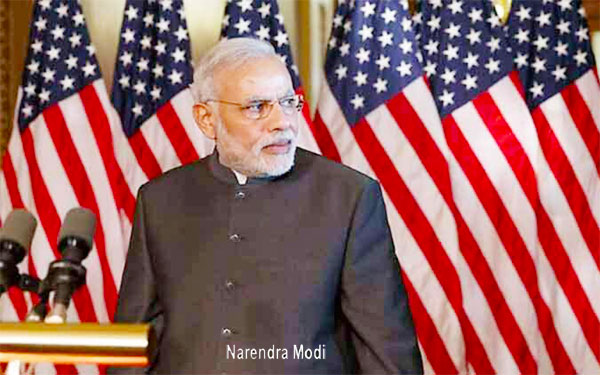
India has no option but to walk a diplomatic tightrope over war in Ukraine as it tried to balance its ties with Russia and the West. The US humiliated Narendra Modi before the whole world with a much publicised denial of visa in 2005, over his alleged role in anti-Muslim violence three years earlier in Gujarat state, where he was the Chief Minister.

More than 1,000 people were killed, mostly Muslims in that riot. The US swiftly changed its stance soon after the Modi-led BJP romped to victory at the 2014 General Election and Washington quickly forgot the Gujarat victims, with the obvious backing of the powerful Israel lobby in America and elsewhere. Israel, surrounded by a sea of enemies, barring the corrupt regimes there beholden to the West sees India as a natural counterbalance because of the almost unbridgeable Hindu-Muslim divide emanating from the time of the Moghul invasion of Bharat. So no wonder Israeli Prime Minister Naftali Bennett was the first world leader to fly to Moscow to appease the situation and it showed how worried ‘the never say die attitude’ state is.

The State Department spokesperson Jen Psaki declared that Modi would get a visa to the US once he took office and forms a government. Modi would be eligible for an A1 visa, said Psaki. She said: “We congratulate Narendra Modi and the BJP on its victory in winning a majority of seats in India’s historic national election, which saw more voters cast their ballots freely and fairly than in any election in human history. Secretary Kerry has also offered his congratulations, and looks forward to working with the BJP on expanding our shared prosperity and security.”

Over the years, the US-India relations reached new heights with India and the US extending nuclear cooperation partnership in late Oct 2020. New Delhi and Washington, in a joint statement issued on Nov 24, 2020, declared that the original agreement that had been signed on Nov 07, 2010 was extended in recognition and appreciation of ‘the strength of the enduring partnership between the two countries on matters of security and reaffirming the important contributions of the US-India nuclear and radiological security cooperation for the benefit of their citizens and the world.’

There is no doubt China is relieved by India’s position. China must have quite rightly ascertained India wouldn’t upset its relationship with Russia by siding with the West. Modi’s stand on the war in Ukraine is very much similar to that of Indira Gandhi as regards the Soviet invasion of Afghanistan in late Dec 1979. That war lasted 10 years. Having failed to achieve its objectives, the Soviet Union ended the disastrous mission in Feb 1989, a year before India terminated its military mission in Sri Lanka’s Northern and Eastern Provinces. India brought its military project to a successful end in March 1990, having compelled the then Sri Lankan government to introduce 13th Amendment to the Constitution in Nov 1987. That objective was achieved at gunpoint.

India’s statement at the interactive session on the OHCHR’s written report on promoting reconciliation, accountability and human rights in Sri Lanka reminded how New Delhi pursued the 80s strategy. India’s Permanent Representative in Geneva Ambassador Indra Mani Pande declared: “We will continue to urge the Sri Lankan Government for the early conduct of elections to the Provincial Councils in keeping with its commitment to devolution of power.”

The late J.N. Dixit, in his memoirs ‘Makers of India’s Foreign Policy’ discussed India’s response to the Soviet invasion of Afghanistan and their military intervention in Sri Lanka. Having referred to its their disastrous 1962 war with China, the triumph over Pakistan nine years later and achieving much desired nuclear capability in 1998, Dixit, one-time Indian High Commissioner in Colombo (1985-1989) commented on policy decisions on Afghanistan and Sri Lanka. It would be better to read verbatim what Dixit, who also served as National Security Advisor said about Indira Gandhi. The comment should be examined against the backdrop of India’s refusal to join the anti-Russia camp. Had that happened, China, would have found itself in much more complicated and difficult situation over the Russian adventure in Ukraine.

Dixit stated: “She (Indira Gandhi) redefined the ideology of nonalignment more preciously in terms of the interests of the developing countries. The two foreign policy decisions on which she could be faulted are: her ambiguous response to the Russian intrusion into Afghanistan and her giving active support to Sri Lankan Tamil militants. Whatever the criticisms about these decisions, it cannot be denied that she took them on the basis of her assessments about India’s national interests. Her logic was that she could not openly alienate the former Soviet Union when India was so dependent on that country for defence supplies and technologies. Similarly, she could not afford the emergence of Tamil separatism in India by refusing to support the aspirations of Sri Lankan Tamils. These aspirations were legitimate in the context of nearly 50 years of Sinhalese discrimination against Sri Lankan Tamils.

In both cases, her decisions were relevant at the point of time they were taken. History will judge her as a political leader who safeguarded Indian national interests with determination and farsightedness.”

Obviously, Modi felt the same way as the late Indira Gandhi did when he came under tremendous pressure to abandon Russia. New Delhi must have weighed how their stand on the Ukraine war affected common front against China.

Some have questioned India’s strategy. Commentators and analysts have raised questions, particularly in the West, over whether the world’s largest democracy should have backed the West. But, India, as a mature democracy has taken a principled stand. Some interpreted New Delhi’s first statement at the UN Security Council that regretted repeated calls from the international community to give diplomacy and dialogue a chance had not been heeded. But, at the end India skipped votes on Ukraine much to the dismay of the US.

Among those who abstained along with India and China were Pakistan, Vietnam, South Africa, Sri Lanka, Iran, Iraq, Cuba and Bangladesh. Altogether 35 countries abstained not because they endorsed the Russian aggression but didn’t want to back a coalition that was responsible for millions of deaths in various regions of the world. The 2003 US-UK led invasion of Iraq on the false pretext of searching for Weapons of Mass Destruction (WMDs) exposed the duplicity of those countries preaching to other nations about accountability.

It would be pertinent to ask whether those countries which staged a walk out last week as the Russian Foreign Minister Sergei Lavrov was addressing the UN in Geneva felt the same way when Western powers invaded Iraq. Some sections of the media quoted Ukrainian Ambassador in Geneva, Yevheniia Filipenko, who led the walkout at UNHRC as having thanked those who took part in the stunt. The Ambassador is right. It is nothing but a stunt as the then US Ambassador Nikki Haley in June 2018 called it a cesspool of political bias.

Lanka takes another beating at Geneva sessions

The Geneva agenda made further progress at the ongoing sessions overshadowed by the war in Ukraine. The Sri Lankan delegation to Geneva comprised Foreign Minister Prof. G.L. Peiris, Justice Minister Ali Sabry, PC, Foreign Secretary Admiral (retd) Jayanath Colombage. The delegation joined Sri Lanka’s Permanent Representative there, one-time The Island political correspondent C.A. Chandraprema.

Prof. Peiris, bitterly complained about the way the UNHRC has treated Sri Lanka and pursued a strategy severely inimical to the country. The Foreign Ministry quoted Prof. Peiris as having said: “In March 2021, the Council voted on Resolution 46/1 which was tabled without the consent of Sri Lanka as the country concerned. The consideration of this matter polarised and politicised this forum. In a startling departure from the mandate which the UN General Assembly originally conferred on this Council, operative paragraph 6 of this resolution refers to a so-called evidence-gathering mechanism, a measure that was strongly opposed by a number of countries. Such initiatives create disharmony both in the domestic and international arenas. It creates obstacles to reconciliation efforts, breeds hatred by reopening past wounds, and polarises society.”

However, Geneva repeated the same old accusations against the backdrop of Sri Lanka’s pathetic failure at least to set the record straight.

Daya Gamage, one-time US State Department employee and the author of ‘Tamil Tigers’ Debt to America: US Foreign Policy Adventurism and Sri Lanka’s Dilemma’ strongly condemned Sri Lanka’s response to the Geneva threat. In comments posted online, Gamage questioned the failure on the part of the Sri Lankan government, at least to remind Geneva how now vanquished Liberation Tigers of Tamil Eelam (LTTE) expelled the entire Muslim community from Sri Lanka’s Northern Province in Oct/Nov 1990, just a few months after India pulled out its troops from Sri Lanka. Gamage stressed that the expulsion of Muslims should have been dealt with as Sri Lanka was being accused of perpetrating genocide. The former US Embassy employee in Colombo said: “Anyone who reads the interpretation of ‘genocide’ in the UN Charter and other scholarly works can know what genocide means.”

The UK-led Sri Lanka Core Group comprising Canada, Germany, North Macedonia, Malawi and Montenegro continued its despicable strategy of persecution of this country for defeating the world’s “most ruthless terrorist organisation” against their sinister advice. That lot voted against Russia over the continuing war in Ukraine but didn’t find fault with the invasion of Iraq or military action against several other countries in the past. Canada recently unearthed hard evidence of genocide and other calculated human rights violations against its indigenous population plays a major role in the project to undermine Sri Lanka.

Sri Lanka’s failure to challenge the very basis of unsubstantiated war crimes allegations in spite of Lord Naseby providing the required ammunition in Oct 2017 along with a significant US military statement (Lt. Colonel Lawrence Smith, US Defence Advisor, Colombo) in June 2011, over two years after the successful conclusion of the war is a point to ponder. Can there be an excuse for continuously failing to set the record straight in Geneva and New York. What prevents Sri Lanka from making a reference to Indian intervention at least on the basis of what Dixit stated in his widely read memoirs? Why can’t we remind the world Geneva proceeded with a contentious process based on unverified accusations that cannot be examined till 2031? Or point out the vast discrepancy in the number of dead (both civilians and combatants) as reported by the UN Colombo and the disputed Darusman report?

The current dispensation has caused countrywide chaos by extremely poor management of the national economy. There is no doubt the vast majority of people struggling to make ends meet have been deprived of the basic needs. Disruption of both fuel and gas supplies as well as daily countrywide power cuts have jolted the public. Having repeatedly promised a system change, the current government has caused gross human rights violation by depriving all communities of the basic needs. It would be a grave mistake on the part of the government to believe the crisis can be conveniently blamed on the Covid-19 global epidemic.

The Geneva didn’t receive the attention it required in the local media due to the war in Ukraine and unprecedented political crisis caused by sharp differences emerging within the SLPP-led ruling coalition. The rebel group made explosive accusations pertaining to Finance Minister Basil Rajapaksa, who holds Sri Lanka and US dual citizenship, of pursuing a strategy to facilitate Western intervention. The rebel group compared the current situation with that of Indonesia in the 1960s that brought military dictator Suharto to power and resulted in butchering of possibly several hundred thousand innocents suspected of being Communist sympathisers.

Regardless of pompous declarations made, Sri Lanka has been encircled on the Geneva front with so-called evidence-gathering mechanism free to proceed. Perhaps, Sri Lanka should explore the possibility of presenting its case with all available evidence, including now unclassified wartime dispatches from the British High Commission in Colombo with fresh request to the UK as well as other key diplomatic missions to submit their wartime dispatches to the UN evidence gathering mechanism. Sri Lanka never used Wiki leaks revelations for its advantage.

Let me end this piece by reproducing a section of Wikileaks managed to secrete out of US diplomatic cables from Geneva. A cable dated July 15, 2009 signed by the then Geneva-based US Ambassador Clint Williamson cleared the Sri Lankan Army (SLA) of crimes against humanity during the Vanni offensive. The cable addressed to the US State Department was based on a confidential conversation Ambassador Williamson had with the then ICRC head of operations for South Asia, Jacque de Maio on July 9, 2009. Ambassador Williamson wrote: “The army was determined not to let the LTTE escape from its shrinking territory, even though this meant the civilians being kept hostage by the LTTE were at an increasing risk. So, de Maio said, while one could safely say that there were ‘serious, widespread violations of international humanitarian law,’ by the Sri Lankan forces, it didn’t amount to genocide. He could cite examples of where the army had stopped shelling when the ICRC informed them it was killing civilians. In fact, the army actually could have won the military battle faster with higher civilian casualties, yet it chose a slower approach which led to a greater number of Sri Lankan military deaths. He concluded however, by asserting that the GoSL failed to recognise its obligation to protect civilians, despite the approach leading to higher military casualties.”

Wednesday, 2 March 2022

Man arrested in the UK over high-profile Jaffna killing released within 48 hours

 SPECIAL REPORT : Part 409

Published

  
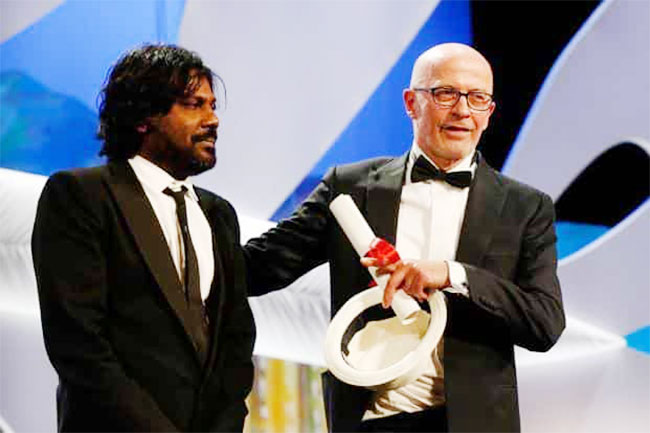
Celebrated French film Director Jacques Audiard with actor Antonythasan Jesuthasan (left). One-time child soldier, Jesuthasan, who has been reported ‘missing’ is perhaps one of the most famed ex-LTTE cadres today.

By Shamindra Ferdinando

The Metropolitan Police Service, UK, has said that a person ,recently arrested in the UK over his alleged involvement in the killing of journalist Mylvaganam Nimalarajan, 39, in his Jaffna home on Oct 19, 2000 is a Sri Lankan national.

Jack Griffith, Press Officer – Specialist Operations at the London Metropolitan Police Service said so in response to the writer’s query whether the 48-year-old suspect is a UK national or a citizen of Lankan origin or a political asylum seeker from Sri Lanka.

The response was received on Feb 25th, the same day The Island posed the question to the Metropolitan Police Service. Appreciating the swift response from the British, it would be pertinent to question the status of the suspect as the Press Officer’s response suggested that the unnamed person hadn’t secured British citizenship yet.

The media, including the Tamil Guardian, on Feb 24th, reported the arrest of the suspect at an address in Northamptonshire on Feb 22. The media quoted the police as having declared the arrest ‘as part of a proactive operation’ and the first arrest made by the UK in connection with war crimes allegedly committed in Sri Lanka. Sri Lanka brought the war to a successful conclusion in May 2009.

The Sri Lankan has been arrested on suspicion of offences under Section 51 of the International Criminal Court Act 2001. “This is a significant update in what is a sensitive, complex investigation,” the media quoted Commander Richard Smith as having declared. Smith leads the Met’s Counter Terrorism Command. However, the British police hadn’t explained how the first suspect, taken into custody in connection with such a high profile probe, could be released within 48 hours, pending further investigations.

In fact, by the time the media reported the arrest on Feb 24, the suspect has been quietly released. Unidentified persons killed Nimalarajan who contributed to the BBC Tamil and Sinhala services, the Tamil daily Virakesari and the now defunct Sinhala weekly Ravaya. The EPDP was accused of killing Nimalarajan, an accusation strongly and repeatedly denied by the political party.

Sooka hails UK action

NGO activist Yasmin Sooka hailed the British action though by the time she issued a statement in this regard the suspect has been freed. Sooka of the International Truth and Justice Project (ITJP), which investigates alleged Sri Lankan war crimes and crimes against humanity declared: “The proactive investigation which led to the arrest demonstrates the commitment of the Metropolitan Police to justice and accountability even 22 years later. Those who kill journalists are not safe anywhere in the world. It is abhorrent that an alleged killer of a BBC journalist should hide in the UK.”

The writer raised the issue at hand with Foreign Secretary retired Admiral Jayanath Colombage over the last weekend. One-time Navy Commander Admiral Colombage said that the Foreign Ministry was following the case. The official indicated that every aspect of the case would be examined.

Had he been involved in the actual killing of Nimalarajan or provided support for the dastardly act in some way? Would he be extradited to Sri Lanka? Or had the UK sought Sri Lanka’s support to conduct the investigation? Had he been a member of the EPDP, or some other Tamil group or perhaps a member of a paramilitary group? At the time of Nimalarajan’s killing, the suspect had been 26 years of age.

Against the backdrop of Sooka expressing disgust at a person responsible for a BBC journalist’s death taking refuge in the UK, wouldn’t it be pertinent to question the status of Adele Balasingham, the Australian-born wife of the late LTTE ideologue Anton Balasingham. One-time British High Commission employee and Virakesari staffer Balasingham, who received and enjoyed the status of a British citizen in spite of being the chief advisor to the proscribed terrorist group passed away in Dec 2006 in the UK. Perhaps ITJP should state its position on Adele Balasingham who had been directly involved with the LTTE and even pictured at terrorist parades handing over cyanide capsules to female LTTE cadres. Perhaps, even Subha and Dhanu, who had been assigned for Rajiv Gandhi’s assassination, received their cyanide capsules from Adele Balasingham in the northern jungles of Sri Lanka. Dhanu carried out the suicide mission on the night of May 21, 1991 at Sriperumbudur, Tamil Nadu. Nearly 60 other innocents perished in the attack.

The recent British police action and the claim of the first arrest in the UK in connection with war crimes should be examined taking into consideration the failure on their part to take action against those promoting terrorism and ex-members of various Sri Lankan terrorist groups (some of them are now in Parliament) given citizenship.

Zooka, who had been a member of the Darusman Panel (Report of the Secretary General’s Panel of Experts on Accountability in Sri Lanka) that accused Sri Lanka of war crimes in March 2011, five years later acknowledged the presence of ex-LTTE cadres in several countries, including the UK. Had there been a specific procedure to accommodate ex-Sri Lankan terrorists beginning with those trained by India?

Had the British treated those who fought for the LTTE differently from the ones that served other groups? The tainted ITJP survey released in June 2016 inadvertently revealed the existence of clandestine networks, facilitating Sri Lankans of Tamil origin, including former members of the LTTE, to reach Europe through illegal means. Did the person, arrested by the Metropolitan Police Service, too, reach the UK through illegal means? The Sri Lanka Foreign Ministry should ask the British to reveal the status of the suspect and most importantly how and when he reached the UK.

The release of the expensive survey, titled ‘Forgotten Sri Lanka’s exiled victims’ by the ITJP, affiliated to the Foundation of Human Rights in South Africa, coincided with the commencement of 32 sessions of the Geneva-based United Nations Human Rights Council (UNHRC). The much-touted study disclosed that LTTE personnel, including those who had been with Shanmugalingam Sivashankar alias Pottu Amman’s dreaded intelligence service, had secured citizenship in European countries, including the UK. That report was meant to intensify pressure on Sri Lanka on the Geneva UNHRC front, but ended up inadvertently exposing an ugly truth. But, Sri Lanka lacked a cohesive strategy to exploit such lapses.

The report dealt with information obtained from 75 Tamils, living in the UK, France, Switzerland and Norway. Almost all of them had fled Sri Lanka after the conclusion of the war, in May, 2009. The vast majority of interviews had been conducted in the UK. The ITJP claimed that those ex-LTTE cadres, based in Germany, had declined to contribute to the survey.

The architects of the project and their sponsors owed an explanation why those who had taken refuge in India during the conflict and post-conflict period were not included in the project. Actually how many ‘disappeared’ in India having gone there by boat across the Palk Strait and conveniently listed as missing and put on Sri Lanka account over the years?

On the basis of the interviews conducted, with the help of Sri Lankan Tamil interpreters, who had either worked for the UN or other International NGOs, in the Vanni, during Eelam War IV, the report estimated that the vast majority had served various LTTE units. The report named those combat and support units as Radha, Sothiya, Imran Pandiyan and Malathy regiments as well as the Intelligence Wing. The non combat units included the LTTE Media Unit, the TV station, the Political Wing, the Peace Secretariat, the International Secretariat, the Medical Wing, the Transport Unit, the IT division and the Education Section.

New identities for ex-terrorists

The Office of Missing Persons (OMP) should seek the cooperation of foreign governments to establish the whereabouts of those who had been categorised as missing. The Foreign Ministry should check with British authorities to find out whether the 48-year-old person suspected to be involved in the Jaffna journalist’s killing, too, has been categorized as a missing person. Had he been given an opportunity to change his identity? The possibility of Sri Lanka facilitating the suspect’s arrival in the UK, too, cannot be ruled out. It would be pertinent to mention that the UK humiliated Sri Lanka by exposing the issuance of a diplomatic passport to one-time LTTE commander Vinayagamoorthy Muralitharan aka Karuna Amman after he rebelled against the LTTE. At that the time British officials arrested him, Karuna carried an official passport issued to Kokila Dushmantha Gunawardena whose occupation on the passport was given as Director General of Wildlife Conservation. Better known as ‘Colonel’, Karuna was deported in July 2008 to Sri Lanka, having been arrested and detained since Sept 2007. What made Sri Lanka issue a diplomatic passport to Karuna though he played a significant role in the overall strategy against the LTTE?

In spite of the OMP being created in terms of the 2015 Geneva accountability resolution, Western powers haven’t helped Sri Lanka to track down those living overseas under new identities while they remained categorised as ‘missing’ persons generally blamed on Colombo. The contentious issue of missing persons or those disappeared continue to undermine post-war national reconciliation efforts. Unfortunately, successive governments haven’t addressed the issue in earnest without the cooperation of relevant Western countries, who are obviously part of the conspiracy against Sri Lanka. This failure to properly investigate war time disappearances has allowed interested parties to harass the country at international forums and Geneva sessions in particular.

Lord Naseby once questioned the UK’s failure to prosecute Adele Balasingham in spite of the accountability on her part for child and suicide cadre recruitment. The Conservative Party veteran blamed his government for allowing freedom for Adele Balasingham whom he described as an LTTE leader living in the UK.

The recent arrest in the UK of a key suspect in the Nimalarajan killing should prompt Sri Lanka to freshly examine the contentious issues of missing persons and impunity provided to terrorists living overseas. There is no point in denying some excesses on the part of the Sri Lankan military and the police during the nearly 30 year cruel internecine war, as all wars are. There had been reprisals, deaths in custody and extra judicial killings during the conflicts in 1971 (JVP led insurgency), 1987-1999 (the second JVP led insurrection) and 1983-2009 (war in the North and East). However, Sri Lanka hadn’t resorted to genocide or war crimes as alleged by interested parties. It wouldn’t be fair to examine the accountability issue without taking into consideration the Indian military intervention (July 1987 to March 1990) and the period before when India trained armed and deployed thousands of Tamil terrorists in a large scale destabilisation project here to counter JRJ’s obvious pro-Western stance and it was meant to pave the way for the ultimate deployment of the Indian Army here. New Delhi achieved its objective in July 1987. But, by the time, India terminated its military mission here thousands of LTTE terrorists and Tamil civilians perished. Those who demand justice for Tamils are conveniently silent on victims of the Indian military action. Today, no one remembered how a group of PLOTE (People’s Liberation Organisation of Tamil Eelam ) cadres died while fleeing the Maldives in early Nov 1989 following an abortive bid to assassinate the then Maldivian President Gayoom. The Indian Navy sank the vessel commandeered by PLOTE cadres in the high seas.

TNA seeks media attention

The Tamil National Alliance (TNA) at the forefront of the ongoing campaign against the government last week demonstrated opposite the Presidential Secretariat demanding solutions to their grievances. Having recognised the murderous LTTE in 2001 as the sole representative of the Tamil speaking people, the TNA solidly backed its terrorist cause until the very end, thought it today demands justice for the Tamils. The TNA leadership never bothered to issue a public statement in 2009 against the LTTE employing human shields of its own people on the Vanni east battlefield. The Western powers never found fault with the TNA for its despicable role during the war. Throughout the war, the TNA served the LTTE, diligently. In fact, the LTTE-TNA alliance set the stage for the final war by engineering the defeat of Ranil Wickremesinghe at the 2005 presidential election. The rest is history. Years later, Wickremesinghe in his capacity as the yahapalana Prime Minister declared that those who had been categorised as missing were either killed in the battlefield or were living abroad. Unfortunately, even this government never exploited Wickremesinghe’s statement to our advantage.

****

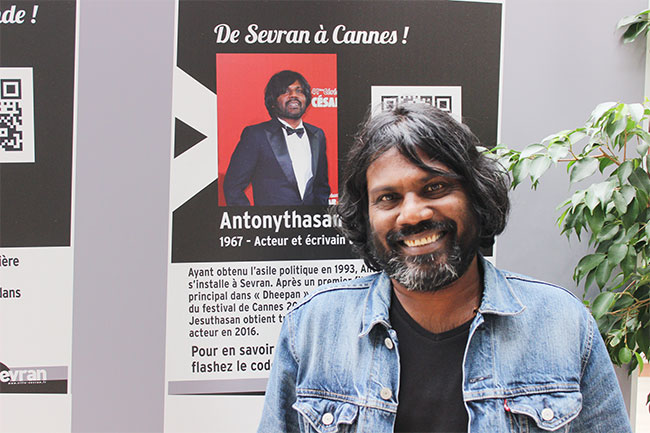
Antonythasan Jesuthasan is perhaps the only ex-LTTE cadre to receive international acclaim as an actor after fleeing Sri Lanka during an early phase of the war. In an interview with Tom Seymour (Dheepan’s Antonythasan Jesuthasan: from Tamil Tiger to star of a Palme d’Or winner in The Guardian) posted online on March 31, 2016, Jesuthasan, perhaps, unwittingly revealed how he deceived the United Nations High Commissioner for Refugees (UNHCR) to secure political asylum. Seymour said that Jesuthasan after having shown him a dense lattice of scars on his forearm declared: “I did those to myself. I was 22, and I had spent years trying to come to the west. I wanted to get a fake French passport, but I had to be accepted as a refugee. I went to the UNHCR [the UN High Commissioner for Refugees], but they wouldn’t believe my story. So I cut myself, and held up my arm, and said to them: ‘Look at my blood. This is my word.” Jesuthasan is just one among thousands who obtained political asylum on false claims. Jesuthasan ended up as the star of Dheepan, directed by Jacques Audiard, possibly France’s most celebrated modern director. There cannot be a better example than Jesuthasan to highlight the web of deceit pertaining to the vast majority of those who successfully secured political asylum. But, Sri Lanka Foreign Ministry never bothered to set the record straight. Born in Allaipiddy, on the Velanaitivu islet, Jesuthasan claimed he fought the Sri Lanka Army in August 1990 and subsequently fled the country and managed to reach France.