Wednesday, 7 July 2021

How former CID Chief Shani ended up in Geneva agenda and clampdown on Ranjan’s tapes


SPECIAL REPORT : Part 375
Published


By Shamindra Ferdinando

Many eyebrows were raised when the Geneva-based UK Mission to the WTO, UN and other International Organizations recently referred to one-time Director of the Criminal Investigation Department (CID) Gnendra Shani Abeysekara.

In a brief statement, dated June 22, 2021, that dealt with Sri Lanka, the UK, on behalf of the literally self-appointed Sri Lanka Core Group (whether we like it or not), comprising Canada, Germany, North Macedonia, Malawi, Montenegro and the UK, demanded the safety of Abeysekara. The grouping told the world: “We call for former CID director Shani Abeysekara’s safety to be ensured.”

The Geneva statement was made ahead of Abeysekara’s retirement. At the time Abeysekara retired on June 30, 2021, he was on bail having been arrested, in July 2020, in connection with the alleged fabrication of evidence against former DIG Vass Gunawardena and several others. The latter group had been arrested over the alleged abduction and killing of Mohammed Shyam, on May 22, 2013. Along with Abeysekara, the Appeal Court bench consisting of Justices Nissanka Bandula Karunaratne and R. Gurusinghe on June 16, 2021 also granted bail to former Sub Inspector of CID Sugath Mendis. Both were subjected to strict bail conditions.

Attorney-at-Law K.W. Janaranjana, the editor of Annidda, has meticulously dealt with the killing of Mohammed Shyam, investigations conducted by Abeysekara, the 2019 change of government, the probe taking a new turn, Abeysekara’s arrest and, finally, the Court of Appeal granting the former CID Director and SI Sugath Mendis bail. The full page article authored by the civil society activist, formerly with Ravaya, carried on its June 27, 2021 edition, is a must read.

The UK-led Core Group addressed the Abeysekara’s arrest, pertaining to the alleged fabrication of evidence. Yahapalana Justice Minister Thalatha Atukorale, too, called for an end to what she called persecution of Abeysekara. The Sri Lanka Core Group wouldn’t have taken up Abeysekara’s case in Geneva without being pushed by the Colombo-based civil society group. There had never been such a Western intervention on behalf of a law enforcement officer here, though there were intrusions by individual countries. Switzerland accommodating Abeysekara acolyte Chief Inspector Nishantha Silva and his family in its asylum programme is a case in point. CI Silva, accompanied by his family, left the country just over a week after the 2019 presidential election. Their departure to Switzerland paved the way for those who had been involved in the conspiracy to accuse newly elected President Gotabaya Rajapaksa’s government of abducting local Swiss Embassy employee, Francis Garnier, formerly Sriyalatha Perera.

The London headquartered Amnesty International, in late Nov 2020, expressed concerns over Abeysekara’s safety, in prison, after he was tested Covid-19 positive. According to the AI, the police officer who had been interdicted over alleged fabrication of evidence, in respect of Mohammed Shyam’s case, earned the wrath of the second Rajapaksa government for exposing human rights abuses implicating top politicians.


SC endorses HC ruling

One of the high profile cases, handled by Abeysekara, was the killing of four persons, including former lawmaker Bharatha Lakshman Premachandra, who had been assigned to handle the UPFA trade union activity. The then Attorney General filed 17 indictments against 13 defendants for the murders of Bharatha Lakshman Premachandra, Damitha Darshana Jayathilake, Jalaldeen Mohamed Azeem and Manuel Kumaraswamy, on October 8, 2011, the day of the Local Government Elections, at Himbutana, Angoda. Following an extensive trial, High Court judges Padmini M. Ranawaka and M.T.B.S. Moraes (believed to be in Fiji as a judge) sentenced the defendants to death on Dec 8, 2016. However, the President of the trial-at-bar, Judge Shiran Gooneratne (now in the Supreme Court) disagreed. He acquitted 13 defendants from all charges filed against them whereas Judge Padmini Ranawaka, with Judge M.T.B.S. Moraes, agreeing, acquitted 08 of the 13 defendants from all charges.

At the time of the Himbutana incident, Duminda Silva had been Colombo District lawmaker and Monitoring MP for the Defence Ministry. The other Monitoring MP in that Rajapaksa administration was Sajin Vass Gunawardena, assigned to the Foreign Ministry.

The Supreme Court, on Oct 11, 2018, dismissed an appeal filed by Duminda Silva and the three others. The SC bench comprised five judges. Duminda Silva and the three other accuseds, filed an appeal against the death penalty imposed by the High Court on Dec 8, 2016. At the SC proceedings, the 01st accused, Police Constable Anura Thushara de Mel was acquitted of all charges by the bench consisting of the then Chief Justice Priyasath Dep, Justices Buwaneka Aluvihare, Nalin Perera, Priyantha Jayawardena and Vijith Malalgoda. Thereby the SC reaffirmed the death penalty imposed on Duminda Silva, Srinayake Pathiranage, Chaminda Ravi Jayanath alias Dematagoda Chaminda and Dissanayake Mudiyanselage Sarath Bandara.

However, the releasing of audio tapes of conversations among Abeysekara (he hadn’t been appointed Director CID then), Deputy Minister of Social Empowerment Ranjan Ramanayake, the then High Court judge Mrs. Padmini Ranawaka and President Maithripala Sirisena, in the wake of the 2019 Presidential Election, sent shock waves through political parties, the judiciary, the police and the civil society. Controversy still surrounds the circumstances under which the police received the recordings, secretly made by Ramanayake. Selected tapes were released to both the print and electronic media. Social media prevented efforts to hush up the shocking revelations, pertaining to the Himbutana killings, and the subsequent judgment.

Those in authority conveniently refrained from conducting a proper investigation into the scandalous interventions made by Ramanayake, as well as the conduct of HC judge Mrs. Ranawaka, and Abeysekara, though the police recorded some statements, including that of Mrs. Ranawaka. Parliament, through a statement issued by its Director Department of Communication, Shan Wijetunga, explained its position. That statement dated Feb 7, 2021, based on the decisions taken by the Committee on Parliamentary Business, as regards Ramanayake’s tapes, is reproduced here: “The CDs containing the recorded telephone conversations which were handed over to the Hansard Department of Parliament by MP Ranjan Ramanayake was taken into a lengthy discussion during the Committee on Parliamentary Business held today (Feb. 07, 2021).

 Accordingly, the Committee Members directed Parliament officials to submit the alleged CDs to the Speaker of Parliament, Karu Jayasuriya, to examine matters concerning national prejudice, insults directed at elite persons and words which are inconsistent with Parliament.

The Committee then decided that the Speaker should examine it further and take appropriate action. The decision to table the CDs and give access to the MPs was deferred for later consideration.”

Parliament never released the CDs. Karu Jayasuriya’s recent call to grant presidential pardon to Ramanayake should be examined against the backdrop of how Parliament responded to the disturbing revelations and the suppression of CDs.


Meeting press outside Temple Trees

Ramanayake got into trouble for a statement he made outside Temple Trees, on August 21, 2017, following a parliamentary group meeting of the then ruling party. A simmering controversy erupted over the leaked tapes in the wake of the Supreme Court sentencing Ramanayake on January 12, 2021. A three-judge bench, comprising Justices Sisira de Abrew, Vijith Malalgoda and Preethi Padman Surasena, sentenced Ramanayake to four years rigorous imprisonment after convicting him of contempt of court. The Attorney General filed the case following a complaint filed in the Supreme Court by Ranawaka Sunil Perera of 43/11, Walawwatta Road, Gangodawila, Nugegoda. The case has been in terms of Article 105(3) of the Constitution.
Ranawaka Sunil Perera moved the Supreme Court on the day after Ramanayake accused lawyers and judges of being corrupt.

Rasika Dissanayake, with Sandun Senadhipathi, appeared for the petitioner, on the instructions of Sanath Wijewardena, whereas Tamil National Alliance lawmaker M.A. Sumanthiran, PC, with Viran Corea and J.C. Thambiah, appeared for the respondent on the instructions of D. Vithanapathirana. Sarath Jayamanne PC ASG, with Suharshi Herath SSC, represented the Attorney-General.

But, interventions made by Ramanayake, throughout 2016, in respect of judgment in the Himbutana killings, had never been properly investigated, though Parliament, and the police, received the tapes well over a year ago. The bottom line is that the appalling disclosures in audio tapes had never been subjected to judicial proceedings.

Now Karu Jayasuriya, in his new capacity as the Chairperson of the NMSJ (National Movement for Social Justice), pioneered by the late Ven Maduluwawe Sobitha wants President Gotabaya Rajapaksa to pardon Ranjan Ramanayake, the way he freed Duminda Silva. Following the last parliamentary election, in August 2020, Prof Sarath Wijesuriya gave up the NMSJ leadership for Jayasuriya’s entry. Those who are genuinely interested in good governance and accountability should listen to those tapes and take tangible measures to conduct a thorough investigation into the whole affair. The conversations involving Abeysekara and Ramanayake, President Sirisena, Ramanayake and Judge Mrs. Ranawaka depict a pathetic situation.

Before the writer dealt with the leaked conversations, it would be pertinent to mention that Abeysekara received promotion to the rank of SSP on August 8, 2016, and appointed as Director, CID, in the first week of Sept 2017. Abeysekara served as CID Director till he received a transfer, on Nov 21, 2019, as Personal Assistant to DIG, Galle.

Did Ramanayake speak to High Court Judge Mrs. Ranawaka to influence the murder conviction against Duminda Silva, sans permission from the party leadership? Did the then top UNP leadership ask him to approach judges in respect of various cases? Ramanayaka is also on record phoning High Court judge Gihan Pilapitiya and Magistrate Dhammika Hemapala. Following the disclosure of a fraction of the tapes secretly recorded by Ramanayake, the police compiled statements from Mrs. Ranawaka (retired), Pilapitiya and Hemapala. Let me focus on the conversations involving Mrs. Ranawaka, Ramanayake, Abeysekara and President Sirisena (now SLPP Polonnaruwa district MP. Sirisena remains the SLFP leader).


How Prez’s intervention
sought for promotion

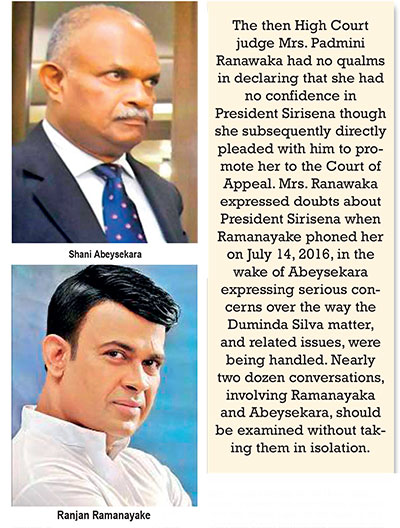
Mrs. Ranawaka had no qualms in declaring that she had no confidence in President Sirisena though she subsequently directly pleaded with him to promote her to the Court of Appeal. Mrs. Ranawaka expressed doubts about President Sirisena when Ramanayake phoned her on July 14, 2016, in the wake of Abeysekara expressing serious concerns over the way the Duminda Silva matter, and related issues, were being handled. Nearly two dozen conversations, involving Ramanayaka and Abeysekara, should be examined without taking them in isolation. According to conversations now in public domain, Mrs Ranawaka asked Ramanayaka to intervene on her behalf when the latter pressed her on the pending judgment on the Himbutana killings. The judge also made reference to the then lawmaker and Attorney-at-Law Ajith P. Perera during her conversation, initiated by Ramanayake. The way the conversation continued, clearly indicated that the call taken by Ramanayake, on July 14, 2016, couldn’t have been the first and they knew each other very well.  Mrs. Ranawaka, obviously exploited Ramanayake’s intervention to explore the possibility of moving up the ladder with unbridled political patronage.

Let me stress that Ramanayake didn’t mince his words when he repeatedly sought assurances from Mrs Ranawaka and Abeysekara, in separate conversations, whether they were sure of a guilty verdict in respect of the Himbutana killings. Abeysekara repeatedly assured Ramanayake he was convinced of a guilty verdict. At one point, Abeysekara declared all three judges would take a common stand. Abeysekara had been so confident of the impending ruling, at one point he assured Ramanayake that he was 10,000 percent sure of the verdict. Abeysekara warned Ramanayake of dire consequences if he made any further direct interventions, particularly with Mrs. Ranawaka.

 Abeysekara, however, pointed out to Ramanayake that calling Mrs Ranawaka was nothing but a mistake but he cut a sorry figure by pleading with the UNP Deputy Minister not to discuss the issue at hand with anyone, including President Sirisena. Ramanayake ignored Abeysekara’s advice.

After the three-member bench delivered judgment on the Himbutana killings, Ramanayake, on Sept 12, 2017, arranged for President Sirisena to talk with Mrs. Ranawaka. She unashamedly sought President Sirisena’s intervention to secure a promotion to the Court of Appeal. Having repeatedly assured good governance and accountability, the yahapalana grandees caused unprecedented turmoil. In the absence of a proper inquiry at any level, Ramanayake’s interventions in judicial matters were never dealt with.

In spite of Ramanayake’s deplorable conduct, the Samagi Jana Balavegaya (SJB), the breakaway faction of the UNP, had no misgivings in accommodating him on its Gampaha District list at the August 2020 General Election. The SJB cannot absolve itself of the UNP’s culpabilities, ranging from Treasury bond scams, perpetrated in Feb 2015 and March 2016, to failure to prevent the 2019 Easter Sunday attacks, despite being forewarned with precise intelligence.

Former Speaker Karunaratne Jayasuriya, despite always being clad in immaculate lily white national attire, like most shrewd politicians, however failed to inquire into Ramanayake’s sordid vigilante type justice. What we should understand is that he is foremost a politician. Jayasuriya, one-time UNP Deputy Leader and a member of the 2015 UNP parliamentary group, was named the Speaker, therefore his actions/failures can be explained. However, the pathetic failure on the part of the SLPP to initiate an inquiry into the Ramanayake affair, nearly a year after the last general election, is an indication of the utterly irresponsible Parliament, where many a backroom deal is made.

All parties represented in Parliament, particularly the SLPP, and the SJB, with nearly 200 lawmakers in Parliament should take a clear stand on political interventions in judgments. Whatever the shortcomings, those drafting a new Constitution, at a great cost to the taxpayer, should do away with constitutional provisions in respect of presidential pardons and formulate a mechanism for judicial review of previous rulings in case of the emergence of fresh evidence. Presidential pardon shouldn’t be a ‘tool’ available for the executive, under any circumstances. Political parties should reach a consensus on the need to abolish the presidential pardon, as such powers make a mockery of democracy.  

But, in the so-called greatest democracy, the USA, even if we leave aside the erratic and unscrupulous behaviour of President Trump and take for example the actions of President Obama, one of the darlings of the liberal media there, he pardoned nearly 2000 felons before he left office At least in the local instance of Duminda Silva, the presidential pardon managed to undo a grave injustice to a man, who was shot first in the head. So the President overturning his murder conviction for the other killings that took place after he was incapacitated, amidst shenanigans involving Ranjan Ramanayake, Shani Abeysekara and Judge Padmini Ranawaka, was the right thing to do.

 The government should go for a thorough inquiry into Ramanayake’s tapes. Let us hope Parliament, without further delay, makes all tapes available to its members and takes tangible measures to facilitate no holds barred investigations. The way Abeysekara used Ramanayake to target Brigadier Suresh Salley of the Directorate of Military Intelligence (DMI) is evidence how all stakeholders exploited various situations to their advantage. Abeysekara wanted Ramanayake to set the stage for Salley’s removal. Whatever the circumstances, the then Premier Wickremesinghe unceremoniously removed Salley.

Perhaps, the Foreign Ministry should make available certified translations of all available telephone conversations among former High Court judge Padmini Ranawaka, retired SSP Shani Abeysekara, former lawmaker Ranjan Ramanayake and former President Maithripala Sirisena to members of Sri Lanka Core Group. The Foreign Ministry should seriously consider briefing the Core Group members, particularly the UK, Canada and Germany, to prevent them from further exploiting Abeysekara’s case.

Tuesday, 29 June 2021

Deafening silence of vociferous diplomatic community

SPECIAL REPORT : Part 374

Published


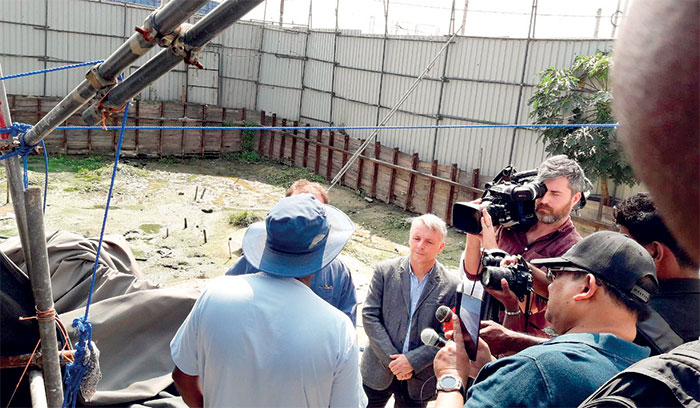
German Ambassador Jorn Rohde accompanied by both local and foreign journalists at the Mannar mass graves site


By Shamindra Ferdinando

Sri Lanka is ‘blessed’ with a very vocal section of the diplomatic community. Those who represent this grouping work overtime on domestic issues. During the conflict, they did their best to throw a lifeline to the Liberation Tigers of Tamil Eelam (LTTE) when it was literally gasping for its last breath. They stepped up their efforts in the post-war period.

Sri Lanka lacked a workable strategy to deal with growing external interventions. This grouping worked through some political parties, a section of the civil society groups, and the media. They intervened in a spate of issues, ranging from the disappearance of NGO activist Kathiravel Thayapararajah, in Sept 2009, to safety and security of one-time Director of the Criminal Investigation Department (CID) Shani Abeysekera.

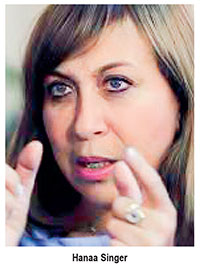
The grouping backed any issue that facilitated its overall strategy to tarnish the country for defeating the world’s most ruthless terrorist outfit by their own reckoning. The grouping never forgave the Rajapaksas for bringing the war against the LTTE to a successful conclusion, in May 2009. The UN has been deeply involved in the high profile politically-motivated operation. There cannot be a better example than UN Resident Coordinator Hanaa Singer’s intervention in the simmering issue of cremation of Muslim victims of the raging Covid-19 epidemic.

Singer, in a letter dated Nov 12, 2020, addressed to Prime Minister Mahinda Rajapaksa, pressed the government to end the cremation of all Covid-19 victims. The controversial letter, also copied to Foreign Minister Dinesh Gunawardena, Justice Minister Ali Sabry, PC, and Health Minister Pavithradevi Wanniarachchi, challenged the disposal through cremation the bodies of those who died of the Covid-19 infection. Singer backed UN intervention on the basis of a plethora of requests from the Muslim community, as well as others.

Singer faulted Sri Lanka for what she called a discriminatory policy adopted as regards disposal of bodies.

A section of the media received the Colombo-based UN head’s letter hours after it was delivered to Offices of the Prime Minister and Foreign, Justice and Health ministers. Who released Singer’s letter? Did the UN Resident Coordinator’s Office make the letter available to the media? Or did the PM’s Office, or did the ministers, Gunawardena, Sabry or Wanniarachchi release it? Who benefitted from the public getting to know the UN intervention in purely a domestic matter? The story received significant international media coverage. Interested parties felt the issue could be quite useful at the March 2021 sessions at the Geneva-based United Nations Human Rights Council (UNHRC) sessions to further hammer the country.

The UN Resident Coordinator’s push to end mandatory cremation here received the backing of three members of the Sri Lanka Core Group at Geneva. The Sri Lanka Core Group comprises the UK, Canada, Germany, North Macedonia, Malawi and Montenegro. Can one imagine a justifiable reason for North Macedonia, Malawi and Montenegro to be part of the Sri Lanka Core Group except to serve as lackeys of the West? The UK, Canada and Germany backed the moves to end mandatory cremation. They exploited the issue to the hilt. Those who cannot stomach Sri Lanka’s triumph over terrorism always sought to isolate the country’s wartime leadership. But, they didn’t have an issue with the war-winning Army Chief General Sarath Fonseka as he had succumbed to political maneuvering that paved the way for the Sinha Regiment veteran to challenge President Mahinda Rajapaksa at the January 2010 presidential election, the first major national poll, after the near three-decade old war ended. Fonseka lost by a staggering 1.8mn votes.

So, it’s no wonder that one of the first things that the Iraqi rebellion did after the Western-led invasion of that country was to blow up the whole UN compound in Baghdad for the sordid role the world body played in building up a bogus case against Iraq of there being weapons of mass destruction in that country, on which the US-led invasion there took place.


Core Group worried over Easter

Sunday suspect

 At the behest of diplomatic missions in Colombo, the UK, at the ongoing 47th Geneva sessions, on June 22, 2021, on behalf of Sri Lanka Core Group raised the following issues. The grouping (1)stressed former CID Director Shani Abeysekera’s safety and security (2) plight of human rights lawyer Hejaaz Hizbullah (3)continuing restrictions on memorialization (4) declared support for the Bar Association of Sri Lanka as regards the need for an independent and impartial investigation into recent deaths in police custody.

Let me, first of all, appreciate the Sri Lanka Core Group taking a tough stand on deaths in police custody. The government should be embarrassed over continuing deaths in police custody. The Human Rights Commission of Sri Lanka and the Bar Association of Sri Lanka issued strong statements demanding an end to extra judicial killings. The police should be held accountable for such killings and Parliament cannot absolve itself of the responsibility for police ‘executions’. The SLPP government owes an explanation why tangible measures haven’t been taken to end police killings.

The Sri Lanka Core Group statement conveniently refrained from mentioning that Attorney-at-Law Hejaaz Hizbullah had been held under the Prevention of Terrorism Act (PTA) in connection with the 2019 Easter Sunday attacks which claimed the lives of 270 men, women and children and caused injuries to 500 other totally innocent folks. Among the dead and the wounded were several dozens of foreigners. The Sri Lanka Core Group also refrained from making any reference to the LTTE when it raised objections to continuing restrictions on memorialization.

The Core Group leader, the UK, and Canada, are home to substantial numbers of Sri Lankan terrorists. One-time British High Commission employee LTTE theoretician Anton Balasingham received British citizenship and lived there, in style, until his death in Dec 2006. Adele Balasingham, who once encouraged young girls to join the LTTE terrorists and publicly tied cyanide capsules round the necks of those girls, lives in the UK while the British HC preaches post-war national reconciliation to us.

The much-touted Canadian stand on the accountability issue in Sri Lanka is nothing but a joke now. The discovery of 600 or more remains of children at the Marieval Indian Residential School, which operated from 1899 to 1997, in the province of Saskatchewan, and last month’s, discovery of some 215 remains, at a similar school in British Columbia, exposed what fake do-gooders they are in a land they plundered from its natives. China raised the issue at the ongoing Geneva sessions. The media exposed the murder of indigenous children in the wake of Canada recognizing genocide in Sri Lanka. Actually, Geneva should call for a comprehensive investigation into Canadian murder of hundreds of native children they had forcefully taken from their families, under a much publicised project to ‘civilise natives’, while Canada is still trying to hoodwink the world with concerns over alleged continuing  human rights abuses in some selected countries, like China and Sri Lanka.

Canadian PM has made a foolish bid to divert attention by requesting Pope Francis to come to Canada to apologise for church-run boarding schools where hundreds of unmarked graves have been found.

It would be pertinent to mention what Jiang Duan, Minister of the Chinese mission to the United Nations in Geneva said about Canada violating human rights of its indigenous people. Duan urged the UNHRC to keep following the human rights issues in the North American country. That statement had been made by China on behalf of a group of countries. The writer is glad that Sri Lanka had been among that group. Canada, home to thousands of ex-Sri Lankan terrorists and their families, continue to harass Sri Lanka at every opportunity, for political reasons. The recent passage of Bill 104 in Canada that recognized genocide in Sri Lanka, exposed Canadian strategy meant to appease Tamil Canadians of Sri Lankan origin with an eye on their huge vote bank.

 Quoting reports, the top Chinese diplomat said over 150,000 indigenous children had been forcibly taken away from their parents and sent to boarding schools during 19th and 20th centuries.

“They were subjected to malnutrition, and many fell victims to abuse and rape. At least 4,000 children died of disease, neglect, accidents or abuse while at schools,” Jiang said, calling for a thorough and impartial investigation into all cases where crimes were committed against the indigenous people, especially children, so as to bring those responsible to justice, and offer full remedy to victims.

“We are also deeply concerned over the illegal killings of civilians by Canadian overseas military servicemen and systemic racial discrimination, xenophobia, Islamophobia within Canada,” Duan noted, adding that Canada has also repeatedly exploited human rights issue as a tool to promote its political agenda.


Oxford AstraZeneca vaccine in short supply

As the writer earlier stressed, a section of the Colombo-based diplomatic community, in a way functions as a partisan and unashamed political grouping. An influential section of the civil society and the media cooperate with the grouping resulting in various issues being taken up. They aggressively addressed Sri Lanka’s policy of cremating bodies of all Covid-19 victims. Those who had accepted and appreciated external interventions on behalf of the Muslim community must have been quite surprised over their silence against the backdrop of nearly 580,000 people so far deprived of AstraZeneca/Covishield booster shot.
Sri Lanka shouldn’t have expected their intervention if they followed diplomatic norms in other matters. But, having fought for the Muslims’ right to bury their Covid-19 dead and expressed concerns over an Easter Sunday terror suspect and defended attempts to politicize war dead, the UN and its partners shouldn’t have remained silent over Sri Lanka being deprived of Oxford AstraZeneca required for the second dose.

Shouldn’t UN Resident Coordinator Singer have at least taken up the matter with New York as nearly 600,000 Sri Lankans faced an increased threat from the deadly Delta variant? Those missions eternally concerned for the wellbeing of Sri Lanka did nothing to facilitate sufficient stock of Oxford AstraZeneca vaccines.

Swiss project

 Civil society groups, too, remained silent in spite of reports of Western powers hoarding vaccines while smaller economies struggled to cope up with the situation. Those who expressed concern over the safety and security of interdicted SSP Abeysekera as well as the wellbeing of Hejaaz Hizbullah, remained quiet about nearly 600,000 deprived of AstraZeneca second dose.

People haven’t forgotten how a high profile Swiss operation meant to embarrass President Gotabaya Rajapaksa went awry in Nov-Dec 2019 in the immediate aftermath of the last presidential election. The Swiss Embassy, in Colombo, went to the extent of trying to evacuate its local employee Garnier Banister Francis, formerly Siriyalatha Perera, and her family, after a swift police investigation exposed the Swiss plot. They had been so hard pressed to prevent the exposure of the blatant lie, a ridiculous attempt was made to drive Francis holed up in the diplomatic mission straight to the Bandaranaike International Airport (BIA) and evacuate her and family in an air ambulance that was kept on standby there. President Gotabaya Rajapaksa personally intervened to thwart the Swiss plot. If they succeeded, the so-called case of Swiss Embassy employee abducted and molested by government agents would have been mentioned in the Sri Lanka Core Group statement issued on June 22 as a gospel truth.

The Swiss intervened with Prime Minister Mahinda Rajapaksa close on the heels of Francis claiming her being abducted near the Embassy. Interested parties staged the embassy drama in the immediate aftermath of Inspector Nishantha Silva of the CID and his family securing political asylum in Switzerland. The fugitive CID officer, too, would have received space in the Core Group’s statement if the Swiss operation succeeded. 

Sarah Newey, GLOBAL HEALTH SECURITY CORRESPONDENT, in a May 12, 2021 report in The Telegraph, titled ‘UK could share 20 pc of doses worldwide and still vaccinate all adults in July, analysis suggests’ discussed the issue at hand against the backdrop of the release of a report by Unicef and Airfinity. A section of the international media dealt with the crisis caused by wealthy ‘hoarding’ vaccine supplies.

Newey reported that the UK could donate 20 percent of its available coronavirus vaccines and remain on track to vaccinate all adults by the end of July, analysis suggested, amidst rising frustrations that wealthy countries hoarded jabs.

 Based on the then supply forecasts, a decision to share a fifth of doses with poorer nations from June would push back Britain’s vaccination timeline by just 10 days, according to analysis by Unicef and the life sciences research facility Airfinity.

 The widespread calls to UK Health Secretary Matt Hancock to resign over the last weekend in the wake of The Sun publishing pictures of Hancock and a colleague, non- executive, director, Department of Health Gina Coladangelo kissing, possibly indicated that he had been too busy to think of sharing a surplus of vaccines.

The Health Secretary was finally forced to quit following The Sun revelation of Hancock and Gina Coladangelo, both married with three children, kissing inside the Department of Health on 6 May.


A bungling administration

 The SLPP government, too, should accept responsibility for the crisis caused by its shortfall of AstraZeneca second jab. The Government Medical Officers Association (GMOA), while demanding an orderly inoculation project, took advantage of its position to ensure a second jab for family members, friends and associates. The secret inoculation project carried out by GMOA members at Galle revealed the mismanagement of the whole operation. The police, too, inoculated outsiders, including journalists who sought the intervention of high ranking Cabinet ministers. The government could have avoided the crisis over AstraZeneca second jab if half of the 1,264,000 jabs received from Serum Institute were used as the first jab. Instead, those at the helm of the vaccination drive inoculated as many as 925,242 persons (first jab during late January-early April 2021). The bungling SLPP government never explained why well over half of available AstraZeneca jabs had been used in the first round and the unpardonable nearly one and half month delay in using Sinopharm.  In spite of China delivering 600,000 jabs on March 30, the government didn’t use them. State Minister Dr. Nalaka Godahewa is on record as having said that the delay in using Sinopharm caused many deaths and aggravated the situation. Actually, the Samagi Jana Balavegaya (SJB) should have moved a no-faith motion against the government over Dr. Godahewa’s admission. But SJB too played politics at every turn. With some of its members earlier proclaiming that Lankans would be used as guinea pigs to test Chinese vaccines. Unfortunately, the pathetic main Opposition didn’t even bother to respond to the State Minister’s shocking admission.

 Recently, the British Parliament was told how the British High Commission in Colombo based its wartime assessment on Sri Lanka on a range of sources, including media and civil society. Let me reproduce a question raised by Lord Naseby and response provided by Lord Goldsmith to underscore the way the BHC, Colombo, gathered information. Lord Naseby on April 21, 2021 asked Her Majesty’s government what sources were used to ascertain the situation in Sri Lanka during the civil war in that country between January 1 and May 18, 2009.

Lord Goldsmith responded on April 29, 2021. The following is the response verbatim: “The UK government’s assessment of the situation in Sri Lanka during the civil war was informed by a broad range of internal and open source reporting, including from our High Commission in Colombo, international organizations, civil society and media.”

It would be interesting to know whether any Colombo based international organizations, civil society and media informed the BHC, Colombo of the AstraZeneca crisis at least after Sri Lanka detected the deadly Delta variant. Even if BHC had alerted the disgraced Health Secretary Hancock, he was probably too busy with Gina Coladangelo even to consider Sri Lanka’s requirement.

How can we forget the way Western embassies played politics with the recovery of skeletal remains from what was called the largest mass grave in Mannar? They blindly blamed the Sri Lankan military. Acting on assertions made by Colombo-based diplomatic missions, the United Nations High Commissioner for Human Rights Michelle Bachelet at the March 2019 sessions faulted the Sri Lankan military over the Mannar mass graves. Geneva was in such a hurry it didn’t even wait for a report from a carbon dating laboratory in the US that subsequently revealed skeletal remains dated back to around 500 years during the European colonial era (1499 to 1719 period.)

The samples were sent to the laboratory after concerns were raised to ascertain if the skeletal remains were of those who were killed during the war between government troops and Tigers which ended in May 2009.

Following the US lab report, Western embassies, one-time LTTE mouthpiece the Tamil National Alliance, the civil society and the media quietly dropped the Mannar issue. Thanks to a US lab report, Mannar mass graves no longer figure in statements issued by the UK-led Sri Lanka Core Group.


Tuesday, 22 June 2021

Significance of CPC-HIPG MoU

 SPECIAL REPORT : Part 373

Published


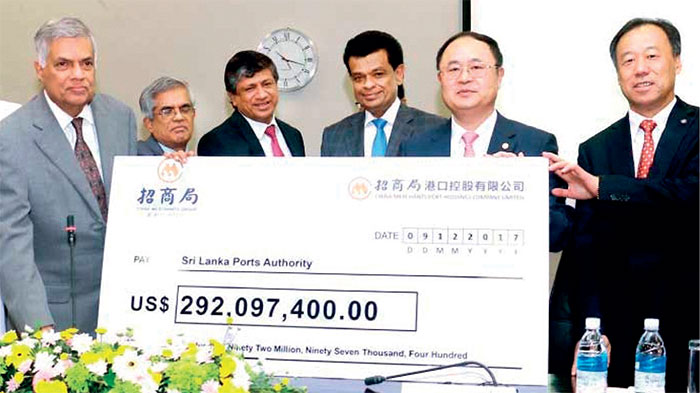
Dec 09, 2017: A jubilant PM Wickremesinghe at the formal handing over of HIP to China. The UNP leader holds a cheque written in favour of the Sri Lanka Ports Authority.


By Shamindra Ferdinando

The Ceylon Petroleum Corporation (CPC), on behalf of Sri Lanka, recently entered into an unprecedented Memorandum of Understanding (MoU) with the Hambantota International Port Group (HIPG) to expand its storage and bulk distribution facilities.

Why did CPC need a MoU with HIPG to go ahead with the project?

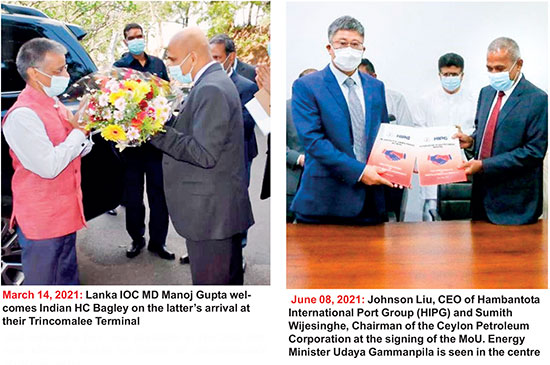
The signing of the MoU took place on June 8 at the Energy Ministry with Johnson Liu, CEO of HIPG, and Sumith Wijesinghe, Chairman, CPC, representing the two parties. Energy Minister Udaya Gammanpila was present at the signing ceremony. The MoU dealt with the agreement signed between the CPC and the strategic public-private partnership, involving Sri Lanka and China Merchants Port Holdings (CMPort).

The CPC issued just a picture of the event on the day after the signing of the MoU. According to a statement, comprising nine lines, among those present at the signing, in addition to Minister Gammanpila, were Energy Secretary K.D.R. Olga, Additional Secretary, Chaminda Hettiarachchi, and Managing Director of CPC, Buddhika Madihewa.

Tyron Devotta, on behalf of Public Relations firm, Media 360, handling HIPG, issued a comprehensive statement, on June 14, as regards the MoU finalized on June 8. Veteran journalist and columnist, Devotta, quoted, CEO Johnson Liu as having told the June 8 gathering at the Energy Ministry: “The vision of HIPG is to develop the Hambantota International Port (HIP) to become an energy hub for South Asia. Whilst HIPG has put the infrastructure in place to realize that goal, we are also aware that we cannot achieve it without the participation of all the players in the equation. To this end, we recognize the importance of Ceylon Petroleum Corporation as a vital cog in the machinery. The Hambantota Port is encouraged by this move, by the corporation, and as much as it will support the smooth and efficient supply of fuel to the customer, it will also strengthen the position of this Sri Lankan port on the global maritime map.”

The overall project is also subject to the approval of the Sri Lanka Ports Authority (SLPA) in view of its stake in the Hambantota Port project.

The CPC intends to establish a separate state-of-the-art storage terminal and other required facilities on a 50 acre Mahaweli Authority land, for both domestic and export purposes, connected to the HIP, via a pipeline.

Why did the media receive a separate statement that dealt with the issue at hand, lucidly? Devotta explained why Sri Lanka required far larger storage facilities to ensure energy security. Let me quote

Media 360 release verbatim: “The existing storage facility of CPC/CPSTL is sufficient to store refined petroleum product requirements of the entire country for a period of only one month, a capacity below the requirements of ensuring the energy security of the country. CPC currently imports refined petroleum products to cater to, approximately, 70% of the country’s demand, via the Colombo port, and suburbs. The CPC has identified the need to increase its fuel storage capacity to cater to at least three months’ of the country’s demand.”


Energy sector neglected

Successive governments neglected the energy sector, though all recognized the pivotal importance of ensuring energy security. Even after the successful conclusion of the war, in May 2009, the political leadership lacked the vision to take tangible measures to expand storage and bulk distribution facilities, as well as to set up a new refinery.

Over 12 years after the eradication of the Liberation Tigers of Tamil Eelam (LTTE), measures are being taken to develop HIP as a strategic energy centre but, unfortunately, the port is no longer in Sri Lanka’s hands due to the short-sighted policies of the previous yahapalana regime. The statement issued by Media 360 signified the change in the Hambantota scenario brought on during the previous Sirisena-Wickremesinghe administration. The bottom line is that Sri Lanka energy sector projects et al are subject to HIPG approval. That is the reality.

Having invested USD 974 mn in the HIP, as mentioned in the HIPG website, CMPort owns a strong 85 percent of the shares in it, whereas the SLPA’s stake is 15 per cent. CMPort received HIP’s commanding control in 2017 on a 99-year lease granted by the Government of Sri Lanka (GOSL) to develop, manage and operate the port area. The Sirisena-Wickremesinghe government signed the Hambantota port deal in late July 2017.

The then Ports and Shipping Minister Mahinda Samarasinghe, a confidant of President Maithripala Sirisena, signed the agreement, on behalf of Sri Lanka, after Arjuna Ranatunga gave up the portfolios in opposition to the transaction. Ranatunga, who unsuccessfully contested the last general election on the UNP ticket, told the writer recently he couldn’t have accepted the agreement as it was not fair by Sri Lanka. Samarasinghe now represents the SLPP parliamentary group having entered Parliament from the Kalutara District. At that time, Samarasinghe signed the agreement, he was a National List MP courtesy President Sirisena. The President, in his capacity as the SLFP leader, accommodated Samarasinghe on the National List after he failed to retain his seat.

Ranatunga explained how interested parties brazenly manipulated the whole process to the advantage of those seeking control of the HIP. The recently finalized CPC-HIPG MoU underscored that 99-year lease to HIP actually meant the strategic asset cannot be regained in the gainful life time of any Lankan living now. That is the undeniable unpalatable truth. A government that had secured a five-year mandate at the 2015 general election ended up losing an incomparable strategic asset.

Lawmaker Vasudeva Nanayakkara, during the Sirisena-Wickremesinghe administration, made an abortive bid to halt the handing over of the Hambantota port by way of court action. The Supreme Court, however, dismissed Nanayakkara’s action. Today, Nanayakkara and the SLFP that facilitated the Hambantota transaction are represented in President Gotabaya Rajapaksa’s cabinet.

In the wake of the 2015 change of government, the UNP-led administration adopted an extremely hostile stand Vis-a-Vis China. Having accepted US leadership as well as US-India-Japan-Australia security-political and economic partnership, the Sirisena-Wickremesinghe government engaged in a dangerous game much to the discomfort of the public. But, China managed to outmaneuver forces ranged against it and manipulated rapid developments in post-election period. The finalization of agreement in late July 2017 on HIP is nothing but a strategic achievement for Chinese diplomacy. The then Joint Opposition (JO) now recognized as the Sri Lanka Podujana Peramuna (SLPP) had no option but to keep quiet for obvious reasons. It would be pertinent to mention that following the 2015 defeat, Mahinda Rajapaksa, accompanied by former External Affairs Minister Prof. G.L. Peiris, visited Beijing amidst severe criticism of China-Sri Lanka relationship under the previous Rajapaksa government.

CPC-HIPG MoU

The signing of the MoU between the CPC and HIPG didn’t attract the media attention it deserved. The MoU came into being between Minister Gammanpila’s declaration on June 6 on the proposed new refinery at Sapugaskanda to be built at a cost of USD 3 bn (Rs 6,000 bn) on BOT (Build, Operate and Transfer) basis and his announcement of upward revision of fuel prices on Jun 11. The fuel price hike triggered a political turmoil, with SLPP General Secretary Sagara Kariyawasam, MP, of course, with SLPP founder Basil Rajapaksa’s blessings, demanded Minister Gammanpila’s resignation.

Former Attorney General’s Department employee, Attorney-at-Law Kariyawasam received the backing of the vast majority of the SLPP parliamentary group as he took on a small group of government lawmakers, who declared their support for Gammanpila. The battle caused a dicey situation with some speculating a division among the Rajapaksas as regards not only political strategy but future direction of the party as well. The country is in such economic dire straits with the lockdown alone costing billions to the exchequer daily, the ruling coalition cannot, under any circumstances, pave the way for internal squabbles to cause further deterioration. SLPP General Secretary Kariyawasam found fault with the Energy Minister for the substantial price hike. But, can the Pivithuru Hela Urumaya (PHU) leader be held responsible for waste, corruption, irregularities and negligence over a period of time that resulted in the CPC being in debt to the tune of Rs 652 bn to the Bank of Ceylon and the People’s Bank. Both Minister Gammanpila and the Presidential Media Division (PMD) warned that CPC’s loans amounting to Rs 652 bn and the Ceylon Electricity Board’s Rs 85 bn debt could undermine the banking sector and reminded the crisis the country was in.

Unchecked corruption has weakened the national economy to such a degree over the years, the incumbent government is now facing a massive cash flow crisis as it has literally nothing to fall back on.

Unfortunately, corruption continues, unabatedly. Examination of proceedings of the parliamentary watchdog committee reveal corruption is on the march with the support of those constitutionally empowered to address the issue. Debilitated by corruption, successive governments have pursued a despicable strategy in selling national assets. Trade Minister Bandula Gunawardena shamelessly justified the strategy in Parliament on June 8. What Minister Gunawardena basically said was to sell off whatever assets to bridge the budget deficit. Gunawardena owed the electorate an explanation as to how the country would cope once all assets are disposed of, regardless of the consequences.

The previous yahapalana administration reached consensus with Indian investments on four major projects, namely Mattala airport, East Container Terminal (ECT) of the Colombo port, remaining oil tanks at the Trincomalee oil tank farm, and an LNG power plant in Sampur. The collapse of the UNP-SLFP partnership disrupted Indo-Lanka projects. But, the SLPP, having had discussions with India early this year, decided to go ahead with the ECT project, though strong opposition within compelled the government to drop the idea. The SLPP has accused the Weerawansa-Gammanpila-Vasudeva led alliance of sabotaging the ECT project.


Cocktail of political and financial turmoil

Growing Chinese influence by way of investments et al here should be examined in the context of India-US relationship and the ‘Quad Alliance’, comprising US-India-Japan-Australia ganging up to confront real or imagined threats from fast growing China.

The question is whether India is looking for an unnecessary internecine conflict with China thereby unwittingly doing the bidding of the West. All indications are this is Asia’s century with China being the new world number one and India a close second. As we have said before, if these two clash, the traditional West would only be watching with glee the killing of two birds with one stone.

It would be suicidal for Sri Lanka to get entangled or even to wish for any kind of conflict between India and China, both being nuclear armed powers.

Delhi should also keep in mind that it was not China that lit separatist fires right across India into the late 80s and many of those Indian separatist groups had their rear bases in the traditional West.

These big talkers who now lectures at every opportunity about rules based order, followed no rules when they plundered much of the world often committing genocide to grab other people’s lands and unashamedly enslaved millions of black people in particular.

So why is India, having been a victim of such grave humiliation and plunder, now wants to kiss and forgive the same oppressors?

Imagine if there was no China, the West would have ganged up to prevent India from becoming a superpower

It is granted we shouldn’t ignore India’s current and future security concerns. But as long as the Chinese are for mutual economic benefit why can’t India even enter into lucrative trilateral partnerships here.

However given the built up paranoia in New Delhi, India is unlikely to give up its hold on key sectors. The Indian High Commission reacted decisively and swiftly when Energy Minister Gammanpila declared in Colombo on Feb 17, 2021 that the Trincomalee oil tank farm would come under Sri Lanka’s purview. The declaration was made in the presence of Prime Minister Mahinda Rajapaksa at an event to pay compensation for people affected by development projects undertaken by his Ministry. Minister Gammanpila said that he had been able to conclude talks the previous Sunday with the Indian High Commissioner Gopal Bagley (Gammanpila didn’t mention the HC’s name) regarding the taking over of the Trincomalee oil tank farm. He claimed that the High Commissioner accepted his government proposals in that regard though they weren’t compatible with India’s agreement with the Sirisena-Wickremesinghe administration.

Gammanpila expressed confidence in working with the Lanka IOC to develop Trincomalee facilities.

Responding to a media query on joint development of the Upper Oil Tank Farms in Trincomalee (Gammanpila didn’t make any reference to Upper Oil Tank Farms in Trincomalee), the Spokesperson of the Indian High Commission said: “India and Sri Lanka have identified energy partnership as one of the priority dimensions of their cooperation. India is committed to working together with Sri Lanka for the Island’s energy security. In this context, consultation and discussions have been undertaken to promote mutually beneficial cooperation for development and operation of the Upper Oil Tank Farms in Trincomalee. We look forward to continuing our productive engagement with Sri Lanka in this regard”.

Indian HC Bagley visited Lanka IOC’s Trincomalee oil terminal on March 14, 2021. Bagley, in his first visit there, also inspected a grease plant under construction. Once it started production, it would be able to meet Sri Lanka’s entire demand for grease. Perhaps what is significant is Bagley’s inspection of both Upper and Lower Tank farms in Trincomalee. A statement issued by Lanka IOC said that during the visit to the Upper Tank Farm, the High Commissioner was briefed in detail about the current status and the possibilities regarding its usage and development. The visit was made during HC Bagley’s tour of the Northern and Eastern Provinces

In the wake of the 2019 change of government, the incumbent government sounded the possibility of reviewing the agreement on the HIP. China swiftly ruled out that possibility. Sri Lanka (both the government and the Opposition responsible for the present financial crisis, seems to be wholly inadequate to meet the challenges. Decline in the financial and political situation has been further escalated by the raging global pandemic

Covid-19 has paved the way for predatory moves by interested parties.

The US declaration that Sri Lanka wouldn’t be considered for MCC (Millennium Challenge Corporation) Compact and apparent collapse of SOFA (Status of Forces Agreement), also with the US, do not mean end of those endeavours. Sri Lanka entered into ACSA (Access and Cross Servicing Agreement) in August 2017 with the US though MCC and SOFA failed, perhaps a temporary setback for Washington.