Tuesday, 3 May 2022

Sri Lanka’s moment of shame

 SPECIAL REPORT : Part 417
Published

  
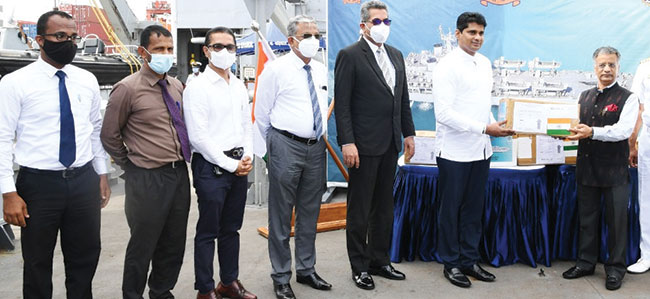
Onboard INS Gharial at the Colombo harbour: Prof. Jayasumana receiving drugs and other medical supplies from Indian HC Baglay (extreme right) Standing next to Jayasumana is Health Secretary retired Maj. Gen. Dr. Sanjeewa Munasinghe, Director General Health Services, Dr. Asela Gunawardana, Coordinator in charge of donor activities, Dr Anver Hamdani, Dr. Sangabodi Wijesinghe and Dr Panduka Mahamithawa

Successive governments allowed exporters to keep their USD earnings out of the country. Governments also turned a blind eye to people sending back money through illegal means (black market), especially with the help of private foreign currency dealers whatever the USD rate is. Basil Rajapaksa, during his short stint as the Finance Minister, went to the extent of commending the black market route much to the surprise of his colleagues. A British and Sri Lankan passport holder says Sri Lanka paid a huge price for turning a blind eye to what was happening. The promotion of the black market, at the expense of the banking system, cannot be condoned under any circumstances, he says, and those responsible should be named and shamed.

By Shamindra Ferdinando

INS ‘Gharial’–a Landing Ship Tank of the Indian Navy-arrived at the port of Colombo on the morning of April 29 amidst the worst ever economic-political-social crisis experienced in post-independence Sri Lanka now threatening to plunge the country into chaos. The vessel brought a large consignment of drugs and other medical supplies required by Sri Lanka as the country struggled to maintain it’ashealth services.

The delivery of Indian medical assistance highlighted the pathetic failure of the incumbent dispensation to meet the basic needs of the population. INS ‘Gharial’ left for the Maldives at 4:30 pm on May Day.

Prof. Channa Jayasumana, in his capacity as the Health Minister accepted the Indian medical supplies onboard the Indian LST. Indian High Commissioner Gopal Baglay was there to welcome the Health Minister. Prof. Jayasumana recently succeeded Keheliya Rambukwella following the massive violent explosion of public anger at President Gotabaya Rajapaksa’s private residence at Pengiriwatta, Mirihana, on March, 31 over the economic fallout.

Rambukwella continuously dismissed claims pertaining to the shortage of drugs and other medical supplies at State-run hospitals. Therefore, the Minister maintained that as sufficient supplies had been available there couldn’t be a shortage of drugs and medical supplies.

Having been twice elected to Parliament from the Kandy electoral district, Rambukwella switched his allegiance to the then President Mahinda Rajapaksa during his first term. Media Minister Rambukwella succeeded Health Minister Pavitradevi Wanniarachchi, in August 2021, in a mini-cabinet reshuffle that also conveniently removed Dullus Alahapperuma from the Energy Ministry to facilitate the controversial deal on the Yugadanavi power station.

Separate statements, issued by the Indian High Commission and the Health Ministry following the handing over of the Indian supplies, exposed how the Health Ministry tried to cover up a serious shortage of drugs and medical supplies at the Peradeniya Teaching Hospital.

The statements issued by the Indian High Commission clearly stated that the consignment of drugs and medical supplies, delivered on April 29, were meant for the Peradeniya Teaching Hospital whereas the Health Ministry statement made no reference at all to the Peradeniya hospital crisis that was first reported on March 29, 2022, during Indian External Affairs Minister Dr. S. Jaishankar’s visit to Colombo.

The Indian HC statement stressed several important issues (1) Indian Navy ship was especially deployed to ensure the expeditious delivery of the medical consignment, a gift from the people of India (2) The delivery was in response to a request from the Peradeniya Teaching Hospital after Dr. Jaishankar’s intervention after hearing difficulties experienced by hospital authorities (3) India has received more specific requests from Sri Lankan state hospitals and now is in the process of scheduling dispatches and (4) Of the USD 1 bn credit line provided by India to Sri Lanka, USD 200 mn has been allocated for the supply of drugs and medical supplies.

Let me reproduce verbatim the last paragraph of the Indian HC statement that dealt with the overall assistance provided so far this year. Eldos Mathew Punnoose, head of Press, Information and Development stated: “India has been extending expeditious support to Sri Lanka in the recent past.

Overall economic assistance which stands close to USD 3 billion in 2022 alone has been of various kinds:

USD 1 billion credit line for essentials; USD 500 million credit line for purchase of petroleum products; USD 400 million bilateral currency swap; and over USD 1 billion under the Asian Clearing Union Framework. The USD 1 billion credit line is operational and 16,000 MT of rice has already reached Sri Lanka, among other items, under this credit line.”

Why did India fund the development of Most Ven. Maduluwawe Sobitha Thera village Elapathagama in the Anuradhapura district during yahapalana administration? India made available Rs 300 mn for the project, launched in memory of the late Ven. Maduluwawe Sobitha, the architect of Mahinda Rajapaksa’s defeat at the 2015 presidential election. Karu Jayasuriya, who sought Indian assistance, in his capacity as the Speaker today heads the National Movement for Social Justice (NMSJ) the brainchild of the late Ven. Sobitha.

Jayasuriya, who poses as a Mr. Clean in local politics, always clad in immaculate white clothing, owed an explanation as to why he sought foreign funding for a political project. No point in finding fault with India for seeking to enhance its clout. The Indian project seems on track and facilitated by the deterioration of Sri Lanka’s national economy.

Tamil Nadu Chief Minister M. K. Stalin, too, sought to take advantage of the situation. Sri Lanka shouldn’t be surprised the way the State government unanimously passed a resolution urging “the central government to positively consider the request of the Tamil Nadu Government to immediately send food and other essential commodities including lifesaving medicines from Tamil Nadu, to the people of Sri Lanka, who are facing severe hardships; Stalin cannot be unaware of the Indian assistance programme.

We also should not forget the fact that arch villain in the US State Department, responsible for many a bloody regime change around the world, especially in the toppling of the legally elected government in Ukraine in 2014, where she was seen handing out sweets in the streets of Kiev, while the US instigated maidan rebellion was in full swing there, led by Nazis, was here recently.

India’s great generosity could be due to it seeing a hidden Western hand in the burgeoning problems here. Already the West has taken up the human rights club to hammer India with over Kashmir no sooner New Delhi refused to toe the one sided Western narrative on Ukraine, while they have had no qualms about atrocities committed in Yemen and elsewhere, with their blessings.

While we don’t condone even for a moment some utterly imbecile decisions of this government that have exasperated the country’s problems, yet at the same time we can’t help in suspecting a Victoria Nuland led American plot here. Did she come here to give the go ahead to a bloody regime change with willing local quislings, especially among the Western funded NGOs? Don’t forget the fact that former US Secretary of State John Kerry foolishly crowed publicly about how they funded the regime change here in 2015!

At the mercy of foreign countries

The incumbent government obviously let down the people. Having repeatedly promised to do better than the previous administration, accused of twice robbing the Central Bank and betraying the war-winning military at the Geneva-based United Nations Human Rights Council, the Sri Lanka Podujana Peramuna (SLPP) within two years presided over the collapse of the national economy. It was no doubt speeded up by the successfully drying up our worker remittances (billions of dollars) by an underground banking network. Here again our intelligence failed us badly.

The Indian statement that dealt with the pathetic state of Sri Lankan hospitals should be examined against the backdrop of how the current dispensation pleaded with the international community to help run state hospitals.

Indonesia, in consultation with the World Health Organization (WHO) offered essential medicines and medical equipment worth USD 1.6 mn. Altogether 3.1 tonnes of humanitarian assistance was to be delivered in two batches-the first arrived in Sri Lanka on April 28 and the rest will be on May 08. Sri Lanka received a cheque for 700,000 Thai Baht. The Sri Lankan mission in Bangkok, in a statement issued on April 29, quoted President of the National Assembly and Speaker of the House of Representatives of the Kingdom of Thailand, Chuan Leekpai as having said 700,000 Thai Baht was not much, but the gesture represented a feeling of true friends, helping each other in difficult times.

Italy, too, announced emergency aid to the tune of Rs 125 mn (341,115 Euros) to procure drugs and medical supplies. The Italian mission in Colombo said that their contribution would be channlled through the Italian Bilateral Emergency Fund at the World Health Organization (WHO) to allow payment to suppliers abroad directly as per planned procurement by the Ministry of Health in line with supply-chain management processes.

The Foreign Ministry announced that the International Committee of the Red Cross, too, has assured drugs and medical supplies and even humanitarian assistance whereas cash-strapped Sri Lanka engaged in a desperate exercise to procure essentials. The failure on the part of the Rajapaksas to come to terms with the reality has further deteriorated the overall outlook. The crisis rapidly developing at the network of state and private hospitals has been publicly acknowledged by Prof. Jayasumana whose appearance at an Indian Navy vessel that brought in drugs and other medical supplies reminded Sri Lanka utterly corrupt and inept political party system that they were only good at one thing. That was to rob the country. The Opposition is no better in having staged two daylight Central Bank robberies and those same MPs, who did their best to whitewash those crimes have no shame in now pointing the finger at the present rulers.

Since the forex crisis curtailed imports, including petroleum products, lawmakers and officials appeared with Indian High Commissioner Baglay and other officials at various occasions. Energy Minister Udaya Gammanpila and his successor Gamini Lokuge appeared with Indians when India delivered petroleum products. Then there was another picture of humiliation when trade officials, including Trade Secretary,

Bhandrani Jayawardhana received a consignment of Indian rice. As the situation deteriorates further Sri Lanka would go down further under debt as a result of 30 years of continuous mismanagement of the national economy by those elected by the people.

China-Lanka relations at a crossroads

Chinese Ambassador in Colombo Qi Zhenhong didn’t mince his words when he expressed concerns over Sri Lanka entering into a dialogue with Washington-based International Monetary Fund (IMF). Declaring that China is ‘sad’ over Sri Lanka’s move Qi Zhenhong, addressing the media at the Cinnamon Grand on April 25, faulted the latter over its strategy.

Having worked closely with Sri Lanka throughout the war against separatist Tamil terrorists, China is obviously annoyed and disappointed over the latest developments though they were not really surprising.

The India backing for Sri Lanka at the IMF must have compelled China to rethink its overall strategy vis-a-vis Sri Lanka. US ally India backing Sri Lanka at the IMF is clearly in line with the overall Western strategy pursued by ‘Quad’ comprising the US, Japan, Australia and India.

Ambassador Qi Zhenhong side-stepped a media query on Sri Lanka seeking IMF intervention at a media briefing at the Kingsbury on March 21. The Chinese envoy revealed Sri Lanka’s request for funds amounting to USD 2.5 bn, in addition to USD 2.8 bn obtained since the global Covid-19 pandemic eruption in early 2020. Subsequent media queries forwarded to the Chinese Embassy, in respect of Sri Lanka’s request for 1.5 billion US dollars in buyer’s credit and another billion-dollar loan, didn’t yield a positive response.

Obviously with the advent of Basil Rajapaksa, the dual US citizen and his pro-American line (read Yugadanavi deal concluded at midnight in utter secrecy, for example) the China’s distancing from us began.. When we were fighting the war with the separatist terrorists, the West always tried to trip us and it was China that stood by us. Actually by helping us to fight separatist terrorists Beijing did India a great favour as the real target of the West has always been the breakup of India.

The besieged government fighting for its survival even at the expense of Prime Minister Mahinda Rajapaksa may not know yet or haven’t examined the issues at hand in depth. What would be the consequences of Sri Lanka’s dialogue with the IMF? One of the key issues that had emerged since Ambassador Zhenhong’s April 25 media briefing is whether China would turn down Sri Lanka’s request for USD 2.5 bn or can Colombo do away with the Chinese funding and be at the mercy of the IMF?

The Chinese Ambassador called the second media briefing two weeks after newly appointed Governor of the Central Bank Dr. Nandalal Weerasinghe announced Sri Lanka would suspend payments on its foreign debt and initiate negotiations with creditors.

The IMF has declared that Sri Lanka’s debt is not sustainable or cannot be repaid with macro-economic adjustments involving rate and tax hikes alone and debt had to be restructured to reduce the gross finance need to a manageable level. China believes Sri Lanka is on the wrong path.

Sri Lanka needs to discuss contentious issues with China. It would be pertinent to ask whether Sri Lanka’s decision to enter into a dialogue with the IMF had been discussed with China the way Sri Lanka secured India’s backing for the move. Or did India advice Sri Lanka to take its woes to the IMF? Sri Lanka needs to set the record straight without further delay. Sri Lanka-IMF dialogue appeared to have dealt quite a serious blow to China-Sri Lanka relations and the failure to address China’s concerns may cause irreparable damage.

During yahapalana administration, also on the request of Speaker Karu Jayasuriya, China arranged the entire parliament to visit China. China also provided laptops to members of Parliament and senior officials.

Perhaps Justice and Finance Minister Ali Sabry’s recent meeting with the Chinese Ambassador must have helped stabilize the situation.

Galle Face uproar

The continuing political crisis against the backdrop of economic fallout continues to attract foreign attention. For over three weeks, the government has struggled to contain the volatile situation and the continuing large scale protests opposite the Presidential Secretariat and Prime Minister Mahinda Rajapaksa’s office/residence at Temple Trees, indicate the deterioration. To make matters worse for the government, the Maha Sangha has issued an ultimatum to Prime Minister Mahinda Rajapaksa to resign forthwith to enable consensus among political parties represented in Parliament. The ultimatum was issued the day after a top Australian diplomat received a briefing on the developments from the Foreign Secretary, Admiral Prof. Jayanath Colombage.

The unprecedented challenge to the government has received the attention of First Assistant Secretary, North and South Asia Divisions of the Department of Foreign Affairs and Trade of Australia, Gary Cowan when he met Colombage at the Ministry of Foreign Affairs.

First of all, the Foreign Ministry claim that the crisis was solely due to the Covid-19 pandemic cannot be accepted. Australia, being a ‘Quad’ member, is fully aware of the developments here and it would be nothing but silly to pretend Covid-19 alone caused the current economic crisis. The declaration that the government and President Gotabaya Rajapaksa were prepared for a solution in terms of the Constitution, too, cannot be taken seriously as the situation has reached a critical point, with the public demanding the resignation of both President Gotabaya Rajapaksa and the entire Cabinet of Ministers, including Prime Minister Mahinda Rajapaksa. There is no doubt that reference has been made to law enforcement personnel opening fire on those who blocked the main railway line at Rambukkana.

In spite of strong relations between the two countries, Australia is among those who punished the war-winning Sri Lankan military on the basis of unsubstantiated allegations, obviously towing the Western Line, dictated by Washington and London. Perhaps, the Foreign Ministry should have politely inquired as to how and on what basis Maj. Gen. Chagie Gallage was categorised as a war criminal and deprived of visa during the yahapalana administration. The Australian official was here to mark the 75th anniversary of the establishment of diplomatic ties between Australia and Sri Lanka.

The government seems to have conveniently ignored the ground situation. Former Foreign Affairs Minister and the leader of the Mahajana Eksath Peramuna (MEP), that has aligned itself with the SLPP on May Day declared the ruling party was still in control. Addressing supporters at Nugegoda, lawmaker Gunawardena emphasised that they formed a government not to quit in the face of protests. The MEP leader declared that the SLPP, and those aligned with the ruling party, had the mandate, both in and outside Parliament. The Chief Government Whip reiterated the commitment of President Gotabaya Rajapaksa, Premier Mahinda Rajapaksa and Members of Parliament to the government, amidst about one third of those elected on the SLPP ticket demanding the immediate resignation of the entire Cabinet of Ministers, including the Prime Minister. The absence of President Rajapaksa, the Premier, as well as the founder of the SLPP, Basil Rajapaksa, at the event, underscored the crisis the ruling coalition is faced with. The MEP leader appeared to have conveniently forgotten the government has suffered irreparable damage, therefore, incapable of exercising any political power.

Wednesday, 20 April 2022

Sordid politics of environment and big money

SPECIAL REPORT : Part 416

Published

  
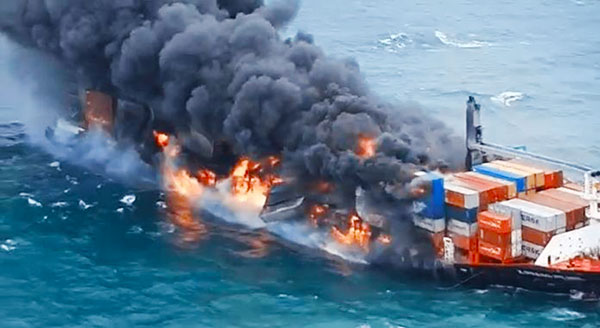
Container carrier X-Press Pearl on fire off the Colombo Port in late May 2021

Those genuinely keen on protecting the environment should without further delay launch a project to protect rain forests. The ongoing power cuts have underscored Sri Lanka’s dependence on hydropower. The continuing destruction of forest cover can cause irreparable damage to the country’s hydro power generation capacity, thereby causing a catastrophic situation. Perhaps the CEJ and the likeminded groups should exploit the current situation to pressure political parties, whoever in power, to take environment protection seriously or face the consequences. The bottom line is that the country cannot replace hydropower generation capacity with thermal, including coal, in the foreseeable future. Therefore, every endeavour should be made to protect the existing hydropower capacity.

By Shamindra Ferdinando

Some of those activists at the round-the-clock ‘Go Gota Home’ protest, outside the Presidential Secretariat, at Galle Face, carried placards querying the delay on the part of the government to compensate the communities affected by the sinking of the Singapore registered cargo vessel MV X-Press Pearl, off the Western coast, last year.

The Express Feeders’ owned fire stricken cargo ship, sank on June 02, 2021, during an attempt to tow it away to deep seas. Sri Lanka lacked the wherewithal to bring the fire on deck, that had been reported on May 21, under control. In spite of firefighting support provided by India and other foreign vessels, the vessel went down, causing the worst ever ecological disaster in busy local waters, outside the Colombo harbour.

MV X-Press Pearl sank 9.5 nautical miles, NorthWest of the Colombo port, the day after President Gotabaya Rajapaksa directed that it be towed to deeper seas. The vessel went down where it had been since May 19 after entering Sri Lankan waters.

Controversy surrounds the way the relevant authorities probed the circumstances that led to MV X-Press Pearl stealthily carrying a leaking container, loaded with nitric acid, being allowed to enter Sri Lankan waters. The public have a right to know how the government dealt with the vessel’s local Agent, Presidential Award winner Sea Consortium Lanka of Setmil Group, accused of suppressing information about the acid leak.

The highly politically motivated ‘Go Gota Home’ campaign appeared to have attracted many groups, including those handling contentious environmental issues, which may have contributed to the overall deterioration of public confidence in the government. The handling of the X-Press disaster is a glaring example of an utterly corrupt system that protected the affluent at the expense of the hapless public.

The massive eruption of public anger against President Gotabaya Rajapaksa, at the approach to his private residence, at Pangiriwatte Road, Mirihana, on the night of March 31, marked a new phase in politics. Having caused chaos at Pangiriwatte, the ‘Go Gota Home’ campaign, overnight, targeted selected government members. Violent protests in several districts, particularly in the Anuradhapura district, underscored the growing public anger at those wielding political power.

At the same time while we do not wish to be paranoid conspiracy theorists, it must be noted that some of the present protests appear to be well coordinated and funded and quite possibly maneuvered by a hidden hand, as happened in the run up to the change of government in 2015, engineered by the US, about which it later crowed about publicly through its then Secretary of State, John Kerry. Though President Gotabaya is responsible for some controversial decisions taken hastily, like the abrupt decision to ban agrochemical imports or doing away with some key taxes no sooner he was elected, it must be stated that none of it was done for his personal benefit, but there has been far too many built up coincidences in the run up to the present conflagration, like the MT New Diamond sinking, X-Press Pearl disaster of epic proportion, the wrong composition of butane and propane in LPG shipped to Sri Lanka that caused needless explosions and even loss of life, etc. In the light of what has happened recently in Pakistan, and elsewhere, we believe the country needs to be extra alert to such foreign engineered plots.

The high profile campaign discarded all political parties, represented in Parliament, thereby denying the Opposition an opportunity to exploit unexpected political developments. The protest campaign that had been launched, opposite the Presidential Secretariat, on April 09, received the backing of many groups with diverse objectives. Among the interested parties were civil society organisations, including the Centre for Environmental Justice (CEJ) spearheading an intense legal campaign against the current dispensation.

The CEJ moved court over the X-Press Pearl disaster, in the absence of a genuine effort by relevant government machinery to obtain proper compensation. If those responsible for taking action had addressed the issue purposefully, the sinking of X-Press Pearl wouldn’t have been an issue at the ‘Go Gota Home’ campaign.

It would be pertinent to examine the issues at hand against the backdrop of those seeking compensation for MV X-Press Pearl disaster being part of the ‘Go Gota Home’ campaign. The current crisis has erupted at an opportune time as cash-strapped Sri Lanka struggles to meet the basic requirements of the public.

The ship disaster, off the Western coast, cannot be discussed without taking into consideration the massive fire onboard MT New Diamond, off the Sangamankanda coast in the East, in early Sept 2020.

The Committee on Public Enterprises (COPE) proceedings and an exclusive interview Sirasa anchor Asoka Dias, formerly of Upali Newspapers did with the first Dean of the Faculty of Fisheries and Marine Sciences and Technology, Ruhuna University, Prof. Ruchira Cumaranatunga exposed the Marine Environment Protection Authority (MEPA).

MEPA and legal system exposed

COPE Chief and MP Prof. Charitha Herath recently lambasted the MEPA, at a recent committee hearing, over the handling of the fire onboard crude carrier MT New Diamond in early Sept. 2020 and the sinking of X-Press Pearl carrying chemicals off the Port of Colombo last year.

Prof. Herath questioned MEPA Chairperson Attorney-at-Law Dharshani Lahandapura, a Viyathmaga activist, as regards their response to the disastrous accidents.

The SLPP National List MP demanded to know why compensation hadn’t been so far secured from the owners of the MT New Diamond. His query was based on the Auditor General’s observations. Jagath Gunasekera, the Acting General Manager of MEPA, said that the court had decided on the fines to be imposed.

Prof. Herath asked why only Rs 51 mn out of estimated Rs 3,480 million, due from MT New Diamond as compensation, had been received. Attorney-at-Law Lahandapura said that though there had been an oil patch, the fire had not caused any environmental damage.

Prof. Herath asked why such a huge estimate in respect of damages had been made if no disaster had occurred. Gunasekera said Rs 51 million had been paid for firefighting operations and related matters.

According to Gunasekera an expert panel had recommended Rs 3,480 mn compensation and the relevant file had been submitted to the Attorney General’s Department.

Prof. Herath pointed out that the AG hadn’t responded to the MEPA so far, and asked what the MEPA would say if the COPE alleged that it had collaborated with the ship owners to help them reduce compensation payments for environmental damages caused.

When the COPE Chief questioned the role of MEPA’s Legal Officer in respect of the overall response, the MEPA representative at the hearing disclosed that she had been sidelined. The official revealed she hadn’t been allowed to participate in any of the discussions with the Attorney General’s Department on civil or criminal proceedings. Prof. Herath demanded to know why she had been sidelined. Lahandapura claimed that MEPA had assigned responsibilities to another official as the Legal Officer was not responsive to the MEPA’s requirements. Prof. Herath dismissed that claim, insisting that there couldn’t be a justifiable excuse for sidelining the legal officer.

Prof. Herath emphasised that the revelation that the MT New Diamond matter issue had been handled outside the purview of the MEPA Legal Section was a serious matter.

Prof. Herath pointed out that though the compensation in respect of X-Press Pearl had been estimated at USD 37 mn, the ship owners had agreed to pay only USD 2.9 mn. Lahandapura admitted that an organisation that had represented the ship owners/insurers had provided advice to MEPA, too. The COPE Chairman pointed out that the organisation concerned would have been able to manipulate the whole process to the advantage of the ship owners/insurers. The MP said that someone could easily level the charge that the MEPA collaborated with them to reduce the amount of compensation received by the country.

Sirasa interview

Prof. Cumaranatunga didn’t mince her words when she questioned the conduct of MEPA Chairperson as regards the two incidents – the one off the Sangamankanda coast and the other off the Colombo harbour. Responding to interviewer Dias, the academic, who investigated both high profile cases, accused Lahandapura of suppressing some sections of the report on MT New Diamond submitted by her team. She pointed out how the MEPA Chief claimed before the COPE that damages hadn’t been caused to marine life, contrary to the report submitted by the experts. An irate Prof. Cumaranatunga declared that MEPA Chief had insulted members of her team by propagating blatant lies. Asoka Dias couldn’t have conducted that interview at a better time. With the growing public protests, demanding a system change, the operation at the MEPA explains how interested parties pursued projects beneficial to them, regardless of the consequences. Prof. Herath should ask Prof. Cumaranatunga to make her position clear before his Committee and take whatever necessary action. The government cannot remain silent against the backdrop of the head of the expert team that probed the ship disasters, exposing MEPA.
Prof. Cumaranatunga revealed how she raised the issues at hand with Lahandapura soon after the COPE rapped MEPA over the controversial handling of the ship disasters. Declaring that Lahandapura’s response to her queries hadn’t been satisfactory, the academic exposed how MEPA manipulated the online process adopted in preparing the final report to secure the signatures of the members of the probe team without providing them the final draft.

The COPE and Sirasa revelations haven’t received sufficient public attention. The ruling coalition and the Opposition haven’t acted on sensational revelations made by the COPE as well as two other watchdog committees, namely the Committee on Public Accounts (COPA) and the Committee on Public Finance (COPF). MEPA should be held accountable for mishandling of two key investigations. Had they been deliberately handling the issues in a way to deprive the country adequate compensation?

Prof. Herath is in no mood to give up his strong stand in respect of the two

muddled investigations. The COPE should pursue this matter. The X-Press Pearl matter is now before the judiciary. It would be the responsibility of all concerned to ensure transparent proceedings. Punitive measures are a prerequisite for justifiable settlement of the X-Press Pearl case.

CEJ moves court

The CEJ and three others, including its Senior Advisor Hemantha Withanage, in a fundamental rights application filed in terms of Articles 17 and 126 of the Constitution, in respect of the X-Press Pearl affair, has named its owner Express Feeders and its local agent Sea Consortium Lanka as 11th and 12th respondents, respectively. They are among 13 respondents, including the Attorney General.

At the time the CEJ moved SC against what the petition called the worst marine ecological disaster caused by the sinking of X-Press Pearl, the outfit hadn’t been aware of the local agent deleting e-mails received from the Captain of the ship.

According to the petition, in addition to 325 metric tonnes of bunker oil, the vessel carried altogether 1,486 containers – 25 tonnes of hazardous nitric acid, caustic soda, sodium methylate, plastic, lead ingots, lubricant oil, quick lime and highly reactive and inflammable chemicals such as Sodium Methoxide, High Density Polyethylene (HDPE), Low Density Polyethylene (LDPE) “Lotrene”, Vinyl Acetate, Methanol, bright yellow sulphur, urea, cosmetics, etc.

Petitioners stated that the Captain and the crew members of the MV X-Press Pearl knew of the nitric acid leak from about 11th May 2021, nine days before the blaze started and had deliberately failed to inform the Sri Lankan authorities of the impending grave risk. But, the CEJ had been in the dark regarding the treacherous actions of the local agent and the whole issue would take an unexpected turn against the backdrop of Prof. Cumaranatunga’s revelations.

The CEJ receives funding from both local and foreign sources, including the UN. Responding to The Island queries, Withanage explained the gradual growth of CEJ’s operations since its launch in 2004 following the breakup of the Environmental Foundation Ltd. Assuring transparency in the CEJ’s operations, Withanage alleged that the state agencies that had been tasked to protect the environment either connived brazenly with some of the corrupt elements who wielded political power regardless of the consequences or betrayed the country’s interest for personal gain. The sordid disclosures made during COPE proceedings and the Sirasa interview as regards the sordid behaviour of MEPA, responsible for the protection of marine environment should prompt the government to take tangible measures.

Unfortunately, MEPA as well as other agencies answerable for matters concerning the environment, are pursuing strategies acceptable to their political masters.

The much discussed court cases pertaining to clearing of Wilpattu jungles, releasing of elephants and the threat to Sinharaja forest exposed the corrupt political party system.

Withanage asserted that political parties exploited corrupt systems in place to raise funds. If those who exercised political authority addressed matters of serious concern there wouldn’t have been a need for CEJ to move the Supreme Court over the X-Press Pearl disaster. Withanage questioned the conduct of the premier government agency, the Central Environmental Authority (CEA) now headed by ex-JVPer Siripala Amarasinghe. Withanage asserted that politicians and officials were equally responsible for the pathetic state of affairs.

There cannot be a better example than the importing of toxic garbage containers from the UK and simply dumping them here during the yahapalana administration. While Amarasinghe and then President and former Environment Minister Sirisena claimed at the time they were tackling the issue expeditiously, if not for the CEJ successfully moving the court, the British garbage would have been here still. Having blamed the Mahinda Rajapaksa tenure for large-scale environmental destruction, Withanage alleged that the current dispensation was the worst. The civil society activist cited the removal of restrictions on the mining and the transport of sand as one of the evil decisions taken by the current government. The move was obviously meant to allow those connected with the party to make money. The relevant authorities fully cooperated with politicians, Withanage alleged.

The court was told between 2017 and 2019, the UK shipped 263 containers of waste to Sri Lanka. The containers were labelled ‘used mattresses, carpets and rugs.’ But, amongst other things, authorities found bio waste from hospitals. It included radioactive clinical waste, rags, bandages and body parts from mortuaries. Thanks to CEJ’s action, the entire lot – altogether 263 containers – were shipped back by February 2021. It would be pertinent to examine the conduct of the environment ministry and the CEA with regard to the import of British waste. Contrary to expectations, the current dispensation didn’t take punitive measures against those responsible for the importing of dangerous cargo and kept them in specified areas pending disposal.

The government should be ashamed of its failure. The Parliament, too, should inquire into such glaring failures. Can those in authority now and then vouch that foreign waste didn’t end up at Aruwakkalu sanitary garbage dump in Puttalam as once alleged by top environmental scientist Dr. Ajantha Perera in an interview with this newspaper?

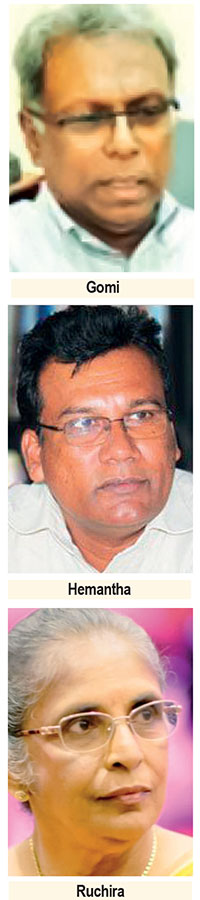
One-time top trade official Gomi Senadhira recently discussed how in spite of Sri Lanka’s success in sending back over 3,000 tons of British toxic waste, authorities allowed foreign garbage. Senadhira asked whether the Customs, Trade Ministry, the BOI, and the CEA deceived the public on garbage imports.

Senadhira raised two basic issues (verbatim) (a) How did the Customs detect the 3000 tonnes of “illegally imported foreign garbage”? Wasn’t it only when the containers that remained in the port for months without being cleared by the importer started to stink and leak? When were the tonnes of customs-cleared garbage in a clandestine garbage dump created inside the BOI discovered by the BOI and the CEA?

Wasn’t it only after a media exposure? Didn’t all this happen after the implosion of the Meethotamulla garbage dump? Coincidence? Maybe. Maybe not. Methotamulla collapsed at the start of the yahapalana regime.

(b).During the four-year period 2017-2020, while struggling to ship back 3,000 tons of illegally imported stinking waste, the customs and the CEA had facilitated “legal” imports of a much larger quantity of garbage into the country. For example; Sri Lanka imported nearly 20,000 tonnes of plastic waste (HS391590) In addition, nearly 1000 MTs of plastic waste under HS 391530 was also imported every year.

Most of it, according to customs data, was imported from China. As far as I am aware, China does not export plastic waste”

Perhaps, the CEJ should speak with Senadhira to map out proper strategy to counter clandestine projects. Interested parties must have profited immensely at Sri Lanka’s expense.

Wednesday, 13 April 2022

US exposes Lanka over Zuberi, Wickramasuriya affairs

 SPECIAL REPORT : Part 415

Published

  
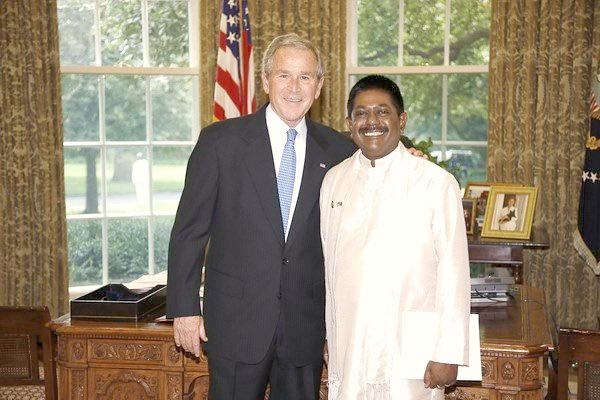
Jaliya Wickramasuriya with President George W. Bush in July 2008

The ongoing protest campaign in the wake of eruption of violence at Mirihana underlines the responsibility on the part of Sri Lanka to address issues – economic and political at hand. Successive governments have encouraged waste, corruption, irregularities and mismanaged the national economy. The bottom line is the current balance of payments crisis, the cumulative effect of mismanagement and corruption at every level over the years and exacerbated by two colossal blunders — the doing away with key taxes at the beginning of President Rajapaksa’s term, which deprived government coffers several hundred billion rupees per year and the abrupt decision by him to halt chemical fertiliser imports. But the culpability for the situation must be borne by the Executive, the Legislature and the Judiciary. There is more than a grain of truth in what big mouth Ranjan has been saying. Then of course there was a worldwide calamity in the form of the pandemic and some foolish measures taken not only here but worldwide like turning to the printing press for easy cash is now haunting almost the entire world.

By Shamindra Ferdinando

Political appointee Jaliya Chitran Wickramasuriya, 61, of Arlington, Virginia, served as Sri Lanka’s Ambassador to the United States and Mexico from July 2008 to May 2014. Wickramasuriya, on April fool’s Day, 2022, pleaded guilty to diverting and attempting to embezzle $332,027.35 from his employer, the Government of Sri Lanka (GoSL). The attempt had been made when the GoSL acquired a new embassy building in Washington D.C. in 2013.

Having repeatedly denied his involvement, in spite of returning the stolen money, Wickramasuriya, a cousin of the ruling Rajapkasas, pleaded guilty in the U.S. District Court in Washington DC (District of Columbia) to a charge of conspiracy to commit wire fraud. The charge carries a statutory maximum sentence of five years in prison and potential financial penalties.

Judge Tanya S. Chutkan is scheduled to sentence Wickramasuriya on July 20, 2022.

Wartime Foreign Minister Rohitha Bogollagama didn’t mince his words when he declared Wickramasuriya’s conduct as nothing but a disgrace, though the then Minister’s conduct, while in office, was anything but stellar, especially when it came to matters relating to his family, personal and political life. Bogollagama, who handled the matters relating to the war effort well, said that Wickramasuriya caused irreparable damage to the Foreign Service and humiliated the country.

Interesting, Bogollagama, who succeeded Mangala Samaraweera following a dispute that led to the Matara MP’s sacking, had been the Minister in charge of foreign affairs at the time the US-based Wickramasuriya received the ambassadorial post at the behest of President Mahinda Rajapaksa. Wickramasuriya succeeded top career diplomat Bernard Goonatilleke in Washington.

The Parliamentary High Post Committee (PHPC), chaired by the Speaker, cleared Wickramasuriya’s appointment pronto. In fact, PHPC over the years cleared almost all appointments recommended by successive governments. At the time Mahinda Rajapaksa won the presidency in Nov 2005, the US-based Wickramasuriya had been engaged in the tea export business and was first appointed the Consul General in Los Angeles, California.

Bogollagama lost at the April 2010 parliamentary election. Prof. G.L.Peiris took over the Foreign Ministry as External Affairs Minister but no change was made in Washington for obvious reasons. The then Monitoring MP of the Foreign Ministry Sajin Vass Gunawardena wielded immense power over the ministry. That was the time R. Duminda Silva functioned as the Monitoring MP of the Defence Ministry. In the absence of proper supervision at all levels, the situation deteriorated rapidly. The fraud perpetrated by the Ambassador while purchasing a new building for the Sri Lankan Embassy, in Washington, should be examined in that context.

The US compelled Sri Lanka to recall Wickramasuriya in July 2014 following investigations conducted by the Internal Revenue Service (IRS) about six months before Mahinda Rajapaksa lost the presidential election. Career FS officer Asela Weerakoon took over the mission, temporarily, before another FS senior Prasad Kariyawasam moved in. Before inquiring into the tax fraud further, it would be pertinent to discuss how Wickramasuriya held such a diplomatic appointment for seven years. Wickramasuriya was on a contract.

FS officers serve a particular mission for a period of three years whereas retired FS officers and political appointees receive contracts for two to three years. But, Wickramasuriya, having served as Consul General in Los Angeles, received the topmost diplomatic appointment and held it until the US exposed him.

The yahapalana administration waived the diplomatic immunity granted to Wickramasuriya.

The US Attorney’s Office for the District of Columbia, in a statement dated April 01, 2022, based on documents furnished to the court, declared from in or around late 2012 through November 2013, Wickramasuriya devised a scheme to defraud the GoSL during its 2013 purchase of a new Embassy building in Washington, D.C. by inflating the price of the real estate transaction by $332,027 and, at closing, diverted those funds from the government to two companies which had no role in the real estate transaction. After the January 2013 closing, Wickramasuriya directed these payments to the two companies. Later in the same year, Wickramasuriya redirected an equal amount of funds back to government accounts, leaving the Sri Lankan government with no loss.

From Wyoming Avenue to Whitehaven

Why did Wickramasuriya return the money? The man in Washington had no option but to do so after President Mahinda Rajapaksa raised the issue with him. Unfortunately, the Rajapaksa administration quite conveniently refrained from initiating action against him and Wickramasuriya was allowed to continue. Obviously, President Mahinda Rajapaksa didn’t want his cousin penalised regardless of the grave offense committed while serving as Sri Lanka’s top envoy in Washington.

Did Wickramasuriya make the move to shift the Sri Lankan mission based at Wyoming Avenue, N.W, Washington DC, 20008 to 3021 Whitehaven, St. N.W., Washington DC, 20008 with specific intention of stealing money. The decision to purchase the property was made in Oct 2012 by the GoSL and the funds transferred to the HSBC Bank account in Washington DC. The Ambassador and others involved in the conspiracy devised a plan to swindle the GoSL. Having finalised the agreement to procure the new building at a cost of USD 6.25mn, the Ambassador obtained USD 6.6 mn from the GoSL. Having paid the sellers real estate company and the buyers real estate company USD 187,500.00, each, Wickramasuriya directed the title company and the closing attorney to transfer USD 332,027.35 to Embassy consultant company A (USD 82,027.35) and Sri Lankan company incorporated in Sri Lanka (USD250,000). US investigations revealed that the Embassy consultant had been a lawyer and a close associate of Wickramasuriya. The lawyer has operated Embassy consultant company A and Embassy consultant company B and in spite of no involvement in the transaction received part of the funds provided for the acquisition of the new building.

The US court was told how several attempts were made by the Title Company to carry out instructions given by Wickramasuriya after the bid to wire USD 250,000 to the Sri Lankan company on January 17, 2013 failed as a result of an intermediary bank rejecting the move. Finally, USD 250,000 has been wired to the Sri Lankan company’s Sri Lankan bank account on March 20, 2013.

US investigators exposed the sordid embezzlement carried out by the then Sri Lanka’s top envoy in the US. Although Wickramasuriya paid back the entire sum by late October 2013, the US investigated the fraud and brought the judicial proceedings to a successful conclusion.

The Foreign Ministry owed an explanation regarding the Wickramasuriya episode. When The Island raised this issue with the Foreign Ministry recently, the writer was told that the case was pending in the Fort Magistrate court. Now dismantled Financial Crimes Investigation Division (FCID) investigated Wickramasuriya’s case after he was arrested in Nov 2016 at the Bandaranaike International Airport (BIA).

The writer had been in touch with Wickramasuriya after he was granted bail and reported on the matter. Claims made by Wickramasuriya at the time have to be examined against the backdrop of him pleading guilty to the attempt to defraud the GoSL.

Those who served the Rajapaksa administration claimed that they were targeted for political reasons. Speaking to the writer from the US in April 2018, Wickramasuriya claimed that US authorities prevented him from leaving the US to appear in the case heard in the Fort Magistrate court.

Wickramasuriya said that he first realized restrictions placed on him when he tried to leave Atlanta for Chile late last year. “I got my boarding pass and was about to get in when Homeland Security personnel stopped me. They wanted to question me at the airport. I was taken to a room where they explained the reasons for my detention.”

Shavindra Fernando, PC, has represented Wickramasuriya, who was deprived of diplomatic immunity though he was assured of protection. Wickramasuriya said that he hadn’t been able to leave the US though he was ordered to appear in court over the alleged embezzlement of funds. The former diplomat quoted Homeland Security officers as having told him that the government of Sri Lanka (GoSL) had wanted the Embassy transaction probed.

Commenting on his Nov 2016 arrest, Wickramasuriya said. “I was in Sri Lanka for two years. They never wanted to record my statement. Although I have travelled overseas about 10 times since returning from the US in May 2014, the police stopped him as he was leaving for the US in the early hours of Nov 17, 2016.”

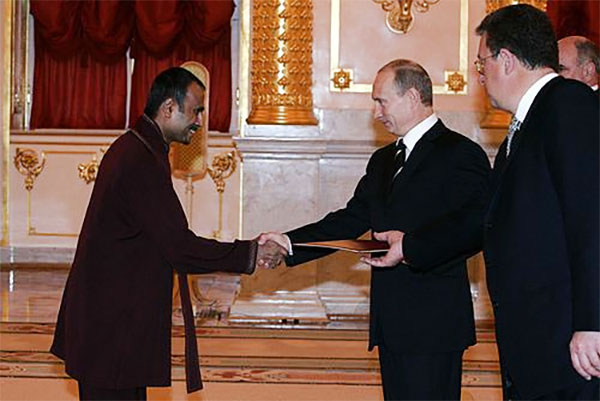
Udayanga Weeratunga presenting his letter of credentials to Russian President Putin at the Grand Kremlin Palace, Moscow

Inconsistency in GoSL reaction

Samagi Jana Balavegaya (SJB) lawmaker Dr. Harsha de Silva pointed out the discrepancy in the US and GoSL response to the Wickramasuriya affair. The US action in respect of Wickramasuriya should be examined taking into consideration the dismissal of several dozens of cases filed against the Rajapaksas and their acolytes.

Referring to a group of lawyers mounting a protest at the Attorney General Sanjay Rajaratnam’s Office during the ongoing campaign demanding President Gotabaya Rajapaksa to step down, Dr. de Silva said that a foreign court was able to carry out the judicial process to a successful conclusion. “How strange. All the high powered and connected crooks are found not guilty in local courts. We have a huge responsibility to do all we can to ensure the institutions are strengthened so that the corrupt are dealt without fear or favour.”

The Wickramasuriya affair has exposed the pathetic way overseas appointments are made at a time cash-strapped Sri Lanka is in the process of pruning diplomatic missions. Sri Lankan mission in Oslo is among those missions.

Successive governments have used diplomatic missions to accommodate those who served the interests of the powers that be. The incumbent dispensation is no exception. Although the appointment of non-career diplomats as heads of missions cannot be totally discontinued under any circumstances, no one can dispute the need for a balance. Over the years, diplomatic posts have been offered to various persons for a variety of reasons. There cannot be a worse example than misusing political authority in respect of diplomatic postings than former President Maithripala Sirisena offering an overseas posting to disgraced former IGP Pujith Jayasundara. Appearing before the Presidential Commission of Inquiry (PCoI) that probed 2019 Easter Sunday massacres, Jayasundara claimed that the President offered him a diplomatic post if he accepted the responsibility for those multiple suicide attacks. Jayasundara also claimed that he received an assurance he would be cleared by an inquiry that was being conducted at that time.

Corruption accusations

Against the backdrop of one-time Sri Lankan head of mission found guilty by a foreign court and the verdict to be delivered on July 20, in spite of Sri Lanka’s failure to do so, the need for a fresh look at the high profile case of Imaad Shah Zuberi, a Los Angeles-based venture capitalist and political fundraiser receiving 144 months in federal prison for defrauding Sri Lanka. Zuberi was sentenced in Feb 2021.

A US court found him guilty for cheating the Sri Lankan government millions of dollars promising to rebuild the country’s image following the end of the war with the crushing victory over the LTTE. The court was told Zuberi received USD 6.5 mn in 2014 following discussions initiated during Wickramasuriya’s tenure as Sri Lanka’s Ambassador in Washington.

Zuberi operated Avenue Ventures LLC, a San Francisco-based venture capital firm, and solicited foreign nationals and representatives of foreign governments with claims he could use his contacts in Washington, D.C. to change U.S. foreign policy and create business opportunities for his clients and himself.

US skullduggery

The US moved the Geneva-based United Nations Human Rights Council (UNHRC) against Sri Lanka in Oct 2015 after playing a significant role in the then Opposition campaign against President Mahinda Rajapaksa. No less a person than US Secretary of State John Kerry declared US funding for regime changing projects in four countries in 2014/2015, including Myanmar and Sri Lanka.

The Justice Department said: “Zuberi promised to make substantial expenditures on lobbying efforts, legal expenses, and media buys, which prompted Sri Lanka to agree to pay Zuberi a total of $8.5 million over the course of six months in 2014. Days after Sri Lanka made an initial payment of $3.5 mn, Zuberi transferred $1.6 million into his personal brokerage accounts and used another $1.5 million to purchase real estate.”

In total, Sri Lanka wired $6.5 million pursuant to the contract, and Zuberi used more than $5.65 million of that money to the benefit of himself and his wife. Zuberi paid less than $850,000 to lobbyists, public relations firms and law firms, and refused to pay certain subcontractors based on false claims that Sri Lanka had not provided sufficient funds to pay invoices.”

It has to be stated that the then government spent money on such foolish attempts to lobby Washington as the country was being hounded by the West for militarily crushing the LTTE, as their experts had been repeatedly telling us over the years our security forces were incapable of achieving such a task.

The Foreign Ministry here acknowledged that payments made to Zuberi had never been investigated at any level. The ongoing protest campaign demanding the government to quit also focused on corruption during the previous Rajapaksa administration. There is no point in denying waste, corruption, irregularities and mismanagement caused irreparable damage to the national economy.

Sri Lanka never investigated the Wickramasuriya affair and the role played by the Sri Lankan mission in Washington in hiring Zuberi, an American of Pakistani and Indian descent. A proper investigation would have probably revealed the involvement of certain politicians and officials there in the scam perpetrated by Zuberi.

The yahapalana administration never made a genuine attempt to investigate the Wickramasuriya affair though he was arrested. However, the then government facilitated the US investigation by waiving diplomatic immunity. But, the payments made to Zuberi via the Central Bank never received the attention of the yahapalana lot.

Once the writer raised this issue with Arjuna Mahendran, the then Governor of the Central Bank, a Singaporean national who fled the country in the wake of the Presidential Commission of Inquiry into the Treasury Bond scams handing over its report to President Maithripala Sirisena in late Dec 2017. Mahendran didn’t indicate any interest. In fact, he did nothing.

Udayanga Weeratunga, a first cousin of the then President Mahinda Rajapaksa, received appointment as Sri Lanka’s Ambassador to the Russian Federation. Weeratunga presented his credentials to Russian President Vladimir Putin at the Grand Kremlin Palace, Moscow, on Nov 16, 2006, a year after Mahinda Rajapaksa won the presidency. Weeratunga served in Moscow till Mahinda Rajapaksa’s defeat at the 2015 presidential election. Having enacted the dictatorial 18th Amendment to the Constitution at the onset of his second term, the war-winning President sought a third term but was defeated.

In January last year, SJB lawmaker Chaminda Wijesiri, raised concerns in Parliament regarding key diplomatic posts offered to those with political affiliations and to friends and relatives of political leaders. The MP questioned the manipulation of the whole process for the benefit of a few.

The then Foreign Affairs Minister Dinesh Gunawardena denied MP Wijesiri’s accusations. The MEP leader who is also the Leader of the House claimed that appointments hadn’t been based on political relationships. The Foreign Ministry followed the recruitment procedure and the appointments made to the Foreign Service had to be approved by the PHPC headed by the Speaker of Parliament. Of course, both Wickramasuriya and Weeratunga had been out of Foreign Service by 2014. Whatever the accusations directed at Weeratunga, he should earn the respect of the public for helping Sri Lanka enhance its firepower with the acquisition of Ukrainian MiGs for the SLAF at the onset of the Eelam War IV. Weeratunga secured the contract for the acquisition of four MiGs and the overhaul of four other MiGs that had been in service with the Air Force. However, controversy surrounds the 2006 deals with those who never believed in Sri Lanka’s triumph over the LTTE, causing media furore.