Wednesday, 7 September 2022

The Order of the Rising Sun conferred on former Governor of Central Bank, Sri Lanka

 SPECIAL REPORT : Part 434
Published

  
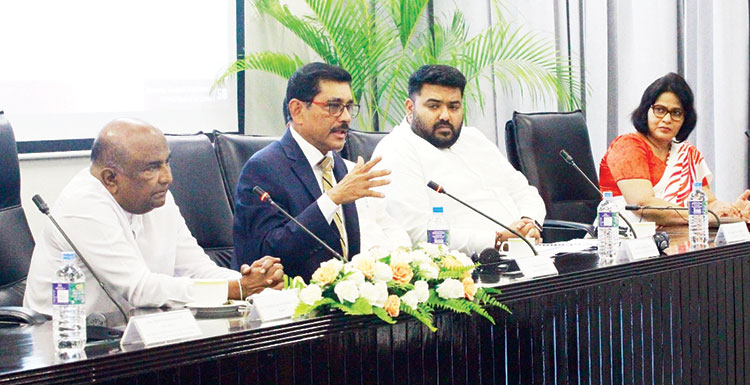
Governor, CBSL, Dr. Nandalal Weerasinghe, responding to lawmakers. (From left:) Speaker Mahinda Yapa Abeywardena, Dr. Weerasinghe, SLFP MP Angajan Ramanathan and Deputy Secretary General of Parliament, Kushani Rohanadeera, who introduced the Governor, while acknowledging the parliamentary accountability for finance (pic courtsy Parliament)

For the first time in parliamentary history, the Central Bank of Sri Lanka has issued a dire warning to Parliament and political parties therein over the responsibility on their part to ensure financial stability and discipline. Their failure to do so would trigger public protests again, they were told. There hadn’t been such a public warning. The warning was issued by no less a person than Dr. Nandalal Weerasinghe, Governor of the Central Bank, when he dealt with ‘Sri Lanka’s current economic situation and way forward’ on Aug 31.

By Shamindra Ferdinando

The Government of Japan, on August 22, conferred ‘The Order of the Rising Sun,’ Gold Rays with Neck Ribbon’ on Deshamanya Prof. Weligamage Don Lakshman, former Governor of the Central Bank (Dec 2019-Sept – 2021). Prof. W.D. Lakshman received the Japanese honour at a ceremony held at the residence of Japanese Ambassador Mizukoshi Hideaki. Kalyani Siriseeli Lakshman, the spouse of the emeritus professor, was conferred ‘The Order of the Rising Sun, Gold Rays with Rosette.’

The Japanese Embassy declared they were honoured for their distinguished contribution in promoting mutual understanding and friendship between Japan and Sri Lanka, through education.

‘The Order of the Rising Sun’ is awarded by the Emperor of Japan to foreign nationals who have made a distinguished contribution to enhancing friendly relations with Japan. The Japanese Embassy statement, dated August 22, also made reference to his tenure as the Governor of the Central Bank.

Before The Island dealt with Prof. Lakshman’s CBSL leadership, it would be pertinent to mention that Sri Lanka’s diplomatic relations with Japan suffered irreparable damage during this tenure when the former unilaterally cancelled the Tokyo-funded Light Rail Transit (LRT) project, after much groundwork had been completed. Dr. P.B. Jayasundera, the then Secretary to President Gotabaya Rajapaksa, in September 2020, just weeks after the UPFA scored a landslide victory at the last general election, issued instructions to terminate the Japan International Cooperation Agency-funded LRT on the grounds that it was ‘very costly and not the appropriate cost-effective transport solution for the urban Colombo transportation infrastructure.’

Recently, the former Chairman of the Committee on Public Enterprises (COPE) Prof. Charitha Herath, MP, asserted, in Parliament, that the cancellation of the LRT project still remained a mystery. The SLPP rebel alleged that even the person (Dr. PBJ) who issued instructions, in that regard, is silent over the circumstances leading to the cancellation of the project. Did President Gotabaya Rajapaksa, the Cabinet-of-Ministers, the Finance Ministry, or Dr. PBJ, who functioned as the President’s chief advisor on economic affairs, consult Prof. Lakshman and then Attorney General Dappula de Livera, PC, before rushing to that decision?

The Governor of the Central Bank heads the five-member Monetary Board. At the time Dr. PBJ issued instructions, as regards the termination of the project, the Monetary Board consisted of Governor Prof. W.D. Lakshman, S.R. Attygalle (both ex-officio), Sanjiva Jayawardena, PC, Dr. Ranee Jayamaha and Samantha Kumarasinghe.

During the COPE proceedings, in May this year, chaired by Prof. Herath, the parliamentary watchdog committee established failure as well as the responsibility on the part of the Monetary Board, Prime Minister Mahinda Rajapaksa (he held the finance portfolio at that time), the Cabinet-of-Ministers, and Dr. PBJ, for the current crisis. The incumbent Governor, CBSL didn’t mince his words when he, in response to questions posed by Prof. Herath and opposition SJB lawmakers, Patali Champika Ranawaka and Dr. Harsha de Silva, named those responsible. Soft spoken Dr. Weerasinghe didn’t hesitate at all when he identified Dr. PBJ as the one who blocked an early agreement between the government and the International Monetary Fund (IMF).

Of course reform medicines, that the Fund prescribes, are very bitter to swallow for those seeking its assistance and it is not short of critics around the world. And many of its patients, especially in Latin America and Africa, are yet in dire straits after swallowing its medicines for years, if not decades. Many of those countries have got some glimmer of hope only after countries like China came forth with generous aid projects, especially in the form of massive infrastructure developments, like railways, housing, etc., often criticized by the West.

Playing politics with a bankrupt economy

 Recently some members of Parliament demanded an inquiry into the failure on the part of Dr. Weerasinghe to inform Parliament of the status of the economy. They found fault with him for declaring Sri Lanka’s inability to service foreign debt before bringing it to the notice of the House.

A section of the media reported that Dr. Weerasinghe is in a soup for not duly informing Parliament about the ground situation. Perhaps, the lawmakers had conveniently forgotten that the then President Gotabaya Rajapaksa had requested Dr. Weerasinghe to take over the leadership of the CBSL after the country became virtually insolvent, even unable to pay for basics from abroad. At the time Dr. Weerasinghe retired, in January 2021, he held the post of Senior Deputy Governor and received the top post on April 08, about a month before a humiliated Mahinda Rajapaksa quit the premiership. Just 72 hours later, the UNP leader succeeded Rajapaksa. Less than two weeks later, Wickremesinghe secured the finance portfolio, too.

In fact, by the time Prof. Lakshman quit, in September 2021, to pave the way for Ajith Nivard Cabraal, who previously served as the Governor CBSL from 2006 to 2015, to return to the same top post, the economy was in tatters. Cabraal’s much publicized six-month roadmap didn’t change a thing. The ruling SLPP continued to engage in silly propaganda as the situation deteriorated, rapidly; by the time President Rajapaksa’s government approached Dr. Weerasinghe in Australia, the crisis was beyond control.

The retired political appointee Prof. Lakshman cannot absolve himself of causing unprecedented destruction and current turmoil though he simply succumbed to political pressure. What Prof. Lakshman actually did was the overseeing of the destruction of the economy in his capacity as the Governor and head of the Monetary Board.

Of course matters were exacerbated by some unforeseen events, beginning with the unprecedented terror attacks by Islamic terrorists here on Easter Sunday 2019, supposedly in retaliation for terror attacks on Muslims, in places like Christchurch, New Zealand, that delivered a body blow to the vital tourism industry here. Then before we could recover from that, there came the pandemic fear from the beginning of the following year with resultant lockdowns that also crippled the entire economy. To the credit of our rulers, we did weather the pandemic storm better than most countries, including India, where unknown numbers perished. We were also hit, like every other country, by the war in Ukraine, which could have been easily defused, like the 1962 Cuban missile crisis involving the then two super powers as now. But in our opinion what reduced us to being international beggars was the almost successful shutting down of our last lucrative foreign exchange earner, the remittances of our expatriate workers by illegal underground money transfer schemes, known as Hawala and Undiyal.

 It was also the fault of the authorities, going back to possibly the 1990s, for allowing private foreign exchange traders to operate with hardly any controls that led to the bleeding of vital foreign currencies from the country. It has been a known fact that proceeds from the lucrative drug trade had been easily repatriated abroad by drug dealers, thanks to the free availability of foreign currency with those dealers, where no questions are asked. We wonder whether such anti-national decisions were taken at the behest of economic hitmen at the IMF and the World Bank.

 Combination of these situations led to the country being reduced to an international beggar.

Hell-bent on appeasing his political masters, Prof. Lakshman, well past his prime, merely followed instructions. Those who remained as Monetary Board members, under Prof. Lakshman’s leadership, cannot absolve themselves of the responsibility for the current crisis. Had Jayawardena, a highly successful lawyer, and Jayamaha, a retired top Central Banker, and even headed private banks, were so concerned and opposed the conduct of Prof. Lakshman and Treasury Secretary Attygalle, they should have quit the outfit. Instead, they remained. And they continued to do so. Their declarations at the COPE proceedings of their failed bids to influence Prof. Lakshman cannot justify their failure.

Of course, the Japanese Embassy, in Colombo, shouldn’t be faulted for recommending the Order of the Rising Sun for Prof. Lakshman in the evening of his life for services rendered during better days. However, the Japanese Embassy caused quite a stir when Senior Professor Sampath Amaratunga, Chairman of the University Grants Commission (UGC) was conferred ‘The Order of the Rising Sun’ twice.

The academic received the award on 14 October 2021 from the then Japanese Ambassador in Colombo, Akira Sugiyama, at his official residence. For the second time, the UGC Chief received the same at Dharmavijayaloka Vihara in Rukmale in Pannipitiya at an event organized on January 22, 2022. The incumbent Japanese Ambassador Mizukoshi Hideaki and the then President Gotabaya Rajapaksa were present on the occasion.

Ali Sabry, PC, had the guts to defend Dr. Weerasinghe in Parliament. In fact, both Dr. Weerasinghe as well as Sabry, in his capacity as the Finance Minister squarely blamed those who had advised President Gotabaya Rajapaksa for the economic meltdown. Having held talks in Washington with the IMF and the World Bank in late May, Sabry, in an exclusive interview with Swarnavahini in early June disclosed how the advisors (Dr.PBJ, Governors of the CBSL, Treasury Secretary et al) deceived the President and the Cabinet-of-Ministers until it was too late.

No one challenged Sabry over his shocking declarations. Actually, Sabry basically repeated what Dr. Weerasinghe told the COPE.

Formidable challenge

Dr. Weerasinghe, obviously has earned the wrath of some lawmakers/political parties for taking an uncompromising stand against irresponsible governance. Addressing the Mps, on the invitation of Speaker Mahinda Yapa Abeywardena, in Parliament, the day after President Wickremesinghe, in his capacity as the Finance Minister presented an interim budget, Dr. Weerasinghe warned that the whole exercise, involving the IMF, could collapse if political parties didn’t change their strategies. Dr. Weerasinghe demanded a genuine acceptance of the agreement or warned political parties to prepare to face the consequences. Had the Parliament met its two primary obligations, namely financial responsibility and enactment of laws, the Speaker wouldn’t have found any justifiable reason to invite the Governor who indicated he would not stand any nonsense under any circumstances.

Whatever some unscrupulous politicians say, the vast majority of the public appreciated senior officials taking such a stand. It would be pertinent to mention the circumstances Dr. Weerasinghe received a six-year term on June 30 as the Governor, CBSL. Dr. Indrajith Coomaraswamy, who succeeded Arjuna Mahendran in June 2016, in the wake of the second far bigger Treasury bond scam, was unceremoniously asked to leave after Gotabaya Rajapaksa’s triumph at the Nov 2019 presidential election. Those who managed the President’s diary almost succeeded in depriving Dr. Coomaraswamy an opportunity to pay a courtesy call on the President before his retirement. Dr. Coomaraswamy’s six-year term was shared by Prof. Lakshman, Cabraal and Dr. Weerasinghe. Now that Dr. Weerasinghe has received a fresh six-year term, the government is not in a position to remove him, unless he left voluntarily.

At last a Governor of the CBSL has dared to take a principled stand vis-a-vis political interference. An utterly corrupt and reckless and irresponsible lot had been told in no uncertain terms that a bankrupt country couldn’t continue the way, those who represented the legislature wanted to exploit the electorate at the expense of the national economy.

The culpability of Cabraal, who represented Finance Minister Mahinda Rajapaksa cannot be disregarded. As the State Finance Minister for Money and Capital Markets and State Enterprise Reform (Aug 2020 to Sept 2021) Cabraal played a significant role in the overall financial management. Dr. Harsha de Silva has repeatedly raised Cabraal’s culpability as regards the current financial turmoil.

Reappraisal of perks and privileges

 As the country struggles to come to terms with the growing difficulties, the government in consultation with all political parties represented in Parliament and trade unions representing key sectors should review the national economy. The need to reexamine and take tangible corrective measures cannot be delayed any further. Perks, privileges granted to all sectors, should be reviewed. If they are genuine, the issuance of much abused duty free vehicle permits can be examined as part of the overall measures to save foreign exchange. Thanks to anti-corruption campaigner, controversial Attorney-at-Law Nagananda Kodituwakku, the country got to know how our lawmakers brazenly abused the duty free permits. They had an absolutely wonderful scheme (wonderful to them and their associates) which allowed them to sell the ownership of the duty free vehicles imported by them to those not entitled to that facility the same day the vehicles were registered in their names.

Nagananda Kodituwakku has not been successful in his attempts to move Court against those lawmakers engaged in a lucrative trade/massive scam with the blessings of Parliament whoever won the general election. Only a few declined the offer to obtain a duty free permit for the sole purpose of financially benefiting at the expense of the national economy.

At the onset of the financial crisis in 2020, the Finance Ministry submitted a Cabinet paper to import duty free vehicles for all MPs. The move was later shelved amidst growing public resentment. Over the years, successive governments mercilessly exploited the country until the national economy deteriorated to such an extent, violent public protests erupted on March 31.

Incumbent CBSL Governor warned political parties represented in Parliament that public protests could erupt again if they repeated their habitual political strategies meant to win elections at any cost.

Dr. Weerasinghe quite cleverly used his speech to highlight how all political parties shamelessly undermined the national economy by promising relief in spite of the government whoever was in power lacking the financial strength to do so. The lawmakers were warned against undermining the economy by electioneering based on promises. There had never been such a fiery speech delivered by an outsider to members of Parliament since the shifting of Parliament, from Galle Face to Sri Jayewardenepura, 40 years ago. Members of Parliament, past and present would have been humiliated and ashamed of the way they managed the national economy, especially since 1977.

The Parliament released the link that gave access to Dr. Weerasinghe’s full speech. President Ranil Wickremesinghe, Prime Minister Dinesh Gunawardena, the Cabinet-of-Ministers, leaders of political parties represented in Parliament, the media and the civil society should pay attention to the Governor’s talk. The Executive, the Legislature and the Judiciary should heed the concerns raised by the Governor. There had never been such a straightforward criticism of an utterly corrupt system that thrived at the expense of the public.

Dr. Weerasinghe response to reckless, corrupt and irresponsible system can be examined against the backdrop of advice given by Dr. Coomaraswamy several years ago. In Nov 2018, Coomaraswamy advised the electorate as regards parliamentary elections. Dr. Coomaraswamy made the appeal before the Presidential Commission of Inquiry (PCol) on irregularities at SriLankan Airlines, SriLankan Catering and Mihin Lanka.

Dr. Coomaraswamy told the PCol almost prophetically that the country was facing a non-virtuous cycle of debt and it was a very fragile situation which could even lead to a debt crisis. “Of course my colleagues in the debt department have plans and capability to manage it. But it’s the duty of every citizen to act responsibly as regards the government policy”, he told the PCol. Dr. Coomaraswamy emphasized that people should elect MPs who were prudent enough to handle fiscal and monetary matters of the country. “I am not referring to any government, but it’s been the case ever since Independence”.

Obviously, the electorate didn’t heed Dr. Coomaraswamy’s call. Those who won the next general election in Aug 2020 simply allowed things to slip out of control. They couldn’t have done so without the support of those who managed the economy. Two of Dr. Coomaraswamy’s successors, Prof. Lakshman and Cabraal are under fire for their role in the current crisis. The Court has been moved against Cabraal.

Dr. Coomaraswamy is on record as having said that the failure on the part of successive governments to manage expenditure since the country gained Independence has caused the current economic instability.

Months later, in response to The Island query, Dr. Coomaraswamy declared Sri Lanka had been plagued by a toxic combination of populist politics and an entrenched entitlement culture among the people.

“Time and again, the electoral calendar has undermined fiscal discipline,” Dr. Coomaraswamy asserted.

Wednesday, 31 August 2022

Corruption saga continues

 SPECIAL REPORT : Part 433

Published

  
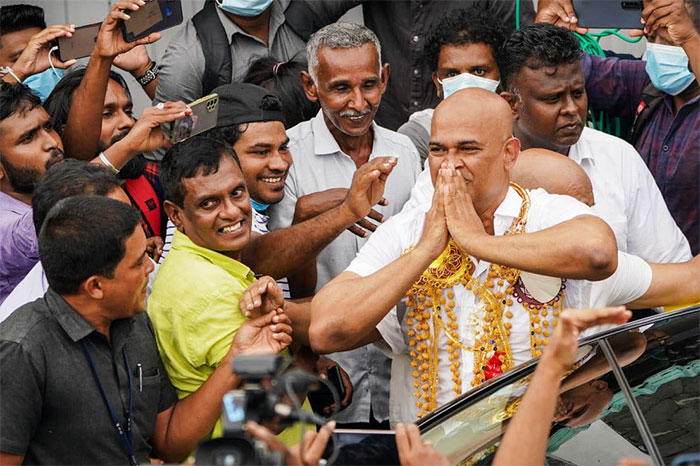
A jubilant Rankan Ramanayake leaving Welikada prison (pic by Jude Denzil Pathiraja)

By Shamindra Ferdinando

The Sri Lanka Institute of Directors (SLID) and Transparency International Sri Lanka (TISL) recently declared corruption as the root cause of Sri Lanka’s current political and economic crisis. The declaration was made in a statement titled, “SLID and TISL launch ‘Business Against Corruption’ Initiative” issued to the media after the two organisations finalised an agreement on a three-year plan to address the issues at hand.

The statement described the contract as strategic collaboration between the two NGOs. Veteran banker Faizal Salieh and Attorney-at-Law Nadishani Perera signed the agreement for SLID and TISL, respectively.

TISL was launched in late 2002 whereas SLID came into being in April 2000. The assertion that corruption bankrupted the country underscored the failure on the part of successive governments (parliaments), the Finance Ministry, Monetary Board, CIABOC, Attorney General’s Department and the Auditor General’s Department, as well as apparent well-meaning bodies, like SLID and TISL. The way the political party system hindered and diluted the National Audit Bill and the Parliament moved court against the releasing of MPs’ asset declarations indicate the challenges faced in reforming the system.

No less a person than the Governor of the Central Bank Dr. Nandalal Weerasinghe, in May this year, acknowledged Sri Lanka’s shameful status. Dr. Weerasinghe, who retired as Senior Deputy Governor, CBSL in January 2021, was requested to take over the CBSL in April this year in the wake of Ajith Nivard Cabraal’s resignation amidst an unprecedented deterioration of the country’s financial situation.

Nadishani Perera succeeded as TISL’s Executive Director from Asoka Obeysekera in January 2021. Salieh was unanimously elected as the Chairman, SLID for the year 2021/22 at a virtual AGM held on Aug. 11, 2021. It would be pertinent to mention that the then State Minister of Finance, Capital Markets and State Enterprise Reforms Cabraal was the Chief Guest at this meet held a month before Central Bank Governor Prof. W.D. Lakshman was unceremoniously asked to step down to pave the way for the State Minister to return to the Governor’s Office.

Cabraal previously served as the 12th Governor of CBSL from July 2006 to January 2015 and returned. His second stint as the 16th Governor, CBSL lasted just eight months. As the 16h Governor he was elevated to the Cabinet rank. As a result, the Governor’s rank in the Table of Precedence has gone up from 20th to fifth place. The Governor is now ranked below the President, Prime Minister, Speaker and the Chief Justice.

In joint fifth place, the Table of Precedence comprises the Leader of the Opposition, Cabinet of Ministers and the Field Marshal.

When Cabraal succeeded Prof. Lakshman the government was in serious difficulty. Having ignored the IMF’s advice in early 2020 to restructure the debt and drop plans to do away with a range of taxes, the then President Gotabaya Rajapaksa’s government caused immense damage to the national economy. But the economic fallout cannot be entirely blamed on corruption since the country had to fend off the worldwide pandemic and the 2019 Easter Sunday terror attacks by Islamic extremists, both of which crippled the country’s vibrant and vital tourism industry and worker remittances, coupled with the fallout from the war in Ukraine.

Nadishani Perera declared their primary objective was to eradicate corruption supported by the private sector. She said so in response to a query from us. They’ll be seeking required funding from the ADB, World Bank and other institutions such as the Centre for International Private Enterprise (CIPE).

A toxic combination of waste, corruption, irregularities, mismanagement and ill-advised decisions contributed to the worst-ever crisis post-independence Sri Lanka experienced. Both public and private sectors should accept responsibility for the crisis. Shocking disclosures made by the Auditor General and at proceedings of the Committee of Public Enterprises (COPE), Committee of Public Accounts (COPA) and Committee of Public Finance (COPF) over the years repeatedly proved culpability of Parliament for the financial crisis.

The SLID-TISL project is meant to enhance transparency, accountability and integrity by encouraging ethical business practices, fair market competition, fair pricing and credible leadership.

The joint statement quoted Salieh as having said: “We are mindful of the current state of affairs, the ground realities, and the challenges faced by companies in doing business. Therefore, our approach on this journey is pragmatic and practical and will enable businesses to proactively and progressively mitigate the corruption risk using preventive measures, checks and balances on a voluntary, ‘best efforts’ basis.”

Nadishani Perera was quoted as having said: “Businesses play a critical role in any nation’s efforts against corruption. At this unique and transformative moment in Sri Lanka’s history, as the citizens have risen against corruption, it is of utmost importance that the business community also commits to do its part towards this mission.”

Bond scams

 In spite of high-profile projects reportedly meant to restore public confidence in public and private sectors, the situation continues to deteriorate. That is the undeniable truth. In late Nov 2016, the USAID in partnership with Sri Lanka Parliament launched USD 13 mn (Rs 1.92 bn) project to strengthen accountability, transparency and good governance.
Parliament owed the public an explanation as regards the success or utter failure of the three-year project. Did it achieve its objectives? Perhaps, the then Speaker Karu Jayasuriya, in his new capacity as the Chairman of the National Movement for Social Justice (NMSJ) will care to explain the outcome of the USAID project. The USD 13 mn project should be examined against the backdrop of the Treasury bond scams perpetrated in Feb 2015 and March 2016 under then yahapalana (good governance) rule. Then Speaker Jayasuriya and the US obviously didn’t care that the yahapalana government delayed investigations into the Treasury bond scams and actually nothing really was done about it until then President Maithripala Sirisena appointed a presidential Commission of Inquiry (CoI) that included two sitting Supreme Court judges in late January 2017 to carry out a public probe.

Probably, Sirisena, now an SLPP MP (Polonnaruwa district) must have quite conveniently forgotten how he dissolved Parliament at midnight on June 26, 2015 to prevent the then COPE Chairman D.E.W. Gunasekera from tabling in Parliament his report on the first Treasury bond scam. At the behest of the UNP leadership, the then lawmaker Attorney-at-Law Sujeewa Senasinghe moved court to thwart the releasing of the COPE report. Senasinghe, an Attorney-at-Law even had the audacity to write a book denying the scam.

Regardless of Perpetual Treasuries Limited (PTL) being under the spotlight over the Treasury Bond scams, the Bar Association of Sri Lanka (BASL) had no qualms in receiving sponsorship amounting to Rs 2.5 mn in support from the tainted firm for its project, Law Asia 2016. The Colombo Port City and the USAID had been among the BASL’s sponsors for its other events.

 Eight years after the first Treasury Bond scam, what is the current status of the investigations and Sri Lanka’s efforts to convince Singapore to extradite Arjuna Mahendran, under whose watchful eyes as the Governor, CBSL the Treasury Bond scams took place? Can the Attorney General and the Justice Ministry explain measures taken by them since the change of government in July to have Mahendran extradited? Against the backdrop of assurances given by the Justice Minister Dr. Wijeyadasa Rajapakse, PC, that a Bill to combat fraud and corruption would be enacted soon, the public have a right to know how the new government intended to handle Treasury Bonds scams probe/prosecutions.

Singapore-based Mahendran challenged The Island editorial (‘Cops and Robbers’) of Friday August 19, 2022. Denying he fled the country, the Singaporean revealed that his Counsel Romesh de Silva, PC secured the permission of Supreme Court justice K.T. Chitrasiri for him to leave the country. Justice Chitrasiri headed the CoI. The issue at hand is whether Mahendran through his learned Counsel gave an assurance to Justice Chitrasiri that he would return to the country in case the Attorney General initiated legal action over the Treasury Bond scams. Perhaps, Mahendran’s Counsel should set the record straight.

The question is when President’s Counsel Romesh de Silva made the request on behalf of Mahendran and secured approval as the former CBSL Governor claimed, did he give an assurance to the CoI that he would return within a specific period or did the CoI sought such a pledge from him.

Vidanapathirana Associates, on behalf of Ranil Wickremesinghe, several weeks after the last presidential election in Nov 2019, responded to a spate of allegations pertaining to Treasury Bond scams et al directed at the former Premier by yahapalana regime President Maithripala Sirisena. Responding to specific allegation that Wickremesinghe helped Mahendran to escape Sri Lankan justice, Vidanapathirana Associates stated (verbatim): “Mr. Arjuna Mahendran gave evidence before the Presidential Commission and therefore obtained its permission to leave Sri Lanka. He has not returned since then.”

The Attorney General’s Department should inquire into the circumstances under which Mahendran left the country.

Controversy over privatization

 Restructuring/privatization of loss-making state enterprises has received attention as part of the overall economic recovery efforts. However, rebel SLPP lawmaker Dr. Nalaka Godahewa recently raised the possibility of the new government exploiting the current economic crisis to privatize profit-making ventures, such as Sri Lanka Insurance Corporation (SLIC) and Sri Lanka Telecom. The former Viyathmaga activist was responding to President Ranil Wickremesinghe’s recent declaration as regards privatization.

Declaring his whole hearted support for the proposed restructuring of loss-making enterprises, Dr. Godahewa however questioned the move to privatize the profitable ventures. Such privatizations will further weaken the public sector due to the Treasury being deprived of much needed cash. Dr. Godahewa assertion that the vast majority of 94 state enterprises privatized between 1990-2003 during the tenure of late President Ranasinghe Premadasa and ex-President Chandrika Bandaranaike Kumaratunga were profitable ventures reveals how the powers that be gradually deprived the Treasury of wherewithal.

The lawmaker while making reference to the controversial circumstances China secured the Hambantota port on a 99-year-lease for USD 1.2 bn in 2017, questioned the move to privatize SLIC and SLT.

Commenting on what he called Sri Lanka’s infamous privatization policy, Dr. Godahewa mentioned a few interesting facts regarding the privatized enterprises though he refrained from naming them. (1) The Supreme Court in 2009 reversed the sale of SLIC for Rs 6 bn during the tenure of Kumaratunga’s regime. At the time of the transaction, the SLIC had assets estimated to be worth over Rs 30 bn (2) The Supreme Court also in the same year reversed two more corrupt transactions, namely Waters Edge and Lanka Marine Services (3) A person who bought a plantation company earned a 100 percent profit within 24 hours after he sold the same property for double the amount he paid for (4) Those who acquired a company that dealt with food much more cash they paid for that particular state enterprise. That enterprise had more money in its bank accounts and the safes than what was received by the government from the buyer and (5) Some of those buyers earned massive profits by selling machinery and equipment.

So, no wonder she was dubbed Chaura Regina (bandit queen) by her one-time political soulmate Victor Ivan in a book he published and to this date ex-President Kumaratunga has not dared to challenge the accusations either in a court of law or by word.

The whole privatisation/restructuring programme appeared to have been carried out at the expense of the national economy while successive governments packed the public enterprises with their supporters. But the massive expansion of the public sector took place at the behest of Mahinda Rajapaksa, who served as the President from Nov 2005 to January 2015.

Public Administration Secretary Priyantha Mayadunne didn’t mince his words a few months ago when he declared how the public service had become an unbearable burden to the taxpayer. But why didn’t he speak up earlier? Mayadunne explained how the public service had been recklessly expanded to nearly 1.5 mn whereas the requirement was 500,000. One-time Justice Ministry Secretary Mayadunne emphasized the need to restructure the public service. Mayadunne’s warning to political parties represented in Parliament, state and private sector trade unions and the civil society that they will soon be categorized as traitors unless they agreed to far reaching economic reforms appeared to have fallen on deaf ears.

Regardless of consequences, the government and the Opposition seemed still struggling to score petty political points than reaching a consensus on workable solutions to address grave political, economic and social issues. Their failure to agree on urgently needed reforms agenda is evidence that the public cannot depend on political parties represented in parliament. Instead of addressing issues at hand, particularly the internationally supervised debt restructuring plan, those who are responsible for the economic fallout seemed determined to consolidate their positions while pursuing the same old strategies.

The government owed an explanation as regards accusations pertaining to the planned privatization of the SLIC and SLT.

TISL’s corruption index

 According to TISL’s most recent Corruption Perception Index (2021) Sri Lanka is ranked 102nd out of 180 countries and territories by their perceived levels of public sector corruption. This assessment is certainly questionable. If corruption allegations directed at decision-makers, both in and outside Parliament, are properly examined taking into consideration the responsibilities of the executive, members of the legislature as well as the judiciary, Sri Lanka must be among the worst lot. The proceedings of the parliamentary watchdog committees, periodic reports released by them as well as the Auditor General’s reports paint a bleak picture. The SLID and TISL should inquire into public enterprises as the former represents nearly 1,000 personnel at top management level at state and private sectors. Instead of taking tangible measures to tackle waste, corruption, irregularities and mismanagement, the anti-corruption project could become yet another lucrative trade.

 Former Samagi Jana Balavegaya lawmaker Ranjan Ramanayake declared as he left Welikada prison last Friday (26) that Justice Minister Dr. Wijeyadasa Rajapakse, PC, asked for a guarantee from him that he would continue his anti-corruption campaign. The declaration was made after Ramanayake serving a four-year term of RI for contempt of judiciary received a presidential pardon after he publicly acknowledged there was no basis for accusations, he directed at the judiciary on Aug 21, 2017 outside Temple Trees. The former MP apologized to the judiciary while promising not to say anything inimical to the judiciary ever again. Obviously, those who had gathered outside Welikada prison to welcome Ramanayake didn’t really comprehend the implications of the politician going back on his much-publicized declarations. During his tenure as a UNP MP, Ramanayake twice lashed out at the judiciary. In respect of the second case the Supreme Court sentenced him to two years RI suspended for five years.

There had never been a proper inquiry into Ramanayake’s audio tapes though they captured the attention of the public. The releasing of audio tapes of conversations among SSP Shani Abeysekara (he hadn’t been appointed Director CID then), the then Deputy Minister of Social Empowerment Ranjan Ramanayake, the then High Court judge Mrs. Padmini Ranawaka and President Maithripala Sirisena, in the wake of the 2019 Presidential Election, sent shock waves through political parties, the judiciary, the police and the civil society.

Controversy still surrounds the circumstances under which the police received the recordings, secretly made by Ramanayake. Selected tapes were released to both the print and electronic media. Attempts to hush up the shocking revelations, pertaining to the Himbutana killings (Bharatha Premachandra killing), and the subsequent judgment failed.

Those in authority conveniently refrained from conducting a proper investigation into the scandalous interventions made by Ramanayake, as well as the conduct of HC judge Mrs. Ranawaka, and Abeysekara, though the police recorded some statements, including that of Mrs. Ranawaka.

Parliament suppressed the matter. The then Speaker Karu Jayasuriya should explain what really happened. Jayasuriya was among those who called for presidential pardon for Ramanayake. The failure to examine Parliament’s pathetic response to the disturbing revelations and the suppression of CDs is a matter for concern.

Did Ramanayake speak to High Court Judge Mrs. Ranawaka to influence the murder conviction against Duminda Silva, sans permission from the party leadership? Did the then top UNP leadership tell him to approach judges in respect of various cases?

Ramanayake is also on record phoning High Court judge Gihan Pilapitiya and Magistrate Dhammika Hemapala. Following the disclosure of a fraction of the tapes, the police recorded statements from Mrs. Ranawaka (retired), Pilapitiya and Hemapala.

Let me focus on the conversations involving Mrs. Ranawaka, Ramanayake, Abeysekara and President Sirisena (now SLPP Polonnaruwa district MP. Sirisena also remains the SLFP leader).

Mrs. Ranawaka had no qualms in declaring that she had no confidence in President Sirisena though she subsequently directly pleaded with him to promote her to the Court of Appeal. Mrs. Ranawaka expressed doubts about President Sirisena when Ramanayake phoned her on July 14, 2016, in the wake of Abeysekara expressing serious concerns over the way the Duminda Silva matter, and related issues, were proceeding to their dislike. Nearly two dozen conversations, involving Ramanayake and Abeysekara, should have been examined without taking them in isolation. According to conversations now in public domain, Mrs. Ranawaka asked Ramanayake to intervene on her behalf when the latter pressed her on the pending judgment on the Himbutana killings. The judge also made reference to the then lawmaker and Attorney-at-Law Ajith P. Perera during her conversation, initiated by Ramanayake. The way the conversation continued, clearly indicated that the call taken by Ramanayake, on July 14, 2016, couldn’t have been the first and they knew each other very well. Mrs. Ranawaka, obviously exploited Ramanayake’s intervention to explore the possibility of moving up the ladder with unbridled political patronage.

Let there be a thorough inquiry into matters of concern. A genuine effort is needed.

Wednesday, 24 August 2022

Corruption: The House in a bind

 SPECIAL REPORT : Part 432

Published

  
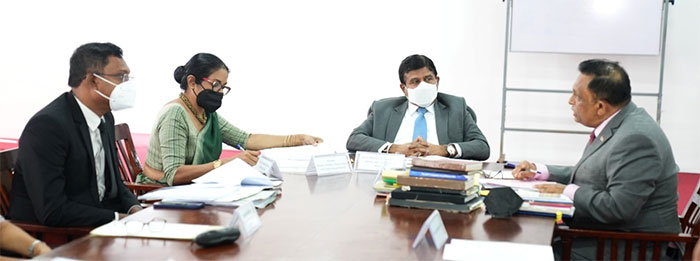
Minister Dr. Wijeyadasa Rajapakse, PC, listening attentively to Sarath Jayamanne, PC, at a recent meeting, at the Justice Ministry, to discuss amendments to the proposed anti-corruption Bill. Jayamanne served as Director General CIABOC (Commission to Investigate Allegations of Bribery or Corruption) during the yahapalana rule. Lawmaker Rajapakse served the same government, as a minister, before the then President Maithripala Sirisena, acting on the behest of the UNP, abruptly removed him from the Cabinet-of-Ministers after he directed corruption allegations against the regime over the leasing of the Hambantota port on a 99-year lease. (From left) Attorney-at-law Ravindranath Dabare, Justice Secretary Wasantha Perera, Minister Wijeyadasa Rajapakse and Sarath Jayamanne (Pic courtesy Justice Ministry)

In the absence of a proper ‘mechanism’ to tackle the massive waste, corruption, irregularities and mismanagement, disclosed by the parliamentary watchdog committees, COPE, COPA and COPF, they are quietly suppressed. In spite of repeated assurances given by the Parliament, tangible measures hadn’t been taken, so far, to ensure legal measures against those responsible. Therefore, the Parliament cannot absolve itself of the responsibility for the current crisis caused by a toxic combination of reckless decision-making, waste, corruption, irregularities and mismanagement.

By Shamindra Ferdinando

Justice, Prisons Affairs and Constitutional Reforms Minister Dr. Wijeyadasa Rajapakse, PC, recently declared that the major allegation directed at lawmakers, was corruption, Minister Rajapakse recalled how he was removed from the post of Chairman of the Committee on Public Enterprises (COPE) during Mahinda Rajapaksa’s first term (2005-2010) as the President, after the outfit disclosed allegations, pertaining to misappropriation of as much as Rs 300 bn in public funds.

Minister Rajapakse said so at the OPA’s (Organisation of Professional Associations) 2022 awards ceremony held at the Cinnamon Lakeside on August 16. Addressing the gathering, after President Ranil Wickremesinghe and Speaker Mahinda Yapa Abeywadena, the one-time President of the Bar Association of Sri Lanka (BASL) said that the Cabinet-of-Ministers has approved a new Bill meant to tackle corruption and fraud. The project has received the support of retired Senior Additional Solicitor General Sarath Jayamanne, PC, lawmaker Rajapakse said, while disclosing the proposed law would deal with asset declarations of lawmakers. Let us hope that the new law, once enacted, will lead to examine among other things the scandalous refusal by Parliament to release the list of its members who have filed their declarations of assets and liabilities, from 2010-2018, in answer to an appeal filed by a journalist Chamara Sampath. The Parliament declined to release the required information in spite of the Right to Information Commission asserting that such information is not protected by parliamentary privilege.

PC Jayamanne, who retired in January last year, was also present on the occasion. Having received the appointment as Director General of the Commission to Investigate Allegations of Bribery or Corruption (CIABOC) in Nov 2016, Jayamanne served in that post till late January 2020. Obviously, Jayamanne hadn’t been acceptable to the Gotabaya Rajapaksa administration. The Rajapaksa administration turned the CIABOC and the Attorney General’s Department upside down. The dismissal of so many cases, filed during Jayamanne’s tenure as the DG, CIABOC and incumbent Chief Justice Jayantha Jayasuriya, PC, in his capacity as the AG, since the last presidential election, is an issue that should be addressed by President Wickremesinghe’s government.

There were obvious shortcomings in those filings, like failure to obtain signatures of all bribery commissioners to sign up on those indictments.

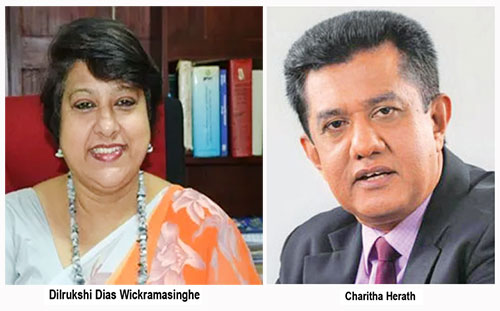
The soft spoken senior AG’s Department officer replaced DG, CIABOC, Dilrukshi Dias Wickramasinghe after the then President Maithripala Sirisena publicly rapped her over the handling of bribery and corruption cases, particularly the high profile AGMS (Avant Garde Maritime Services) investigation.

Actually, the yahapalana government suffered irreparable damage, in late 2015, when its law and order Minister Tilak Marapana, PC, resigned after having defended the AGMS. Dr. Rajapakse, too, strongly defended the ex- Army Commando Officer Maj. Nissanka Senadhipathy’s enterprise.

Minister Rajapakse gave the assurance on a new law to tackle corruption and fraud in the wake, President Wickremesinghe addressing the contentious issue at the inauguration of the third session of the 9th Parliament.

The Presidential Media Division (PMD) in a statement issued in Sinhala, quoted Minister Rajapakse as having asserted that the ‘Aragalaya’, (public protest movement) had been caused by yahapalanaya sans transparency.

The moves to introduce a new Bill, against corruption and fraud, should be examined taking into consideration a controversial Cabinet proposal to pay compensation to 27 persons who held senior administrative posts and other positions during the Mahinda Rajapaksa presidency. They have been offered compensation to the tune of nearly Rs 120 mn whereas appeals made by 11 others were rejected.

The compensation has been awarded by a committee, headed by former Chief Justice Asoka de Silva. Other members of the committee, appointed by the then President Gotabaya Rajapaksa, are former Court of Appeal Judge Sunil Rajapaksa, President’s Counsel V.K. Choksy, former Auditor General S. Swarnajothi (resigned on November 11, 2021 and succeeded by Chartered Accountant K.S. Chandrapala de Silva), and retired Accountant H.D. Weerasiri.

The ruling SLPP (Sri Lanka Podujana Peramuna) wants Prime Minister Dinesh Gunawardena to submit the Cabinet paper, in this regard, to the Cabinet of Ministers, headed by President Wickremesinghe. The case of those who had been allegedly victimized by a disputable process initiated by the then yahapalana Premier Wickremesinghe is likely to be presented to the Cabinet of Ministers, headed by Wickremesinghe himself. What would be the Justice Minister’s stand?

Shocking case of a Solicitor General

After Sri Lanka’s triumph over separatist Tamil terrorism, the then President Mahinda Rajapaksa vowed to eradicate corruption. But, just over a decade later, waste, corruption, irregularities and mismanagement, at every level of administration, has resulted in the country being declared bankrupt. The need to carefully examine the responsibility as well as the accountability on the part of the executive, the legislature and the judiciary cannot be ignored. The legislature should accept the major blame as public finance and enactment of new laws are its responsibility.

Let us discuss Solicitor General Dilrukshi Wickramasinghe’s dilemma—a case that never received sufficient media attention. Having lost the post of DG, CIABOC under controversial circumstances, Wickramasinghe returned to the AG’s Department where she maintained a low profile. The then Attorney General Dappula de Livera, PC, interdicted her on Sept. 25, 2019, following a leaked telephone conversation she had with Avant Garde proprietor Senadhipathi in her capacity as the DG, CIABOC. The conversation was leaked to the media on Sept. 20, 2019, immediately after the recording of the discussion, without her knowledge.

The highly embarrassing recorded telephone conversation, whether edited or not, with Avant Garde Chairman Nissanka Senadhipathy, in which she virtually admits how she had to abuse her position in that litigation. That aspect was never investigated.

In spite of her being cleared by the Administrative Appeals Tribunal (AAT), she was not allowed to return to the AG’s Department regardless of specific instructions issued in that regard. The ruling was given in respect of a case filed by Wickramasinghe against the Public Service Commission (PSC).

Wickramasinghe retired on July 30, 2021 after reaching the compulsory retirement age. The unparalleled ruling was given by a three-member AAT consisting of Justice N.E. Dissanayake, A. Gnanathasan, PC and G.P. Abeykeerthi. Justice Dissanayake functioned as the Chairman of the highest tribunal empowered to inquire into such an appeal.

Wickramasinghe appealed to the AAD on Oct 5, 2020. The AAT inquired into disciplinary authority exercised by the PSC in respect of the Solicitor General.

The original ruling that had been given on July 14, 2021 was amended on July 22 subsequent to the PSC seeking clarification of some matters which the AAT considered important. The AAT acknowledged that the issues that had been raised by the PSC weren’t taken into consideration at the time of the issuance of the July 14 ruling.

Attorney-at-law Riad Ameen and Assistant Secretary PSC Srinath Rubasinghe appeared for Wickramasinghe and the PSC, respectively.

The leaked telephone conversation in question was over the controversial case of the Avant Garde floating armoury that divided the previous government, with two ministers with excellent legal backgrounds striking discordant notes.

Dappula de Livera’s successor, Sanjay Rajaratnam, PC, hadn’t, however, allowed SG Wickramasinghe to resume work in spite of the original order nor the amendment ruling given on July 14 and July 22, respectively. A copy of the original order was delivered to the AG’s Office on the evening of July 14.

The AAT ordered (1) Immediate cancellation of PSC directive dated April 06, 2021 that placed SG on compulsory leave pending the completion of a formal inquiry (2) Rescinding of the PSC directive dated October 19, 2020 that sent the SG on compulsory leave to pave the way for her to resume duties (3) Retiring her on July 30, 2021 on her reaching the compulsory retirement age and (4) finalising the much-delayed formal inquiry into the SG’s conduct in terms of Public Administration Circular 30/2019 dated September 30, 2019, expeditiously.

But, the above-mentioned directives were not carried out. Therefore, Wickramasinghe had to retire on reaching the retirement age.

Having acknowledged that Wickramasinghe had found fault with the PSC for the undue delay in finalising the preliminary inquiry and reinstate her, the AAT asserted that the PSC failed to ‘exercise its discretion in a justifiable, reasonable and an objective manner.

The AAT pointed out that Senadhipathy trapped Wickramasinghe with the help of the then UNP Minister Vajira Abeywardena, who gave his phone to the Solicitor General, declaring that Senadhipathy was on line. According to the proceedings, Abeywardena received the call at a Colombo hotel while he was having dinner with Wickramasinghe and her husband. Abeywadena succeeded Ranil Wickremesinghe in Parliament as the only UNP National List MP.

The AAT questioned the failure on the part of those who conducted the preliminary inquiry to record Abeywardena’s statement or examine his phone. The AAT also noted that Senadhipathy spoke to Wickramasinghe through Abeywardena’s phone after Wickramasinghe strongly opposed the Minister’s move to invite the Avant Garde Chairman to have dinner with them at Abeywardena’s residence at Queen’s Road, Colombo 07.

The AAT stated that it had the power to take remedial measures in respect of decisions ‘tainted with error in law and fact’ taken by the PSC.

The AAT also pointed out that Wickramasinghe hadn’t initiated the call and from the outset she insisted that the recording was ‘doctored, edited and distorted.’ Proceedings revealed that AG de Livera had first listened to a tape recording that was edited at 10 places and Senadhipathy himself admitted having edited the recording but he never submitted the original to the Preliminary Investigation Committee. The AAT pointed out that the AG de Livera at the time he made a statement at the preliminary investigations based his assessment on what the AAT called an edited, distorted and unauthentic version of the recording.

Moves against Prof. Herath

Prof. Chritha Herath, former Chairman of the parliamentary watchdog, the committee on Public Enterprises has been quite conveniently dropped from the COPE. Rebel SLPP lawmaker Dullas Alahapperuma recently took up this case with Prime Minister Dinesh Gunawardena. This issue has been taken up along with the discarding of those who voted for him at the presidential contest on July 03. All of them have been dropped from ‘operating committees.’

Sri Lanka Audit Service Association (SLASA) recently requested President Wickremesinghe to re-appoint both Prof. Herath and Chairman of the Committee on Public Accounts (COPA) Prof. Tissa Vitharana. This request has been made on the basis of the performance of the COPE and COPA under the much appreciated leadership given by the two Professors.

However, in the wake of the break-up of the SLPP over differences over economic and political strategy, lawmakers Herath and Vitharana have ended up among the rebels. Prof. Herath switched his allegiance to the group spearheaded by SLPP Chairman Prof. G.L. Peiris and Dullas Alahapperuma, whereas Prof. Vitharana joined the other rebel group also elected on the SLPP ticket.

The SLASA, in its letter to President Wickremesinghe pushed strongly for the re-appointment of the two lawmakers as the heads of the two parliamentary watchdog committees. The outfit warned of efforts to undermine the overall process of bringing the watchdog committees under utterly corrupt elements.

Speaker Abeywardena should look into the accusations made by SLASA without delay. In case, the Speaker felt the outfit made a deliberate attempt to mislead the President and the Parliament, it should be asked to explain.

Prof. Herath obviously angered the powers that be by courageously pursuing investigations with the support of his committee. It would be pertinent to mention that COPE investigations depend on the disclosures made by the Auditor General’s Department. AG W.P.C. Wickremaratne participated in COPE proceedings or was represented by a senior Department official. Lawmakers Patali Champika Ranawaka and Dr. Harsha de Silva, both members of the main Opposition Samagi Jana Balavegaya (SJB) played a significant role in the examinations undertaken by COPE.

Prof. Herath’s stand at the COPE where he quite clearly antagonized the top SLPP leadership can be compared with the challenge faced by lawmaker Wijeyadasa Rajapakse during Mahinda Rajapaksa’s first term. The reaction of the political party in power to investigations undertaken by watchdog committees over the years revealed the nexus between political power and corruption at every level of the government. There cannot be a better example than the high profile Litro case that exposed the government. Litro, owned by Sri Lanka Insurance Corporation (SLIC) in 2020 hired top law firms to prevent state audit of the enterprise. Over Rs 20 mn was spent on the project. Among those who had been engaged by Litro were Romesh de Silva, PC, tasked with drafting a new Constitution and Sanjiva Jayawardena, PC, member of the Monetary Board. Under Prof. Herath’s leadership COPE took a strong stand against Litro’s move. The SLPP National List member didn’t mince his words when he questioned the rationale in a government-owned enterprises objecting to state audits. Unfortunately, the COPE obviously didn’t receive the backing it required both inside and outside parliament to fight corruption.

COPE created history in May this year when it quite clearly established the circumstances leading to the unprecedented economic fallout. Governor of the Central Bank Dr. Nandalal Weerasinghe, Finance Secretary Mahinda Siriwardana and Monetary Board members, Sanjiva Jayawardena, PC and Dr. Ranee Jayamahaha confirmed how the then Governor of the Central Bank Prof. W.D. Lakshman, Finance Secretary S.R. Attygalle, Prime Minister Mahinda Rajapaksa, in his capacity as the Finance Minister, Cabinet-of-Ministers and Presidential Secretary Dr. P.B. Jayasundera pursued a dangerous economic line.

 It is a mystery why Jayamaha and Jayawardena continued to serve in the Monetary Board under successive CB Governors if they disagreed with policies pursued by them.

Against the backdrop of assurance given by President Wickremesinghe and Justice Minister Wijeyadasa Rajapakse that a new Bill would be enacted to fight corruption and fraud, it would be their responsibility as well as that of the Parliament to ensure proper functioning of watchdog committees.

In spite of the country being declared bankrupt and the vast majority of people unable to have two proper meals a day, corruption is on the march. Disclosures made by the Auditor General and parliamentary watchdog committees over the years point out that mega scale corruption takes place under the patronage of those responsible for ensuring transparency in public finance. That is the undeniable truth.