Tuesday, 10 January 2023

Prez warns of hard times ahead

 SPECIAL REPORT : Part 452

Published

  
President Wickremesinghe (pic courtesy PMD)

Why did former President Sirisena vacate the Paget Road residence, having made it part of his ‘deal’ with the UNP?

A three-judge bench of the Supreme Court, comprising Justices Priyantha Jayawardena, Gamini Amarasekara, and Kumuduni Wickremasinghe, having examined the arguments put forward by both the petitioner and respondent parties, issued an interim order on March 29, 2022, suspending the decision of the Cabinet-of- Ministers to allow former President Maithripala Sirisena to continue use of the residence occupied by him at Paget Road.

By Shamindra Ferdinando

The inordinate delay in filling the remaining vacancies in the Cabinet-of-Ministers underlines the continuing turmoil, within the Wickremesinghe-Rajapaksa government, grappling with the worst ever economic-political-social crisis in post-independence Sri Lanka.

UNP leader Wickremesinghe, in spite of having only one National List slot, polled 134 votes in Parliament, whereas his chief rival, Dullas Alahapperuma, secured 82 votes in the July 20, 2022, contest that elected him as the 8th executive president. Wickremesinghe’s job is to complete the remainder of Gotabaya Rajapaksa’s five-year term won at the last presidential election held in November, 2019.

Having comfortably secured the presidency in the first such vote by members of Parliament, Wickremesinghe appointed his first Cabinet on July 22, 2022. The first Cabinet consisted of 18 lawmakers. Twelve vacancies exist as in terms of the Constitution, 30 Cabinet and 40 non-Cabinet ministers can be appointed regardless of the size of the ruling party/ruling coalition.

The Sri Lanka Podujana Peramuna (SLPP) secured the lion’s share of portfolios though the Mahajana Eksath Peramuna (MEP) received the premiership.

Wickremesinghe had no option but to go ahead with the appointment of the Cabinet after the main Opposition Samagi Jana Balavegaya (SJB) declined to join what Wickremesinghe called an all-party government.

But Wickremesinghe, in his capacity as the Premier (April 12, 2022-July 20, 2022) managed to engineer two crossovers from the Opposition (Galle District SJB MP Manusha Nanayakkara and SJB National List MP Harin Fernando).

Wickremesinghe faced daunting challenges, on multiple fronts as his government struggled to avoid Local Government polls, scheduled for early this year. In spite of its leader being the President, who is also the Commander-in-Chief of the Armed Forces as well as the Defence and Finance Minister, the UNP is in a precarious situation. Restricted to just one National List MP (Wajira Abeywardena), the UNP lacks the organisational strength to conduct a Local Government election campaign.

Wickremesinghe’s sponsor, the SLPP, though still the largest party in Parliament, has been weakened by nearly two dozen desertions.

However, Wickremesinghe as wily as his uncle, the late President Jayewardene, remains confident of pulling through.

During a brief informal chat with Editor of The Island Prabath Sahabandu, Editor of The Sunday Island Manik de Silva, Irida Divaina Editor, Udesh Sanjiva Gamage, Divaina Editor, Narada Nissanka, and the writer, Associate Editor of The Island, at the President’s official residence at Mahagama Sekera Mawatha (formerly Paget Road), Colombo 07, the President explained his position on a range of issues.

At that onset of the 40-minute conversation, President Wickremesinghe dealt with the economic crisis and how it could affect the country this year and possible scenarios, depending on the global situation.

Wickremesinghe warned of imminent hike in electricity tariffs while suggesting the fuel and power crisis couldn’t be tackled with a two-hour-and-20-minute power cut. The UNP leader recalled how successive governments had aggravated the power crisis by refusing to increase electricity tariffs since 2015.

Wickremesinghe, however, cannot absolve himself of responsibility for the current predicament as he served the Yahapalana government, as the Prime Minister, from 2015 to 2019.

The President found fault with the media for discouraging successive governments from increasing electricity tariffs.

The President separately received groups of senior representatives of both the print and electronic media at his official residence on Poya Day (06).

Second Prez at Paget

Road residence

It would be pertinent to discuss the circumstances Wickremesinghe moved to Paget Road residence, previously occupied by former President Maithripala Sirisena.

At the tail end of a politically turbulent five-year term, Sirisena, in his capacity as head of the Cabinet-of-Ministers, secured approval for him to retain his official residence, following the end of his term. Wickremesinghe served as the Prime Minister, at that time, though the proposal was made by the late Mangala Samaraweera, the then Minister of Foreign Affairs. The Janatha Vimukthi Peramuna (JVP) raised this issue in Parliament as to whether it would have been fair for the former President to retain his official residence, though he was constitutionally entitled to an official residence, along with security, and a pension, at the end of his term.

Such extravagant facilities granted to ex-Presidents and their spouses should be re-examined against the backdrop of the current financial crisis. There should be consensus among political parties that such benefits entirely depend on their retirement. Twice President Mahinda Rajapaksa and President Sirisena now serve as members of Parliament. Perhaps, ex-Presidents should be constitutionally barred from seeking office as part of the overall measures to improve the political culture here.

A violent group executed a meticulously planned attack on the then Prime Minister Ranil Wickremesinghe’s private residence at 5th Lane, Kollupitiya, on the evening of July 09, hours after President Gotabaya Rajapaksa fled Colombo as rioters stormed the President’s House. The group stormed the well-guarded residence in the absence of clear instructions from the military and law enforcement higher-ups. The group mounted the attack after Wickremesinghe stoutly refused to resign. Had Wickremesinghe, in his capacity as the Premier, given in, the protest campaign could have taken a turn for the worse. Perhaps, Wickremesingthe decision to stay put and stand up to the Aragalaya storm troopers helped thwart their plans to storm the Parliament complex.

When the politically motivated gang destroyed Wickremesinghe’s private residence, he moved to the vacant Paget Road residence.

Why did former President Sirisena vacate the Paget Road residence, having made it part of his ‘deal’ with the UNP? Obviously, the SLFP leader’s intention was to occupy the place for the rest of his life. There cannot be any ambiguity about Sirisena’s intentions as far as the Paget Road residence is concerned. But thanks to a case filed by Executive Director of CPA, Dr. Pakiasothy Saravanamuttu, Maithripala Sirisena left the place in May 2022.

A three-judge bench of the Supreme Court, comprising Justices Priyantha Jayawardena, Gamini Amarasekara, and Kumuduni Wickremasinghe, having examined the arguments put forward by both the petitioner and respondent parties, issued an interim order on March 29, 2022, suspending the decision of the Cabinet-of-Ministers to allow former President Maithripala Sirisena to continue use of the residence occupied by him at Paget Road.

Prez confident of China,

India consensus

Making reference to Gross Domestic Product (GDP) in 2022 (minus 11) as well projected GDP this year (minus 04), President Wickremesinghe underscored the fact that Sri Lanka’s recovery depended on external factors, the difficulty in overcoming the ongoing crisis and how global issues could influence developments here. Wickremesinghe was referring to the much anticipated consensus with India and China in respect of the debt restructuring plan.

India had never been part of such a plan, President Wickremesinghe declared, referring to the USD 3.5 bn made available by India last year to meet the developing crisis here. The President acknowledged China’s dilemma in throwing a lifeline as it had to consider the implications of such a move.

According to Wickremesinghe, China deliberated the consequences of setting a precedent. The President explained how finalisation of USD 2.9 bn IMF facility spread over a period of four years could infuse confidence among all concerned.

Commenting on the agricultural sector, the President asserted that a bumper harvest was expected during the Maha season. He also mentioned substantial rice imports last year.

The President explained the adverse impact the loss-making Ceylon Petroleum Corporation (CPC), Ceylon Electricity Board (CEB) and the national carrier SriLankan Airlines was having on two State Banks and the subsequent consequences for the Central Bank.

We sought a clarification from the President as regards him calling for explanation from the CPC and SriLankan Airlines over the payment of bonuses last year, contrary to specific instructions issued by the government. Asked whether the Chairmen of the CPC (Mohamed Uvais Mohamed) and SriLankan Airlines (Ashok Pathirage) responded to his call for explanation, the President said they were yet to do so. The President asserted that SriLankan Airlines management granted bonuses ahead of privatisation of the airline. The CPC, too, had responded the same way, he added.

Responding to a query on Chairman of the Public Utilities Commission Janaka Ratnayake’s opposition to the proposed tariff hike, the President reiterated the official, who owned buildings, was personally affected by increaes in electricity prices. The President opined that Ratnayake couldn’t serve as Chairman of the Commission due to a conflict of interest.

Asked whether Ratnayake could hinder government moves, the President said the official couldn’t do. He said there was a dispute between Ratmayake and PUCSL Director General Damitha Kumarasinghe.

Litro Chairman Muditha Peiris received the appreciation of President Wickremesinghe after we commented on his handling of the crisis quite efficiently. (However, serious allegations directed at Litro over the procurement process at a time when the country experienced a balance of payment crisis cannot be ignored. The top Litro management has denied accusations made by the Parliamentary Committee on Public Enterprises, during Prof. Charitha Herath’s tenure as the watchdog’s Chairperson).

Purchase of paddy halted

President Wickremesinghe suggested placing Divisional Secretaries (Assistant Government Agents) in charge of a paddy purchase scheme when we pointed out that though the government expected a bumper harvest this Maha season, farmers were up in arms over the failure on the part of the Paddy Marketing Board (PMB) to perform its primary duty last year. The President asserted that the PMB should be actually closed down.

We pointed out that over Rs 1 bn, in fixed deposit, belonging to the PMB, hadn’t been utilised, in spite of growing demands for government intervention. We also pointed out that State Finance Minister, Ranjith Siyambalapitiya, is on record as having said that the Treasury lacked the wherewithal to launch a paddy purchasing scheme.

President Wickremesinghe stressed the need for a ‘system change.’ The Sri Lankan leader stressed the need for a total overhaul of the system.

Wickremesinghe cited the crisis in the entire education system as a case in point. The need for setting up more government and private universities and the possibility of attracting foreign students, too, was discussed.

Asked whether the government was prepared to review the policy of having a large number of holidays as part of the overall system change President Wickremesinghe acknowledged the need to do so. Wickremesinghe said that he was ready to discuss the issue with religious leaders in an effort to reach a consensus on the reduction of holidays.

The President also stressed the need to streamline Railways and the Central Transport Board after we pointed out how railway services were deliberately disrupted, claiming staff shortage, following the retirement of some of its workers, in line with the government policy.

We also sought a clarification from the President, who also served as the Finance Minister, regarding the inordinate delay in recovering taxes, interests, etc., amounting to Rs 763 bn as disclosed by COPA (Committee on Public Accounts) Chairman Kabir Hashim, while the new and additional taxes were slapped on the entire population. The President responded by saying those were ‘old taxes.’ The President expressed dissatisfaction at the overall revenue collection mechanism. “Revenue should be about 18 to 19 percent of the GDP in a social market economy,” President Wickremesinghe said, while pointing out the requirement to gradually address issues at hand, pertaining to the economy.

President Wickremesinghe, in response to our query regarding accountability issues, dealt with land, PTA, full implementation of the 13th Amendment, and releasing of those who had been in detention for more than 14 years.

The President expressed the belief that Diaspora pressure could ease when his government addressed those issues. That could influence the international community, the President said.

The President was responding to our suggestion that the government should ask for an end to the Geneva process, targeting the war-winning Sri Lankan military, in parallel to the abolition of the PTA, and release of terrorist suspects. We questioned the legitimacy of war crimes accusations against the military after the Tamil community overwhelmingly voted for the war-winning Army Commander, then General Sarath Fonseka, at the 2010 presidential election.

President Wickremesinghe said pressure would begin to ease once the government did away with the PTA and released terrorists suspects.

Commenting on the continuing controversy over the scheduled Local Government polls, President Wickremesinghe said the members of the Election Commission were sharply divided on the timing of the LG polls.

Wickremesinghe indicated that the time was not opportune for Local Government polls, whereas his mandate was to run the country for the next two years.

While tackling national issues, President Wickremesinghe has to be mindful of other problems that may further undermine public faith in the political party system.

A glaring example is allegations made against Ashu Marasinghe. The resignation of Wickremesinghe’s Parliamentary Affairs Secretary, following allegations made by his ex-paramour, Adarsha Karadhana, of him sexually abusing a pet dog. Former MP Marasinghe has immediately initiated legal action against Karadhana and ex-lawmaker Hirunika Premachandra.

The Ashu Marasinghe affair has further weakened public confidence in a corrupt, irresponsible and reckless political party system, struggling to cope up with the worst ever political-economic-social crisis.

Wednesday, 4 January 2023

New diplomatic postings, current priorities and challenges

 SPECIAL REPORT : Part 451

Published

  
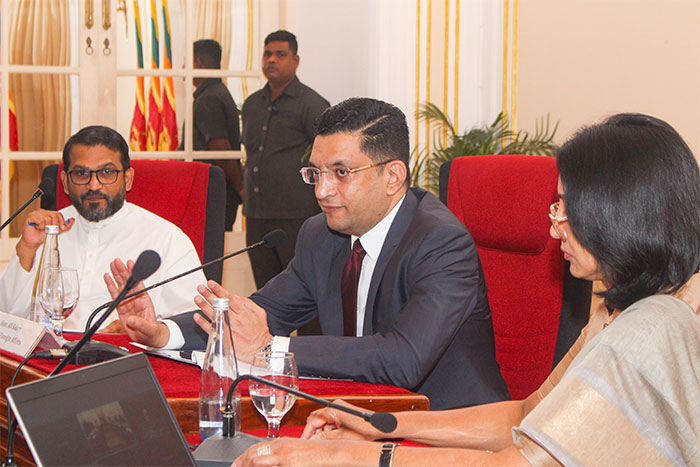
Foreign Minister Ali Sabry, PC, addresses a group of newly appointed heads of missions/posts at the main conference hall of the Foreign Ministry. The SLPP National List lawmaker is flanked by State Minister of Foreign Affairs Tharaka Balasuriya and Foreign Secretary Aruni Wijewardane(pic courtesy FM)

Defeated UNP candidate among new appointees

Sri Lanka’s growing dependence on bilateral assistance in addition to the anticipated USD 2.9bn credit facility from the International Monetary Fund (IMF) is frightening. A statement issued by the Indian High Commission, in Colombo, on Dec 23, 2022, after the handing over of 125 Sport Utility Vehicles to Public Security Minister, Tiran Alles, emphasized the seriousness of the economic crisis. The supply of the first batch of altogether 500 vehicles, to be procured under a USD 100 mn credit line, made available, some time ago, should be examined against the backdrop of the following: (1) Concessional credit lines worth USD 3.2 bn provided by Delhi in diverse sectors including railways, infrastructure, defence, renewable energy, supply of petroleum products, fertiliser, etc. (2) In addition, Sri Lanka received another concessional credit facility amounting to USD 1 bn, through the State Bank of India, for the procurement of essential items.

By Shamindra Ferdinando

The Foreign Ministry, in a press release dated Dec. 27, 2022, announced the appointment of 14 heads of diplomatic missions, and two heads of posts. The new appointees included 13 members of the Sri Lanka Foreign Service (SLFS).

The statement issued by the Public Diplomacy Division appreciated President Ranil Wickremesinghe for giving the lion’s share of appointments to the SLFS. There hadn’t been a previous instance of the Foreign Ministry issuing such a commendation to any of Wickremesinghe’s predecessors.

The FM says it has conducted an orientation programme (Dec. 16-23, 2022) for the group with Foreign Affairs Minister Ali Sabry, PC, discussing his Ministry’s current priorities and foreign policy challenges. Sabry, a close confidant of the ousted President, received the Foreign Affairs portfolio at the expense of academic Prof. G. L. Peiris.

Foreign Secretary Aruni Wijewardane has discussed the leadership role of heads of missions, whereas the orientation programme included discussions on economic, political, security, cultural and consular matters and field visits to the Northern Province, as well as to other government institutions.

Political appointees in the group are Admiral Jayanath Colombage (Indonesia), Udaya Indrarathna (UAE) and Sandith Samarasinghe (Consul General in Melbourne). Sandith Samarasinghe represented the UNP, in Parliament, (2015-2020/Kegalle district). Samarasinghe was one of the few MPs who remained loyal to Wickremesinghe, in the wake of the formation of the Samagi Jana Balavegaya (SJB), in early 2020. Samarasinghe, like all other UNPers, failed to retain his Kegalle district seat, at the last general election, held later that year. Even Wickremesinghe only managed to enter Parliament, through the sole seat the party secured, via its National seat.

One-time Navy Commander, Colombage, who served as the Additional Secretary (Foreign Affairs) to the then President Gotabaya Rajapaksa, since Dec., 2019, received the appointment as Foreign Secretary till August 2020. Wimal Weerawansa and sevearl others accused Colombage of pursuing an agenda inimical to Sri Lanka. Colombage earned the wrath of some over his affiliation with the Pathfinder Foundation, founded by our High Commissioner in New Delhi, Milinda Moragoda. It focuses on bilateral relations with China and India. Colombage has strongly denied any wrongdoing.

The incumbent FS Wijewardane was brought in as FS in May, 2020 amidst unprecedented political turmoil, triggered by violent protests, directed at the then President. Wijewardane succeeded Colombage, who has now received a diplomatic posting, to Indonesia, after he lost an opportunity to secure the ambassadorship in Japan.

Had President Gotabaya Rajapaksa realised the gravity of the situation, he wouldn’t have allowed his media team to declare those who launched high profile protest campaign, most probably instigated by hidden hands on March 31, 2022, outside his private residence, at Pangiriwatte, Mirihana, as extremists seeking to stage an ‘Arab Spring’ type revolution without an inclination to stand up to them. The government’s overall lackadaisical response emboldened protests, while the core reason for the crisis, the lack of foreign currency to finance basic needs, remained unaddressed, as it was beyond its means.

Governor of the Central Bank Dr. Nandalal Weerasinghe, in the second week of April, 2022, declared what he called a pre-emptive negotiated default as Sri Lanka made unilateral announcement that it wouldn’t repay foreign loans. Dr. Weerasinghe earned the appreciation of the public for making the declaration of bankruptcy, regardless of the consequences. Sabry, who served as the Finance Minister at that time had the courage to accept responsibility for Dr. Weerasinghe’s statement.

However, the declaration of bankruptcy also accelerated anti-government protests. The US threw its weight behind the campaign. US Ambassador to Sri Lanka Julie Chung interfered with the government strategy so much so that she issued a statement on May 09 as well organised mobs with specific intelligence, went on the rampage across the country, mainly against government politicians and their properties, calling on law enforcers not to crack down on peaceful protesters. Lawmaker Wimal Weerawansa, both in and out of Parliament, alleged that President Gotabaya Rajapaksa hesitated to suppress the protest campaign as he didn’t want to antagonize the US.

The current crisis cannot be examined without taking into consideration the overall failure of successive governments, particularly President Mahinda Rajapaksa’s war-winning administration (2005-2014) and the Yahapalana government (2015-2019) and the disastrous President Gotabaya Rajapaksa rule (2019-July 2022). This is not to say that the Chandrika Kumaratunga administration was any better as, under that dispensation, the country, for the first time, even recorded a negative growth.

UNP leader President Ranil Wickremesinghe in July last year received a parliamentary mandate to lead the economic recovery. As President, and the Minister in charge of the Finance portfolio, Wickremesinghe should address political, economic and social issues with an open mind. The continuing crisis is extraordinary, the executive needs the unstinted support of the legislature to ensure successful economic recovery in a reasonable time.

But the Executive President must also ensure that ‘robber barons’ are not allowed to exploit the situation, in the name of capitalism, which he wholeheartedly backs, and he must ensure greater discipline and adherence to fair play by the private sector while it continues to be the engine of growth. Particularly, he must ensure that exporters who have surreptitiously stashed export proceeds abroad bring them back to the country as such practices have exacerbated the foreign exchange crisis here, He also must stamp out the underground banking system that has been stealing billions in foreign exchange, earned by our expatriate workers, through punitive punishment and active crackdown by the law enforcers and the Central Bank. Then there are the professional tax dodgers who with the help of unscrupulous firms of Chartered accountants, have been robbing the country, with the help of the lax legal system, while the honest tax payers are often harassed to the limit.

Unfortunately, the executive and legislature seemed to be pulling in different directions, as underscored by the failure on the part of President Wickremesinghe and his parliamentary sponsor, the Sri Lanka Podujana Peramuna (SLPP) to reach a consensus on Cabinet appointments.

As many as 12 vacancies remained in the 30-member Cabinet-of-Ministers. Wickremesinghe named his first set of ministers, on July 22, 2022, soon after the SLPP overwhelmingly elected the UNPer as the first President appointed by Parliament.

Irreversible damage

The Foreign Ministry’s success largely depends on the overall political strategy adopted by the government. There is no point in denying the fact that those who caused irreversible and catastrophic damages never accepted responsibility for their actions. The Yahapalana government decision to co-sponsor an accountability resolution against Sri Lanka, in Oct., 2015, is a case in point.

The then Prime Minister Wickremesinghe and President Maithripala Sirisena never absolved themselves of the responsibility for betraying the war-winning armed forces. The Yahapalana government co-sponsored the US-led resolution, in spite of then Sri Lanka’s Permanent Representative, in Geneva, Ravinatha Aryasinha, rightfully, and spontaneously, taking a strong stand against it. The career diplomat was, however, ordered by Colombo to toe the then government’s line, soon after, which came as strange news to many, like how the UNP government signed a disastrous one sided ceasefire agreement with the LTTE, in 2001, unknown to many in that regime, including then President Chandrika Kumaratunga, who was the country’s Defence Minister.

Sri Lanka is firmly on the Geneva agenda, though Gotabaya Rajapaksa’s government tried to deceive the public by high profile pronouncement that it withdrew from the controversial resolution. The Rajapaksa administration absolutely did nothing to set the record straight, in Geneva. Regardless of promises and accusations, the then Joint Opposition (breakaway faction of the UPFA, led by Mahinda Rajapaksa) directed at the Yahapalana leadership over the handling of Geneva issue, the Rajapaksa administration treacherously refrained from defending the military. The government ensured that the powerful ‘ammunition’, provided by Lord Naseby, way back, in Oct. 2017, and other available ‘evidence’, was never properly utilized. May be the Rajapaksas did not have the required backing from our career diplomatic service as it had been much compromised, especially since 1977.

Rudderless diplomatically, the Rajapaksa administration allowed the Western agenda to continue. In other words, Sri Lanka fully cooperated with those who mercilessly exploited unsubstantiated war crimes allegations to advance their cause. The declaration of Sri Lanka’s bankruptcy status, in April 2022, should be examined against the Western agenda that continuously harassed the country over eradication of terrorism. Some couldn’t obviously stomach Sri Lanka’s triumph over terrorism, hence the persistent campaigning at the UNHRC.

Western powers will unashamedly use trumped up war crimes and unprecedented economic fallout to pressure Sri Lanka to give in. Foreign Minister Sabry never denied Rear Admiral Sarath Weerasekera’s accusation that the President’s Counsel pushed for 21st Amendment on the basis that the finalization of the IMF’s USD 2.9 bn loan depends on the enactment of the new law. What else would the Western powers/IMF demand to help Sri Lanka recover from the economic turmoil?

Premier’s advice

Prime Minister Dinesh Gunawardena’s Office, in a statement issued on Dec. 26, 2022, quoted the MEP leader as having told a group of newly appointed heads of missions that “traditional diplomacy has changed and today’s top priority is economic diplomacy.”

Addressing the group at Temple Trees, the Premier has stressed the importance of attracting investments, promoting exports, tourism and enhance Sri Lanka’s image as a ‘non-aligned neutral country with friendship towards all.’ The Premier was quoted as having declared: “We have not deviated from that policy and our ports are open to everybody and it is your duty to get this message across to the world.”

SLFS members are Permanent Representative designate to the UN in Geneva Himalee Arunathilaka, Ambassador designate to Bahrain Reethi Wijeratne, High Commissioner designate to Australia Chitranganee Wagiswara, Ambassador designate to Vietnam Dr. Saj Mendis, Ambassador designate to France Manisha Gunasekera, Ambassador designate to Kuwait B. Kandeepan, Ambassador designate to Ethiopia and the Africa Union Theshantha Kumarasiri, Ambassador designate to Germany Varuni Muthukumarana, Ambassador designate to Lebanon Kapila Jayaweera, Ambassador designate to Jordan Priyangika Wijegunasekara, Ambassador designate to the Philippines Dr. Chanaka Talpahewa, Ambassador designate to Israel Nimal Bandara and Consul General designate to Milan Dilani Weerakoon .

Let me appreciate and congratulate Dr. Chanaka Talpahewa again for ‘Peaceful Intervention in intra-state conflicts: Norwegian Involvement in the Sri Lankan Peace Process.’ His work. while being in SLFS, is perhaps the most courageous and fearless response of a career diplomat to a treacherous project that was meant to weaken the Sri Lankan State. Although Sri Lanka emerged victorious in that ‘war’ to save its unitary status, an utterly corrupt and reckless lot had destroyed the country.

Sri Lanka shouldn’t expect a significant improvement in the Foreign Service, regardless of new appointments. That should be obvious. The Wickremesinghe-Rajapaksa government cannot be so stupid as to believe that a change of heads of missions/filling vacancies may result in major changes. Regardless of President Wickremesinghe repeatedly assuring his administration wouldn’t take sides, in international and regional ‘conflicts,’ controversy over high-tech Chinese research ship, Yuan Wang 5, visit to the Hambantota Port, last August, underscored Sri Lanka’s predicament, with India kicking up a fuss, trying to treat Sri Lanka as a vassal state.

Colombo struggling to cope up with political turmoil, in the wake of Gotabaya Rajapaksa’s ouster, delayed the visit by about a week following India’s objections. Debt-ridden Sri Lanka needs to address concerns of both India and China, two major bilateral creditors and generous donors, whose cooperation is vital for the successful conclusion of debt restructuring talks. In fact, the whole process, in spite of this being Sri Lanka’s 17th IMF facility, has been delayed for want of approval by New Delhi and Beijing.

India’s membership, in the US-led four-nation grouping, meant to counter China, has further complicated matters for hapless Sri Lanka. Sri Lanka recklessly caused irreparable damage to her relations with Japan by unilaterally cancelling the Japan-funded light train transit system, in Sept. 2020. An angry Japanese leadership, smarting from that incident, ignored Sri Lanka’s plea for urgently required financial assistance, at the onset of the financial crisis, though Tokyo seemed to have changed its approach, after the change of government. The four-member grouping, includes the US, Japan, Australia and India.

Sri Lanka’s relations with Australia remain quite friendly with both countries, in spite of political upheaval here, cooperating closely to block illegal refugees. Australia has extended extraordinary support for Sri Lanka’s efforts by paying for fuel required by the cash-strapped Navy, and Air Force, to maintain sufficient patrols.

However, India’s stand on the continuing Ukraine war should be a case study for poorly led Sri Lanka. After gaining independence, over seven decades ago, the country is in the hands of a pathetic lot whose capabilities are highlighted in the Auditor General’s reports to Parliament.

Necessity for reappraisal of policy

Sri Lanka needs to reappraise the whole gamut of issues, ranging from continuing destructive Indian fishers, poaching in Sri Lankan waters, to humiliating failure to convince Singapore to extradite former Governor of the Central Bank of Sri Lanka, Arjuna Mahendran, despite President Wickremesinghe wanting to go ahead with the hastily concluded free trade agreement between the two countries.

Sri Lanka’s stand on the Access and Cross Servicing Agreement (ACSA), that the Yahapalana government entered into, in August 2017, as well as Millennium Challenge Corporation (MCC) Compact and Status of Forces Agreement (SOFA), should be made public. Although the previous UNP-led administration discussed MCC and SOFA, they never materilized. The possibility of the US seeking to revive MCC and SOFA cannot be ruled out as the developing situation can take a turn for the worse.

The signing of an energy agreement with the US-based New Fortress Energy, in September 2022, under controversial circumstances, and the subsequent declaration made by the then CEB Chairman M.M.C. Ferdinando, regarding Indian Premier Narendra Modi’s intervention, on behalf of the Adani Group, should prompt a thorough examination of such ‘deals’ to prevent recurrence. The deal with New Fortress Energy led to the breaking up of the SLPP parliamentary group, with a small section of the Cabinet-of-Ministers moving the Supreme Court, unsuccessfully, against the transaction whereas Ferdinando denied making allegations against Modi on the basis of what President Gotabaya Rajapaksa had told him.

The signing of the one-sided Ceasefire Agreement, in Feb. 2002, co-sponsorship of accountability resolution, in Oct. 2015, as well as the Singapore-Sri Lanka Free Trade Agreement (SSLFTA), in January 2018, highlighted the absence of at least basic decision-making process. Perhaps, the Foreign Ministry, at least now, should undertake a study of its failures/inadequacies with the focus on major developments over the years.

The cancellation

No less a person than Foreign Minister Sabry has disclosed how President Gotabaya Rajapaksa, on the advice of those near and dear to him allowed the collapse of the economy.

The Minister didn’t mince his words when he named the culprits by their positions during an exclusive live interview on Swarnavahini, in June, last year. But, that doesn’t clear him of the often repeated collective responsibility of the Cabinet-of-Ministers in case relevant issues had been taken up therein.

The reckless ban on fertiliser, agrochemicals, cancellation of the Light Train Transit System and refusal to engage the IMF on the 17th loan facility, needed by Sri Lanka at the correct time led to the ruination of the economy.

Having ruined the economy, those at the helm now expect a miracle to save the country. The much-touted economic diplomacy seems part of the deception as the crisis deepens with no tangible solutions in sight.

Wednesday, 28 December 2022

Will 2023 be a year of further economic-political-social crisis?

 SPECIAL REPORT : Part 450

Published


By Shamindra Ferdinando

A steady stream of press releases, issued during 2022, by Colombo-based diplomatic missions, UN and its agencies, and those representing INGOs, depicted a pathetic picture of Sri Lanka. They dealt with financial and material assistance, provided on Sri Lanka’s request, and also in line with international response to the developing crisis here.

Ruling Sri Lanka Podujana Peramuna (SLPP), and other political parties, represented in Parliament, seemed to be blind to the rapidly developing crisis, especially against the backdrop of the country continually being denied the USD 2.9 bn IMF loan facility.

Having secured ‘staff level’ agreement on Sept. 01, various government spokespersons expressed confidence in obtaining the first tranche, by end of 2022. That hasn’t materialized.

It would be pertinent to mention that the agreement, on the urgently needed facility, has been held up, pending necessary approval of the overall plan by Beijing and New Delhi. The Treasury and the Central Bank are obviously uncertain when the much desired agreement can be finalized.

Foreign media releases highlighted Sri Lanka’s growing dependence on international assistance. Let me first discuss a statement, dated Dec. 19, issued by the World Food Programme (WFP). Carol Taylor, Communications Associate, WFP, Colombo, in a two-page statement, dealt with the food crisis, with the focus on Dustin Shiau, Senior Regional Programme Officer of the U.S. Agency for International Development (USAID)’s Bureau for Humanitarian Assistance (BHA).

Having to receive humanitarian assistance, 12 years after the successful conclusion of the war against the Liberation Tigers of Tamil Eelam (LTTE), underscored Sri Lanka’s plight.

Referring to the USAID official’s visit to one-time LTTE bastion, Mullaithivu, Taylor asserted the population there is among the worst affected. During the war, the WFP provided significant assistance to those trapped in LTTE held areas, particularly in the Vanni region.

According to Taylor, the US has provided USD 20 mn, in 2022, and of that USD 13 mn (approximately Rs 4.7 bn) enabled them to assist the needy, recently. Declaring that the WFP project got underway, in June, just ahead of President Gotabaya Rajapaksa’s ouster, the operation intended to provide food and nutrition assistance to 3.4 mn people.

Taylor estimated they had so far reached one mn people, including schoolchildren, benefited by the free meal programme.

The WFP press statement has substantiated assertions made by the international community as regards the developing economic-political-social crisis here. The government and the Opposition continued to play politics with an unprecedented national calamity caused by mismanagement of the economy, waste, corruption and irregularities.

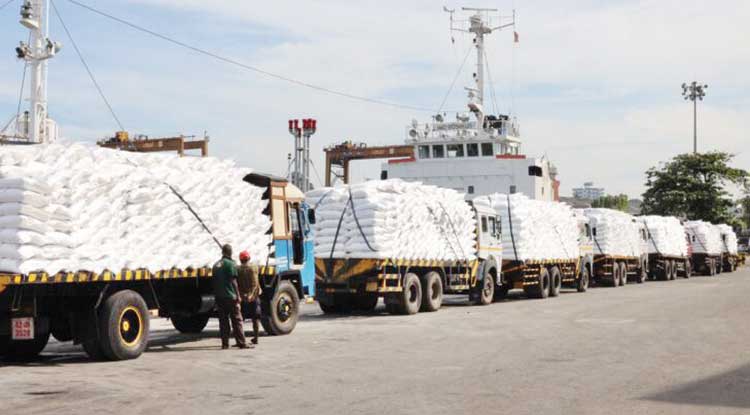
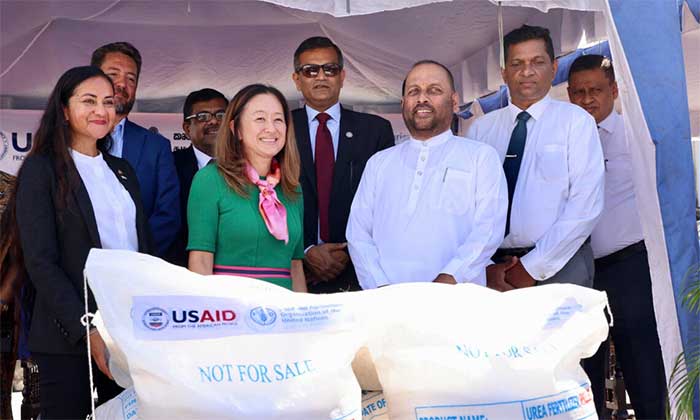
Cash-strapped Sri Lanka received USAID financial assistance, amounting to USD 46 mn, to procure 9,300 tonnes of urea. The first consignment reached Sri Lanka in December.

Those in political authority should be ashamed, particularly because they failed to initiate a programme to purchase paddy. In spite of the intervention of President Wickremesinghe and Prime Minister Dinesh Gunawardena, the Wickremesinghe-Rajapaksa government never released funds, required to buy paddy. Agriculture Minister Mahinda Amaraweera owed an explanation as to whether the incumbent government has ceased the purchase of paddy. If so, there is no point in maintaining the Paddy Marketing Board (PMB) at taxpayers’ expense, while the private sector dominates the market.

The first consignment of urea, received in December, was meant to meet the requirement of 193,000 smallholder paddy farmers, in Jaffna, Mullaithivu, Mannar, Vavuniya, Anuradhapura, Trincomalee, Batticaloa and Moneragala districts. Additional stocks are expected, early next year, and, altogether, one million farmers are expected to receive fertiliser, procured by the Food and Agriculture Organization (FAO), on behalf of the USAID.

Addressing a small gathering, at the Colombo Port, US Ambassador Julie Chung declared that they have announced over USD 240 million in new assistance and additional loans for small businesses over the last year.

In the absence of a cohesive plan, with the Wickremesinghe-Rajapaksa government ensnared in a political crisis, the international community has stepped in. Sri Lanka currently lacks the wherewithal to at least start re-building the economy. Instead, those who ruined this country, over the years, are now preoccupied trying to play the role of its saviour, having brought the once proud nation to its knees.

The hapless Sri Lankan public should be eternally grateful for top South Korean official, Cho Sung Lea, for publicly issuing a warning to Social Empowerment Minister, Anupa Pasqual, for being late for a scheduled meeting at the Ministry, on Dec 21. South Korea Disaster Relief Foundation (SKDRF) President Cho Sung Lea took the State Minister to task for being 30 minutes late for a scheduled meeting in Colombo. The South Korean declared that with the likes of Pasqual, Sri Lanka has no hope of overcoming the continuing crisis. Lea emphasized the pivotal importance of the public having faith in their political leadership.

We will refrain from commenting on how lily white South Korean politicians, including top ones, have been over the years, for the moment, for our politicians often, without doubt, take everyone for granted, no sooner they become important ministers, having become drunk with power.

Having entered parliament from the Kalutara district, Pasqual, a senior member of civil society group Yuthukama, switched his allegiance to President Ranil Wickremesinghe by accepting a portfolio.

Perhaps, the South Korean should be invited to address Sri Lanka’s Parliament, possibly the mother of all problems in the country. Governor of the Central Bank, Dr. Nandalal Weerasinghe, in a hard hitting speech, delivered in Parliament on August 31, squarely held the irresponsible and reckless political party system responsible for the current crisis.

High profile Chinese agenda

US Ambassador Julie Chung at the Colombo Port where she officially handed over a large stock of fertiliser to Agriculture Minister Mahinda Amaraweera and (below) lorries loaded with bags of fertliser (pics courtesy US embassy, Colombo)

The situation is so bad, Sri Lanka has been compelled to ask for, and accept, whatever is offered by the international community. A range of assistance, offered, included stocks of rabies vaccines. India and Germany provided the funding needed to purchase rabies vaccines.

Throughout this year, China provided significant assistance as Sri Lanka struggled to cope up with increasing difficulties. Despite having haughtily questioned Chinese intentions here, with the Yahapalana government causing serious row, and the crisis over the rejected carbon fertiliser shipment, during Gotabaya Rajapaksa administration, Sri Lanka, over the past two years, received significant Chinese assistance.

The political leadership here should be aware that foreign assistance does not come without strings attached. A Defence Ministry press release, dated Dec. 21, dealt with a financial grant amounting to Rs 5 mn, received by that Ministry, from the Chinese Embassy.

Following a joint request made by State Defence Minister, Premitha Bandara Tennakoon, and Defence Secretary, Gen. (ret.) Kamal Gunaratne, the Defence Ministry has received a Rs 5 mn grant for the utilization for the development of the National Cadet Corps (NCC).

The latest Chinese grant, received for the benefit of the NCC, is part of the overall funding programme, covering several important fields, including agriculture and fisheries.

Recently, China announced their decision to donate school uniform material, worth USD 13.51 million, to meet 70 percent of Sri Lanka’s requirement, in 2023. According to a Chinese Embassy statement, the first batch of material is already on its way to Sri Lanka. The first batch contains 2,374,427.5 meters of white shirt/ frock material, 350,031.5 meters of white trouser material, 150,003.5 meters of blue trouser material and 138,134 meters of saffron coloured robe material for monks.

In a twitter message, the Chinese Embassy said that the total length of the material is about 10 times the distance from Colombo to Jaffna. China also supports a free midday meal programme for schoolchildren. Much to the relief of farmers and fishers, China provided 10.6 mn liters of diesel, to be distributed among the two badly affected communities. This was part of the RMB 500 mn (USD 76 mn) emergency grant China voluntarily extended to Sri Lanka. In addition, Sri Lanka sought to convince China to provide a credit line for fuel. China made the offer during Gotabaya Rajapaksa’s presidency (between the March 31 protests – outside the President’s private residence, at Pangiriwatte, Mirihana – and the May 09 attacks on the Galle Face and Kollupitiya protesters). Initially, China declared a 200 RMB grant and later made an additional commitment, amounting to a further RMB 300 mn. The total grant was meant for the urgent purchase of medicine, food, fuel and other essentials.

The Chinese announcement was made in the wake of Sri Lanka suspending debt repayment on April 12. But Agriculture Minister Amaraweera brashly declared that China was responding to a request by President Ranil Wickremesinghe.

China has gradually enhanced its role in the Northern and Eastern Provinces, since the last presidential election, in late 2019. The continuing political-economic-social crisis has facilitated the Chinese agenda as the government has no option but to accept whatever assistance is granted as it couldn’t meet even the basic needs of the population. The executive, the legislature and the judiciary are enmeshed in controversies, at different levels, as the country plunges further into abyss.

Beijing underscored its expanding interests in the Northern and Eastern regions by its Deputy Chief of the Chinese Embassy Hu Wei undertaking a three-day visit in the second week of this month. Wei was there to supervise the distribution of fuel, 9,000 metric tons of rice, among students from underprivileged families, and 100 sets of solar lights to 38 schools across the Eastern Province.

Chinese Ambassador Qi Zhenhong toured the North in December, last year, at the time the economy was experiencing difficulties, though the public were yet to feel it. (Mirihana was to erupt four months later). During the high profile visit, the Chinese envoy took a boat ride to the Adam’s Bridge, widely referred by the Indian media as ‘Rama Setu’, a row of limestone shoals across the narrow Palk Strait between Mannar and Rameswaram, in Tamil Nadu. Some interested parties raised concerns over Qi Zhenhong’s visit to the North, against the backdrop of the suspension of a solar energy project that was to be carried out in three Jaffna islands, with ADB funding.

New Delhi’s strategy on track

In spite of the absence of sustained protests, since UNP leader Ranil Wickremesinghe’s election, through a parliamentary vote, as the President, in July, this year, the country is still in a deeply troubled state. It would be a grave mistake, on the part of the government, to believe that the absence of long queues, for basic services, didn’t mean the end of the crisis. In fact, the continuing power cuts, and the possibility of much longer electricity interruptions, on a daily basis, coupled with the unprecedented hike in power tariffs, can trigger protests.

The recent meetings the Research and Analysis Wing Chief, Samant Goel, had in Colombo with President Wickremesinghe and Basil Rajapaksa, who wields political power over the ruling Sri Lanka Podujana Peramuna (SLPP), meant how concerned New Delhi is with developments here. Obviously the Indian Spy Chief’s visit underlines their interest here as the Wickremesinghe-Rajapaksa government struggles to cope up with daunting challenges.

Having invested here, heavily, over the years, especially having provided much needed financial assistance, this year, that prevented the total collapse of the Colombo administration, New Delhi is obviously deeply committed to further consolidate its position in this tiny nation. India provided extraordinary financial support, prompting India basher JVP leader Anura Kumara Dissanayake to publicly appreciate New Delhi’s response to the crisis here.

But, China poses quite a challenge, having had the opportunity, over the years, to develop a network of friends at the right places. One-time Foreign Secretary, Shivshankar Menon, who had served in Colombo as High Commissioner (1997-2000), dealt with this issue in ‘Choices: Inside the Making of India’s Foreign Policy’, launched in Oct. 2016.

In spite of President Wickremesinghe’s repeated declaration that his government wouldn’t take sides in international or regional conflicts, Sri Lanka is embroiled in a China-US battle for supremacy. Sri Lanka is caught up in ‘Quad,’ strategy. The four-nation security and political alliance, comprising the US, India, Japan and Australia, is pursuing an anti-China agenda. The developing economic-security-social crisis has weakened Sri Lanka’s defences. Therefore, the country is susceptible to Chinese, as well as Quad strategies.

Former Minister, Prof. Tissa Vitharana’s recent declaration that the US may revive its efforts to secure Sri Lanka’s consent for the once-rejected MCC (Millennium Challenge Corporation) as well as SOFA (Status of Forces Agreement), shouldn’t be disregarded as ramblings of an old man.

During the Yahapalana administration (2015-2019), the US sought to finalize MCC, SOFA and ACSA (Acquisition and Cross Servicing Agreement) though Washington managed to secure ACSA, thanks to the then President Maithripala Sirisena’s support. A much weaker Sri Lanka is now a playground for big players, as political parties, represented in Parliament, pulled in different directions, for their own survival, without thinking of the greater good of the country.

Sri Lanka’s relations with Quad member Japan suffered irrevocable damage as a result of the unilateral cancellation of the Japanese-funded Light Rail Transit (LTR) project, in Sept. 2020, a month after the Sri Lanka Podujana Peramuna (SLPP) obtained a near two-thirds seats at the last parliamentary elections. The cancellation of the project, without consultations, angered the Japanese who could have provided significant assistance at the onset of the financial crisis here. Japan went to the extent of ignoring Sri Lanka’s specific requests for an urgent loan facility though some assistance was provided later.

Contrary to former Chairman of the Committee on Public Enterprises (COPE) Prof. Charitha Herath’s claim that the decision to call off the LTR project remains a mystery, the National Audit Office has revealed the existence of a Cabinet memorandum, dated Sept. 24, 2020, in this regard.

Having unilaterally suspended debt repayment, on April 12, 2022, Sri Lanka enters unchartered financial territory in the New Year with the hope a consensus can be reached on the USD 2.9 bn IMF facility as soon as possible early next year. But, Sri Lanka’s hopes remain largely dependent on Indian and Chinese acceptance of the overall plan. Regardless of Sri Lanka’s plight, the response of India and China would be largely influenced by their overall strategies.

Unfortunately, Sri Lanka (Government and Opposition) lacked a tangible action plan to face the daunting challenges in the coming year. Both seemed unprepared to face the crisis and unexpected developments can cause further destabilization. The recent allegations, pertaining to former lawmaker Prof. Ashu Marasinghe, following the release of a video by Adarsha Karadana, who had been living with him, is a case in point. There is absolutely no need for the writer to repeat what is now in the public domain. But, let me repeat what Karadana, who had been living with Prof. Marasinghe, who switched sides after having entered the political scene with the intervention of Wimal Weerawansa, speculated about the Wickremesinghe-Rajapaksa government granting the former National List MP top diplomatic positing. Let us hope the government would prove Ashu Marasinghe’s ex-paramour wrong.