Tuesday, 7 March 2023

Prez takes Trinco Oil Tank Farm to next level

 SPECIAL REPORT : Part 460
Published

  
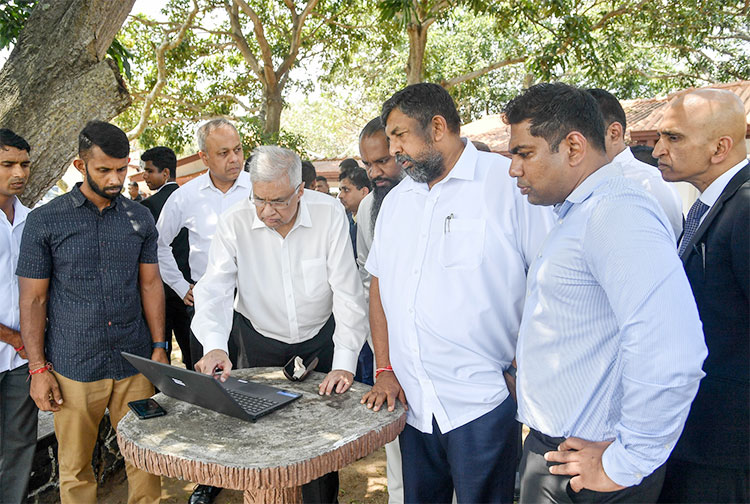
Admiral Ravi Wijegunaratne stands next to President Ranil Wickremesinghe, at the Trincomalee Oil Tank Farm, on 03 March. National Security Advisor, Sagala Ratnayake, is behind Wickremesinghe, while Minister Kanchana Wijesekera is at extreme right (Pic courtesy PMD)

By Shamindra Ferdinando

A pair of Chinese built F-7 multi-role jet fighters flew over SLAF China Bay parade grounds, within minutes after President Ranil Wickremesinghe arrived there, on March 03, to take the salute, as the Chief Guest, at a Commissioning and Wings parade of the No 65 Officer Cadets’ Intake, comprising a total of 40 officers, belonging to No. 17 Lady Officer Cadets’ Intake, and the No. 35 and No. 37 Kotelawala Defence University (KDU) Intakes.

F7s flew from Katunayake air base, the home to the famed No. 05 Squadron that played a significant role, during the Eelam War IV (August 2006-May 2009).

The Commissioning and Wings parade coincided with the 72nd anniversary of the Sri Lanka Air Force (SLAF). The F-7 GS’ flew immediately after President Wickremesinghe, who is also the Commander-in-Chief of the armed forces, arrived at the saluting dais.

It would be pertinent to mention that SLAF Chief, Air Marshal Sudarshana Pathirana, veteran jet pilot, on whose invitation President Wickremesinghe attended the China Bay event, was among the three-member group that recommended the acquisition of Chinese interceptors, in 2007, as the war had entered its final phase, which was undoubtedly a fight to the finish against ‘the world’s most ruthless terrorist outfit’, with a formidable fighting force, comprising naval, air, and land capabilities, all of whose signature modus operandi was the suicide attack.

The group consisted of the then Group Captain Priyantha Gunasinghe (retired in the rank of Group Captain), Group Captain Sudarshana Pathirana and Wing Commander Sajeewa Hendawitharane (retired in the rank of Group Captain) asserted that the Chinese interceptors should be acquired to counter immediate LTTE air threat, and the other available aircraft, at that time, MiG 29s, acquired from Ukraine, should be considered as a long-term solution. This decision was made soon after the LTTE carried out its first air attack on the Katunayake air base, in March 2007. F-7 GS were first flown here, in January 2008. The No. 05 Squadron achieved a 5-6 minute reaction time during a scramble and was the Squadron to be on 24-hour stand by, in an interceptor role, since its deployment in early 2008.

By the time the LTTE was brought to its knees, on the Vanni east front, in May 2009, the four Chinese jets had registered altogether 506 missions. During the last phase of the ground offensive, the then Air Force Commander, Air Marshal Roshan Goonetilleke, moved a pair of those jets to China Bay, in case the top LTTE leadership made an attempt to escape, by sea. At that height of the war, the SLAF jet Squadrons consisted of Kfirs, MiG 27s and F-7s.

On the day of the China Bay parade, the writer was invited to deliver a lecture at the Naval and Maritime Academy, Trincomalee (32nd JNSC course) on ‘media management’ in armed forces or ‘military and media management.’

Well over a decade after Sri Lanka’s triumph over the Liberation Tigers of Tamil Eelam (LTTE), the country is in a bind with the government seeking USD 2.9 bn IMF bailout package. No less a person than theGovernor of the Central Bank, Dr. Nandalal Weerasinghe, recently alleged that the government had been hiding Sri Lanka’s bankruptcy status before he admitted the reality, a couple of moons ago. In an utterly destabilized environment, every sector seems to be in turmoil, no doubt exacerbated by a combination of events, including the 2019 Easter Sunday suicide attacks, crippling the vibrant tourist trade, the Covid-19 pandemic, something not scene in our living memory, hitting the whole world, the following year, thereby robbing the country’s financial sector of vital worker remittances, running to billions of dollars, by underground money transfer systems.

The armed forces are certainly not exempted. The ongoing controversy, over a three-member committee, comprising Admiral of the Fleet Wasantha Karannagoda (Governor, North Western Province), Air Chief Marshall Roshan Goonatilleke (Governor, Western Province) and ex-Army Commander Daya Ratnayake, finding fault with the then Army Commander, Gen. Shavendra Silva, for his alleged failure to bring the 09 May, 2022, violence swiftly under control. The reportage of the unexpected development is a serious challenge to those responsible for media management in armed forces. This contentious issue cannot be discussed without taking into consideration (i) Gen. Silva, the first General Officer Commanding (GOC) of the famed 58 Division (formerly Task Force 1) is the incumbent Chief of Defence Staff (ii) The role played by those at Temple Trees in instigating a hooligan attack on Galle Face protesters and (iii) the ferocity of counter meticulous attacks, mounted by well-organized groups across the country, against those in power.

The continuing economic-political-social crisis has destabilized the country to such an extent with political parties, represented in Parliament, hell-bent on advancing their own agendas, regardless of the consequences.

Like Gen. Shavendra Silva’s controversial conduct, during the events that led to the forced ouster of President Gotabaya Rajapaksa, after having been one of the significant frontline ground commanders, who took the fight to the LTTE, resulting in its eventual defeat, similarly while everyone talks about a IMF bailout to no end, day in day out, critics are legitimately asking whether all this financial turmoil was deliberately created by interested parties and even those in the highest echelons of the government have not done anything tangible to get back USD billions from export proceeds that had been parked overseas, by unscrupulous exporters, as that amount alone is enough for us to climb out of the present rut.

New move on Trinco oil tank farm

Having participated at the China Bay parade, President Wickremesinghe, accompanied by National Security Advisor and Chief of Presidential Staff, Sagala Ratnayake, and several others, including Power and Energy Minister Kanchana Wijesekera, toured the Trincomalee Oil Tank Farm, consisting originally of 100 tanks, situated in 827 acres of land. The tank No. 91, however, was destroyed in Japanese air attacks, launched by ship-borne bombers, and attack aircraft, during World War 11. President Wickremesinghe is the first head of state to visit the Oil Tank Farm since Sri Lanka handed it over to Lanka Indian Oil Company (LIOC) during his previous tenure as the Prime Minister. The Oil Tank Farm is situated in China Bay. Managing Director of LIOC, Manoj Gupta, was there to welcome President Wickremesinghe.

In terms of the agreement, finalized on 07 February, 2003, during Chandrika Bandaranaike Kumaratunga’s tenure as the President, the LIOC took over the 99 oil tanks, each capable of holding 12,300 tonnes (1 tonne =1,000 litres) of fuel. The upper and lower tank farms consist of 85 tanks and 14 tanks, respectively.

On behalf of Sri Lanka, the then Secretary to the Treasury, Jayampathy Charitha Ratwatte ,signed the agreement, operative for a period of 35 years. In fact, the Trincomalee facility is so far covered by three agreements, namely (i) the Indo-Lanka Accord of 29 July, 1987, signed by President JRJ and PM Rajiv Gandhi (ii) the agreement on taking over of possession and related matters of the China Bay installation of the Ceylon Petroleum Corporation (CPC), signed on 07 February, 2003, and (iii) comprehensive agreement on cooperation in economic projects, finalized on 26 April, 2017, by Indian External Affairs Minister Sushma Swaraj and Development Strategies and International Trade Minister Malik Samarawickrema.

President Wickemesinghe declared, at China Bay, in no uncertain terms, the urgent need to go ahead with the Oil Tank Farm development project.

In line with the government’s overall strategy, President Wickremesinghe recently brought in one-time Navy Commander, Admiral Ravi Wijegunaratne, as the Managing Director of the Ceylon Petroleum Corporation (CPC), and to its Director Board as President’s nominee, and also as Chairman, CPC Trincomalee Oil Tank Farm Development Company. The Director Board consists of eight-four each from Sri Lanka and India. The CPC /LIOC venture is meant to speed up the entire process. National Security Advisor Sagala Ratnayake is working on this project.

Of the 99 tanks, 61 tanks are empty. President Wickremesinghe is keen to restore the unused 61 tanks to working condition. Would it be possible to store here what can be safely called the strategic Indian oil reserves?

Indian response to the 80s threat

On 29 July, 1987, President JRJ and Premier Rajiv Gandhi exchanged letters which dealt with the Trincomalee Oil Tank Farm as part of the controversial Indo-Lanka Accord. They essentially addressed security issues, against the backdrop of the then growing Indian concerns that foreign military, and intelligence personnel, posed a serious threat to India. India never acknowledged that Sri Lanka wouldn’t have had to seek foreign military assistance if not for its then Premier Indira Gandhi launching a destabilisation project here by covertly training Sri Lankan Tamil armed groups, as a direct counter to then Sri Lankan President JRJ’s overt pro-Western stand, by even offering Trincomalee as a base to Washington.

India included the Trincomalee Oil Tank Farm in the agreement that was meant to bring the situation under control. But, at the end of its direct intervention, India had lost 1,300 officers and men, over double that number wounded, and Rajiv Gandhi himself was blown up, in Tamil Nadu, by a female Tiger suicide bomber. It was the price India paid for interfering in Sri Lanka’s internal affairs.

At the time New Delhi’s hand was also forced by covert Western actions to destabilize and, possibly, break up India, by backing various separatist groups there. So, in a way, the Tamil separatist movement here was hijacked by the West to sow discord in India, where there are more than 60 million Tamils. The West, led by the USA and the UK, was all out to finish off India, even using Pakistan as a proxy because it was seen as being too close to the then Soviet Union. But they were halted, in their tracks, because of the solid backing that New Delhi received from Moscow, the then countervailing military power. Later, with the collapse of the Soviet Union, in the late 80s, the West found a new convenient mortal enemy in Islamic terrorists, who were in the first place incubated, in Pakistan and Afghanistan, by Washington, to chase out Russians from the latter, with the backing of wealthy Arab countries, like Saudi Arabia.

So those in Delhi should be aware that if there was no China, India would have been the West’s current number two target, after Russia. These pale faces are essentially and, undoubtedly, evil, especially if one looks at what they have done around the world by plundering and enslaving the weakest, while outwardly professing ‘all men are created equal’. At least the Russians, after their October revolution, helped to free many of the enslaved colonies. All those colonies were given independence, for fear of the spread of Communism, and certainly not because the colonial powers suddenly became enlightened.

Let me reproduce the letter, dated 29 July, 1987, signed by Rajiv Gandhi.

” (1) Conscious of the friendship between our two countries, stretching over two millennia, and more, and recognizing the importance of nurturing this traditional friendship, it is imperative that both Sri Lanka and India reaffirm the decision not to allow our respective territories to be used for activities, prejudicial to each other’s unity, territorial integrity and security.

(2) In this spirit, you had during the course of our discussions, agreed to meet some of India’s concerns as follows: (i) Your Excellency and myself will reach an early understanding about the relevance and employment of foreign military and intelligence personnel with a view to ensuring that such presence will not prejudice Indo-Sri Lankan relations; (ii) Trincomalee, or any other ports in Sri Lanka, will not be made available for military use by any country in a manner prejudicial to India’s interests; (iii) The work of restoring and operating the Trincomalee Oil Tank Farm will be undertaken as a joint venture between India and Sri Lanka; (iv) Sri Lanka’s agreement with broadcasting organizations will be reviewed to ensure that any facilities set up by them in Sri Lanka are solely used as public broadcasting facilities and not for any military or intelligence purposes.

(3) In the same spirit India will: (i) Deport all Sri Lankan citizens who are found to be engaging in terrorist activities or advocating separatism or secessionism (ii) provide training facilities and military supplies for Sri Lankan security forces

(4) India and Sri Lanka have agreed to set up a joint consultative mechanism to continuously review matters of common concern in the light of the objectives stated in para 1 and specifically to monitor the implementation of other matters contained in this letter.

(5) Kindly confirm Excellency that the above correctly sets out the agreement reached between us. Please accept, Excellency, the assurances of my highest consideration.”

India raised concerns particularly over US and Israeli presence in the 80s. But, today, India is part of the Quadrilateral Security Dialogue (QSD), widely known as the Quad, formed to meet what the US, Japan, Australia and India perceived as the growing Chinese challenge. Sri Lanka is caught up in the Quad politics due to heavy Chinese investments here, particularly the leasing of the Hambantota Port, for a period of 99-years, to China, in 2017, by the Yahapalana government. But what is really interesting is that the same government finalized a wide ranging memorandum of understanding for cooperation in economic projects, on 26 April, 2017, with India, that covered the Trincomalee Oil Tank Farm, eight months before China secured 85 percent of shares in the Hambantota Port for USD 1.12 bn.

Media management in armed forces

While the writer was working on the presentation for JNSC, the US embassy, in Colombo, in a joint press release with Sir John Kotelawela Defence University (KDU), dealt with the launch of a publication, titled ‘A Shared Vision for the Indo-Pacific: Implications for South Asia,” edited by Dr. Harendra Vidanage, at the Cinnamon Grand, one of the hotels targeted by the Easter Sunday bombers.

Vice Chancellor of the General Sir John Kotelawala Defence University, Major General Milinda Peiris, was among those present, along with US Ambassador here Julie J. Chung.

The joint statement quoted Rear Admiral (ret.) Peter A. Gumataotao, of the USN, as having told the gathering: “What is at stake is our ability to respond to activities that undermine the values and principles of a free and open Indo-Pacific. Competition is good, but when rules are changed, the process should be transparent and agreed on. The US embassy is busy promoting a shared vision for the Indo-Pacific. It would be pertinent to mention that the US embassy issued statements in Sinhala, Tamil and English. Obviously, the media management is part of their operation. A few days before the Cinnamon Grand event, Ambassador Chung visited Parliament. She was there to welcome the appointment of new office-bearers of the Sri Lanka-US Parliamentary Friendship Association. Rebel SLPP MP Chandima Weerakkody was elected the President of the Association.

Sri Lanka seems to be in a catch 22 situation. Contrary to repeated assurances that Sri Lanka wouldn’t take sides in China vs Quad, Sri Lanka appears to be already tilted towards the US-led grouping. The proposed operationalization of the Trincomalee Oil Tank Farm should be examined against the Quad operations. Economic ruination has paved the way for external interventions as Sri Lanka struggled to cope up with growing challenges.

The armed forces and police find the situation tough as media manipulations continue. India is now part of the overall US political-security-economic policy. India actually encourages Sri Lanka to be part of the US-led club but there can be certain concerns. Unfortunately, the Opposition has conveniently missed key factors in the strategic Indo-Pacific project. The status of India-US relations is at its zenith, therefore our giant neighbour wouldn’t mind even if Sri Lanka signed the Status of Forces Agreement (SOFA) with the US. The Americans prefer to call the SOFA Visiting Forces Agreement (VFA).

Sri Lanka entered into the Acquisition and Cross-Servicing Agreement (ACSA) in August 2017 during Maithripala Sirisena’s tenure as the President. Perhaps those responsible for national security should study the circumstances President Sirisena gave into pressure that was brought to bear on him by Sri Lankan Ambassador in Washington at that time, Prasad Kariyawasam, to renew ACSA, in early August 2017. Sri Lanka first signed the ACSA in March 2007. It expired in 2017. The Yahapalana partner obviously had no objection. SOFA was first signed in 1995 during CBK’s presidency. Apparently, the United States asked Sri Lanka for a new pact and sent a draft to the Sri Lankan Ministry of Foreign Affairs, in August 2018. SOFA, however, is on hold.

The Millennium Challenge Corporation Compact (MCC) – a project worth USD 480 mn (Rs 89 bn) – was torpedoed by a committee, headed by Prof. Lalithsiri Gunaruwan, in February 2020. The economist didn’t mince his words when he declared ACSA, SOFA and MCC could be part of the US-Indo Lanka strategy.

Political leadership, regardless of the party in power, appears to have continuously failed to examine developments/situations/events properly. For the first time such a report was prepared in Sinhala.

The government media needs to closely study developing situations. With the emergence of social media, in the past decade, as an extremely powerful tool, media management has become a tough task. Situations cannot be tackled by simply issuing statements, or trying to suppress information.

A cohesive system is required to address issues at hand. Perhaps, those handling media will have to work outside official channels to overcome challenges.

Sri Lanka’s growing dependence on foreign powers to meet its needs, ranging from essential items, including medicines, school uniforms and defence requirements, in a way portends long term problems. Sri Lanka should be certainly grateful for international support but also mindful of other factors.

A recent statement, attributed to Deputy Indian High Commissioner, Vinod K. Jacob, underscored the status of Indian assistance. Jacob declared that India offered as many as 1,500 training slots, annually, to Sri Lanka, at an annual cost of USD 7mn. Jacob was addressing a group of Indian Navy trained Sri Lanka Defence Forces personnel, on board INS Sukanya, on February 28.

Referring to India’s much-touted ‘Neighbourhood First’ policy, Jacob mentioned a five-point plan to take Indo-Lanka relations to the next level. The Indian HC quoted Jacob as having said: “First is the potential for economic and financial cooperation by building on the Indian support to the people of Sri Lanka, in 2022, to the tune of USD 4 billion. The focus could be laid on areas, such as trade in national currencies, ease of investments and strengthening financial cooperation. Second, the two sides are working towards increasing air, ferry, digital and energy connectivity. Third, a new type of development cooperation partnership building on the existing multi-billion portfolio, with special emphasis on vulnerable communities, is required. Fourth, both sides need to enhance people to people exchanges, particularly in tourist movements. Fifth, it is essential to strengthen the cultural, religious, music, movie and sporting links for mutual benefit.”

Sri Lanka needs to develop a strategy of its own, drawing support from the international community. The current economic-political-social crisis should be addressed, without further delay. The failure to reach a consensus, on Local Government polls, can cause a protracted political conflict that may undermine the overall efforts to restore economic stability.

Wednesday, 1 March 2023

Opportunity for deployment under UN command as STF celebrates 40th anniversary

 SPECIAL REPORT : Part 459

Published

  
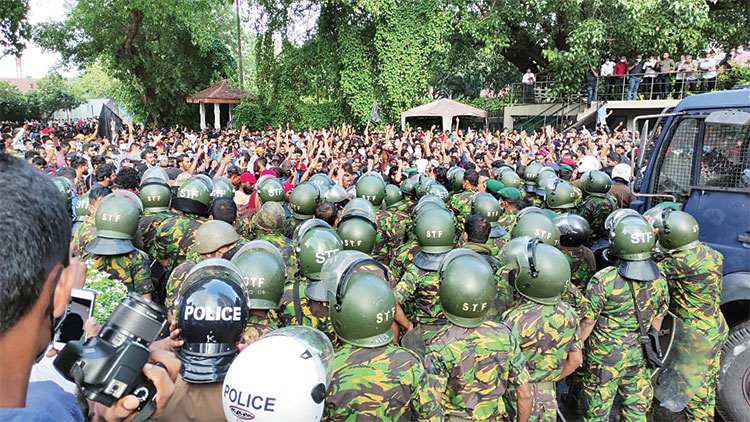
A contingent of STF personnel deployed in Colombo during Aragalaya last year

By Shamindra Ferdinando

Having received its baptism of fire, within months of formation, in early 1983, the police para-military arm, the elite Special Task Force (STF), is now ready to serve under the UN command, in the near future.

The UN deployment is a much desired achievement in the wake of it celebrating 40 years of dedicated service to the nation having sacrificed much by its heroic members.

Well over a decade after the successful conclusion of the war, the STF is now engaged in peacetime duties. Incumbent STF Commandant, Deputy Inspector General (DIG) Waruna Jayasundara, says they are ready for deployment in any part of the world.

Jayasundara, who had served the STF for many years, received the top post, in June 2020, several months after the last presidential election.

Established on March 01, 1983, with a group of 60 personnel, the STF received the leadership of late Senior DIG Bodhi Liyanage, the first Commandant, and was followed by DIG Dharmasiri Weerakoon, Senior DIG Zerney Wijesuriya, late DIG Lionel Karunasena, late DIG Nimal Gunathilleke, SDIG Nimal Lewke, DIG K.M.L. Sarathchandra, DIG R.W.M.C. Ranawana, DIG J.K.R.A. Perera, Senior DIG M.R. Latiff and DIG Lionel Gunathilleke.

Having played a low-key role, during the unprecedented political-economic-social crisis that forced Gotabaya Rajapaksa out of the office of executive president, the STF now faces the unenviable challenging task of countering organized political groups pushing for political reforms.

With trade unions affiliated to various political parties, as well as professional bodies, such as the Government Medical Officers’ Association (GMOA), threatening to cripple the government over the new tax regime, law enforcement authorities are certain to come under pressure. The STF will have to throw its weight behind the police, pressed into tackling the Opposition challenge.

Tackling political dissent is a challenging task, especially at a time restrictions cannot be imposed on the media. Privately owned print and electronic, as well as uncontrollable social media, pose quite a challenge as the slightest excesses,on the part of law enforcers, are certain to reach the public.

The formation of the STF, originally called Special Striking Force, during the JRJ administration, was meant to meet the growing threat, posed by Indian trained terrorists. JRJ gave the go ahead, following recommendations made by a committee, headed by one-time Minister J.W. Subasinghe, and the late President’s son, Ravi Jayewardene, an ex-military man, too, played a major, but an unassuming role, mostly behind the scene, in its infancy, as the then National Security Advisor. It would be pertinent to mention that in spite of the JVP-led 1971 insurgency, those responsible for national security didn’t form a specialized unit, within the police, to meet any eventuality.

The formation of the STF took place four months before the Liberation Tigers of Tamil Eelam (LTTE) triggered the first Eelam War, with the killing of 13 soldiers at Thinnaveli, Jaffna. In Sept. 1984, the STF suffered a demoralizing setback when the LTTE planted landmine claimed the lives of four police commandos. The blast on the Point Pedro –Valvettiturai road also wounded nine other STF men.

Those who volunteered to join the SSF/STF were, initially, trained at Katukurunda and at the Army Combat Training School, Ampara, by instructors, led by the then Maj. Ananda Weerasekera, elder brother of parliamentarian Sarath Weerasekera, who served the Navy during a turbulent period, before retirement in the rank of Rear Admiral, and Maj. S. Manawadu. Ananda Weerasekera retired from the Army after rising to the rank of Major General and later ordained as Ven. Buddhangala Ananda Thera. The Ven. Thera passed away in late Dec 2021.

Tikkam blast

Their initial deployment covered Point Pedro, Velvettiturai and Kankesanturai and the gradual expansion cannot be discussed without deliberating the role played by the then National Security Advisor, Ravi Jayewardene.

Sri Lanka obtained ex-Special Air Services (SAS) personnel via Keenie Meenie Services (KMS), one of the first British mercenary companies to prepare the STF for the battles ahead. In the wake of the Tikkam blast, the STF was re-deployed in the Eastern Province.

SSF personnel initially used SLR rifles, though they gradually acquired a range of new weapons to meet the ever increasing threat. Among the weapons were US manufactured M 16 and German Heckler and Koch. They also acquired a range of mortars, including 120 mm used by the SLA.

The British personnel imparted their knowledge and expertise on a range of subjects, including tactics adopted by anti-riot squads, weapons training, firing practices, counter terrorism search, handling explosives, mapping, use of compass and first aid.

During the Eelam War I (the period before the deployment of the Indian Army in the Northern and Eastern regions), the STF dominated theEastern Batticaloa and Ampara districts. In terms of the Indo-Lanka Peace Accord, that had been forced on Sri Lanka, the Sri Lankan military, the police and its para-military arm were confined to barracks. By the time, India quit Sri Lanka mission, in March 1990, the LTTE was prepared to launch Eelam War II. Fighting re-erupted in the second week of June 1990. During the IPKF deployment, the STF joined the other services, and the police, in fighting the second JVP-led insurrection.

The STF went flat out against the JVP and the reports of excesses during that period hadn’t been denied.

The Bolgoda Lake killings during the Kumaratunga presidency were nothing but a black mark on the STF.

‘Bolgoda killings’ caused irreparable damage to the STF’s reputation in the mid-1990s, when some officers and men were found guilty of extra-judicial killings in the city and its suburbs. During Eelam War IV, an ‘STF operation’ in Trincomalee, too, brought disrepute to the force, though overall it has been a well-disciplined unit.

In response to the LTTE threat, at the onset of Eelam War II, the then President Ranasinghe Premadasa’s government launched military operations. In line with the overall counter-terrorist strategy, the STF was tasked with regaining the Ampara and Batticaloa districts. The STF achieved the challenging task, within months. In the post-IPKF era, the military and the STF faced the battle hardened LTTE that received tremendous boost, by way of experience gained by confronting the mighty Indian Army and the free flow of weapons from abroad. By then, all other Indian trained groups, including the People’s Liberation Organization of Tamil Eelam (PLOTE), responsible for Nov. 1988 abortive bid to oust the then Maldivian President, Maumoon Abdul Gayoom, had given up terrorism. Only the LTTE remained committed to the macabre Eelam project. By 1993, the military and the STF cleared the East to enable the conduct of the Local Government polls.

The LTTE, on May Day 1993, delivered a stunning blow to the STF by mounting suicide attack on President Ranasinghe Premadasa. The LTTE cleverly infiltrated Premadasa’s security contingent and the STF cannot absolve itself of the responsibility for the unprecedented security lapse, whatever the political environment security chiefs had to work in. During Premadasa’s honeymoon (May 1989-June 1990) with the LTTE, the STF provided security to members of the LTTE delegation. The writer, during this period, met the late Anton Balasingham at the Hilton. There were STF personnel outside Balasingham’s room.

When Eelam War II erupted in the second week of June, 1990, the STF had to escort a small group of LTTE personnel, from the Colombo Hilton to the Ratmalana air base. They were then airlifted to Palaly and allowed to leave the base safely as Premadasa and his chief negotiator, the late A.C.S. Hameed, made a desperate bid to bring the LTTE back to the negotiating table.

With emergence of Chandrika Bandaranaike Kumaratunga, as the Prime Minister, and then President, in late 1994, the government entered into fresh round of negotiations. Following a 100-day truce, fighting erupted in late April 1995 with the sinking of two Navy gunboats, at the Trincomalee harbour, and shooting down of Avro aircraft, with heat-seeking missiles, as they were approaching the Palaly airbase. The LTTE made some rapid progress in the Eelam War II, though it couldn’t sustain the tempo. In the East, the LTTE stepped up pressure on STF detachments at Tikkodai, Porativu, and Ambalanturai. In Dec. 1996, the LTTE forced the STF out of its Pulukunawa detachment. In one of the fiercest attacks, faced by the STF, the combined STF-Army contingent, deployed at Pulukunawa, failed to thwart the multi-pronged attack. The LTTE captured some arms and ammunition, including artillery pieces. However, those who vacated the base, with the arrival of reinforcements, fought back to regain the Pulukunawa detachment, within 24 hours.

In 1997, the STF expanded its deployment to the Vanni region. That year, the Army, engaged in Operation ‘Jayasikurui’, suffered devastating losses in the Vanni theatre after making vast advances. After a series of heavy defeats, in the Northern Province, and an abortive bid to assassinate Chandrika Bandaranaike Kumaratunga, the President and Commander-in-Chief of the armed forces, by the terrorists, the UNP regained power, at the parliamentary polls, conducted in Dec. 2001. The stage was set for another round of talks with the LTTE, with the signing of the virtually one-sided Ceasefire Agreement, drawn up by the Norwegians.

When Eelam War IV erupted, in June 2006, the STF was asked to launch operations in support of the overall combined security forces campaign in the East. The STF played a critically important role, during Eelam War IV.

During the 40 years of service to the nation, the STF lost 464 officers and men in the line of duty, while 774 were wounded. Six of its civilian employees also died during this period.

The number of dead and wounded, suffered by the STF, when compared with the SLA, may seem insignificant, though the contribution made by the unit to defeating terrorism was DEFINITELY NOT. The SLA lost 6,000 officers and men during Eelam War IV alone, while some 27,000 received injuries.

Post-war responsibilities

Following the successful conclusion of the conflict, the elite unit received greater responsibility in fighting illicit narcotic trade and organized crime, regular law enforcement, high profile/high risk arrests, protection of radioactive materials deployed across the country, responses to crisis, VVIP Security, search and bomb disposal, fire and rescue in expressways and enforcement of the law with regard to the offenses related to the environment.

The STF faces daunting challenge in preserving the experience gained in counter-insurgency operations in the South (1987-1990) and combat operations in the Eastern Province. With the government recently declaring its intention to gradually cut the strength of the Army to 100,000 by 2030, after reducing the numbers to 135,000 by next year, an assessment is also likely as regards the STF. Currently, the STF consists of nearly 8,000 officers, and men, deployed across the country, including Jaffna.

It would be the responsibility of both political and military leadership to maintain the overall capabilities of the armed forces and the police. There cannot be any dispute over the need to reduce the number of men, under arms, as Sri Lanka struggles to cope up in an extremely rough economic crisis. The peacetime political-economic-social crisis has placed the Wickremesinghe-Rajapaksa government, with pressure being exerted on all sectors, to cut down on expenditure. However, it would be a grave mistake, on the part of the incumbent administration, to deprive the armed forces and law enforcement the wherewithal to maintain peace and, particularly, the strength to face future challenges.

The continuing debate over the granting of police and land powers to the provinces, in terms of 13th Amendment to the Constitution, enacted in late 1987, has not so far touched the fate of the STF, in case full implementation of the controversial piece of legislation, which Sri Lanka was forced to adopt, becomes a reality. As the STF, too, comes under the Inspector General of Police what would be the destiny of the para-military armm, in the event the police deployment, in the provinces, come under respective Chief Ministers.

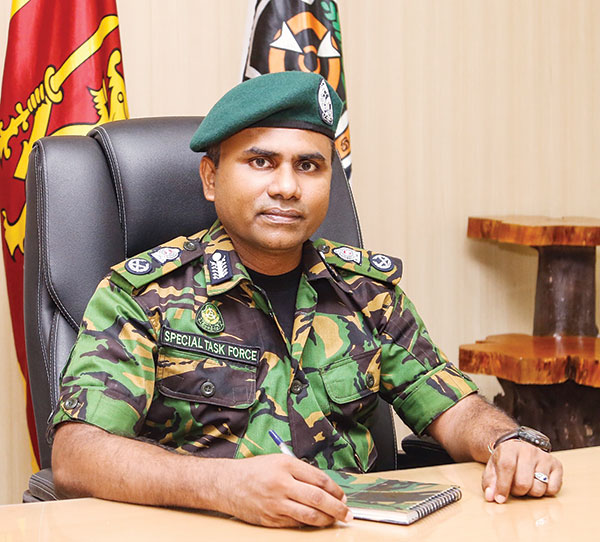
STF Commandant DIG Waruna Jayasundara

Subsequent to the signing of the Ceasefire Agreement (CFA), in late Feb. 2002, the LTTE launched a series of protests, targeting security forces bases, and police stations, in the then temporarily merged Northern and Eastern Province.

Close on the heels of the attack on the Valaichenai police station, the LTTE targeted an isolated base, held by the elite Special Task Force (STF), at Kanjirankudah, south of Batticaloa. Several hundred civilians launched a protest campaign, on Oct. 9, 2002, shortly after an incident involving STF personne, and two LTTE cadres, M. Visuvanathan, in charge of Pottuvil, and Christy Rajah. The LTTE exploited the situation to launch the protest. The LTTE used civilians as a human shield to move into the detachment, though the STF fired warning shots into the air. But, once the STF realized the LTTE’s strategy, the commandos opened fire, killing several persons. Protesters fled carrying the dead and the wounded. The STF recovered seven bodies. Of them, two were identified as Vijayaprakash and Nagarasa. To the surprise of many, Vijayaprakash was identified as one of those held under the Prevention of Terrorism Act (PTA), but released consequent to the CFA.

At the behest of the LTTE, students and their parents stormed the Point Pedro Brigade headquarters, on Sept. 2, 2002, and the Valaichenai police station, on Oct. 1, 2002, inflicting considerable damage on those facilities. The LTTE obviously felt that a sustained protest campaign, directed at the troops and the police, deployed therein, in the wake of Pongu Thamil rallies, would undermine the government’s authority. Instead of taking effective counter measures to control the situation, the then government brought pressure to bear on the media not to highlight the deteriorating situation.

The government restricted the issuing of daily situation reports, and went to the extent of censoring situation reports, issued by the military. The government’s response should be examined, taking into consideration the circumstances under which the police raided the Directorate of Military Intelligence (DMI) safe house, at Aturugiriya, on the ridiculous allegation the Army, with the involvement of ex-LTTE cadres, planned to assassinate Prime Minister Ranil Wckremesinghe, during the 2001 general election campaign.

Although the STF’s response to the LTTE threat to its camp, at Kanjirankudah, it helped the government to stabilize the situation. Tamil civilians resisted LTTE attempts to use children in protests. The government gave an interesting twist to the Kanjirankudah incident. It alleged that the Presidential Security Division (PSD) had been involved in the attack, prompting both the President’s Office and the PSD to issue statements.

The then PSD head, DIG N. K. Illangakoon, a former Deputy Commandant of the STF (he later served as IGP) said that his officers hadn’t even visited the base, ahead of the incident. Shortly after the incident, the government appointed the then SSP Nimal Lewke, the Deputy Commandant of the STF as the senior officer in charge of its personnel deployed in the Ampara-Batticaloa.

Wednesday, 22 February 2023

How govt. agenda caused erosion of public faith in some independent commissions

  SPECIAL REPORT : Part 458

Published


By Shamindra Ferdinando

The Supreme Court (SC) on Feb. 10 dismissed a contempt of court application filed by the Human Rights Commission of Sri Lanka (HRCSL), delivering a shock therapy to the latter.

The HRCSL filed the contempt case against the Chairman of the Ceylon Electricity Board (CEB) N.S. Illangakoon, the Secretary to the Ministry of Power and Energy, M. P. D. U. K. Mapa Pathirana, and Chairman of the Ceylon Petroleum Corporation (CPC), Uvais Mohamed, for failing to comply with an agreement to provide uninterrupted electricity to students sitting for the 2023 Advanced Level (A/L) examinations.

The HRCSL consists of retired Supreme Court Justice Rohini Marasinghe, Venerable Kalupahana Piyarathana Thera, Dr. M.H. Nimal Karunasiri, Dr. Vijitha Nanayakkara and Ms. Anusuya Shanmuganathan.

Moving of SC was consequent to a controversial determination made by the HRCSL. On Jan. 30, 2023, the HRCSL determined the Secretary, Ministry of Power and Energy, Chairman, CEB, and the Managing Director/Chairman, Ceylon Petroleum Corporation, failed to provide electricity, without interruption, during the Advance Level examination, from Jan. 23 to Feb. 17, 2023. The HRCSL found fault with them for not adhering to an agreement worked out by the independent commission.

The HRCSL deemed the CEB Chairman guilty of the offence of contempt, under the provisions of the Human Rights Commission of Sri Lanka Act No. 21 of 1996. The CEB Chairman was accused of willfully and maliciously disregarding the agreement. The Commission called the CEB’s failure to provide an uninterrupted electricity supply, during the examination period, a gross violation of a child’s right to education.

The CEB refused to stop power cuts until the Public Utilities Commission of Sri Lanka (PUCSL) approved a new electricity tariff formula. The CEB announced an end to power cuts immediately after the PUCSL finalized a new electricity formula on Feb. 16.

Of the five-member PUCSL, three, namely Attorney Chaturika Wijesinghe, Douglas Nanayakkara and SG Senaratne, gave the go ahead for a 66 percent tariff increase. They defeated a proposal that had the backing of the PUCSL Chairman, Janaka Ratnayake, for a 36 percent increase. D.N. Kushan Jayasuriya is the other member of the PUCSL.

Having waged a high profile campaign, against the proposed second electricity price hike, Janaka Ratnayake finally suffered a major setback. Ratnayake has lost control of the PUCSL. President Ranil Wickremesinghe personally intervened in the matter and, after careful planning, brought in new members, in place of Mohan Samaranayake and Udeni Wickremesinghe, who served as the Deputy Chairman of the PUCSL at the time trouble erupted at the independent commission.

President Wickremesinghe effected the required changes in the PUCSL to facilitate cooperation between the PUCSL and the Power and Energy Ministry. Wickremesinghe has intervened in the PUCSL in a way no previous President interfered, as he sought to suppress dissent therein. The PUCSL, established by the Public Utilities Commission of Sri Lanka Act No. 35 of 2002, is the economic, technical and safety regulator of the electricity industry, as well as the designated regulator for petroleum and water supply industries. The PUCSL also functions as the shadow regulator for lubricants sold here.

The PUCSL undertakes regulatory responsibilities in terms of the Sri Lanka Electricity Act No. 20 of 2009.

A major contentious issue is the continuing failure, on the part of successive governments, to secure parliamentary approval for the relevant Acts to regulate the water services and petroleum industries.

The HRCSL should examine the quarrelsome issue, involving the CEB, Power and Energy Ministry, and the CPC, over power cuts imposed during Gotabaya Rajapaksa’s administration. The HRCSL cannot take its failure to convince the CPC and the CEB, and the Power and Energy Ministry, to provide uninterrupted power supply during the Advance Level examination, lightly.

Power and Energy Minister Kanchana Wijesekera has been strongly critical of both the PUCSL and the HRCSL. Wijesekera questioned the HRCSL’s intervention after the independent commission announced an unprecedented agreement with the CEB, the CPC and the Power and Energy Ministry.

The recent turmoil undermined both the PUCSL and the HRCSL. Those who are genuinely concerned about the effective operation of the PUCSL and the HRCSL should be seriously concerned about the recent developments.

The Parliament should also examine the inordinate delay in expanding the PUCSL to play the role as water and petroleum sector regulator, as originally envisaged. It would be pertinent to mention that Janaka Ratnayake received appointment as Chairman, PUCSL, for the support he rendered during Gotabaya Rajapaksa’s 2019 presidential election campaign. Ratnayake received the appointment on Feb. 08, 2021. over a year after the last presidential election.

The turmoil in the PUCSL and the HRCSL undermined both commissions and erode public confidence in them.

EC caught up in political agenda

The Wickremesinghe-Rajapaksa government has dealt a deadly blow to the Elections Commission (EC) after its Chairman, Nimal Punchihewa, stood his ground in the face of relentless pressure, exerted by President Ranil Wickremesinghe, to put off the Local Government polls, scheduled for March 09. Wickremesinghe went all out to derail the electoral process, in the wake of the EC’s refusal to bow down to pressure. The government appeared to have been quite surprised by the truly independent stand taken by the EC. Even after EC member, P.S.M. Charles, quit the body, amidst threats received by some of them, Punchihewa, and Director General of the EC, Saman Sri Ratnayake, sustained the effort. However, finally the exasperated Wickremesinghe, having exhausted behind the scene tactics, intervened, publicly, and issued instructions meant to put off the Local Government polls, indefinitely.

After Charles quit, Nimal G. Punchihewa (Chairman), S.B. Divaratne, M.M. Mohamed, and K.P.P. Pathirana, remained members of the EC.

Considering the sorry state of the economy, may be this is not the time to hold polls for local councils, which are often corruption-ridden, with as many as 8000 elected members, who are a severe burden, we can do without, especially at this juncture. The Wickremesinghe-Rajapaksa government, however, is pursuing an agenda that erodes independent commissions. Surely the Parliament of this country did not install a new President, whom they thought was a mellowed politician, to complete the term of his predecessor, to suffer his hollow imperial airs. We know what happened to the country because his late uncle, President JRJ, tinkered with the democracy, at every turn, and fixed every election, held under his tenure, including the infamous referendum, and, finally, the whole country literally went up in flames. Let us only hope that history is not repeating itself.

We are not saying this because we have any greater trust in comrades waiting eagerly to taste power, despite having behaved worse than cannibals in the past, that includes their involvement in the May 09, and, thereafter, unconscionable acts of violence. Recently, MP Mahindananda Aluthgamage, at a press conference, gave a detailed list of the obvious charges they have to answe. So we will refrain from adding to them. But imagine what would have happened to this country had they, and their erstwhile comrades, the FSP, successfully stormed the Parliament, as planned last year, after having tasted success at overrunning other vital state bodies, in the guise of peaceful protests. Remember how a mob lynched just one MP, and his police bodyguard, on May 09, in public, or how they systematically destroyed properties of so many government politicians in that one night alone, across the country.

We are grateful to President Ranil Wickremesinghe for standing up to the mob mentality of the JVP/FSP and gathering up the shaken security establishment behind him to resurrect what was left of the government. It is also quite possible all that was a mere show for our consumption with the ‘Great Satan’ working behind the scene, not so mysteriously, to help him, as happened in places like Libya, or Ukraine, after creating similar situations.

As for the Rajapaksas, they threw away, almost overnight, so much they achieved for this country, because of just one sibling, Basil, and Mahinda succumbing to petticoat government to elevate his progeny, especially the eldest, to positions of power, well ahead of his time, without allowing him to season through the system.

For all we care, an inner clique, among the comrade leadership, unknown to their rank and file, and, along with leading Eelamists, could be working for a US agenda, to ultimately plunge, not only this country, but especially India, into chaos.

The government launched the project to undermine the EC, late last year, with Prime Minister Dinesh Gunawardena, who is also the Minister in charge of Public Administration, Home Affairs, Provincial Councils, and Local Government. Summoning the EC twice to the PM’s Office, where it was advised to postpone the scheduled election. Subsequently, President Ranil Wickremesinghe, too, summoned the EC twice. On both occasions, Premier Gunawardena was also present. But, they couldn’t convince the EC to put off the election, that is legitimately due.

Regardless of pressure being exerted on members, the EC insisted that election can be held, though the government experienced difficulty in releasing the required funds.

The police owed an explanation, regarding the status of the investigation into alleged threats, directed at some members of the EC, and a despicable bid made by IGP C.D. Wickremeratne to create another issue, by submitting highly exaggerated expenditure, pertaining to the March 09 poll. Some ministers, too, made a desperate bid to discourage the EC, and the electorate, by repeatedly warning of the government’s inability to meet the poll expenditure.

Wajira Abeywardena, MP, the lone UNP National List MP in Parliament, conducted a campaign of his own to justify the postponement of the poll, whereas UNP Chairman Palitha Range Bandara too played his part.

At the behest of the government, Public Administration, Home Affairs, Provincial Councils and Local Government Ministry Secretary, Neil Bandara Hapuhinna, made an abortive bid to derail the electoral process by directing Divisional Secretaries not to accept deposits from candidates. An angry reaction from the EC compelled Hapuhinna to withdraw instructions, issued on January 09. Hapuhinna found himself in an extremely embarrassing situation after Premier Gunawardena contradicted his claim that January 09 instructions were based on a decision taken by the Cabinet-of-Ministers. Now the matter is before the Supreme Court.

Samagi Jana Balavegaya (SJB) candidate for the post of Mayor of Colombo, Mujibur Rahuman, has moved the Supreme Court against Hapuhinna.

Having failed to manipulate the EC, President Wickremesinghe finally directed the Secretary to the Treasury, Mahinda Siriwardana, and Government Printer, Gangani Liyanage, to stop the electoral process. JVP leader Anura Kumara Dissanayake is on record as having said that the Government Printer was ordered to stop printing until the EC made the payments. There had never been such a deliberate bid to sabotage an election, under any circumstances, since the UNP put off the General Election, scheduled for August 1983.

The then President JRJ held a referendum, on Dec. 22, 1982, to ask the electorate whether it accepted extending the life of Parliament by six more years. Thereby the next General Election was held in 1989.

In terms of Article 104 B (2) and 104 GG (1) of the Constitution it makes it clear that all state authorities are duty bound to cooperate with the Elections Commission and that refusing, or failing to do so, is a criminal offence, punishable with imprisonment. In terms of Article 33 (c) of the Constitution, the President, too, is empowered to ensure the creation of proper conditions for the conduct of free and fair elections, at the request of the Election Commission.

Prez’s strategy

President Wikremesinghe’s UNP is not in a position to contest the Local Government polls. Wickremesinghe’s strategy is geared to avoid election this year. With the UNP now reduced to just one National List MP in Parliament, even though for a long time in the past it was one of the two major parties, is simply unable to conduct a LG polls campaign in its current decimated state. In spite of securing the Presidency, the UNP remains vulnerable, and extremely weak, politically. The UNP has conveniently turned a blind eye to previously taken Supreme Court decisions, relevant to the current situation.

During the Yahapalana administration, on Dec. 15, 2017. the Supreme Court in SCFR 35/2016 clearly explained the pivotal importance of conducting timely elections for local authorities and the importance of the franchise. The SC stated: “Franchise is a fundamental right enjoyed by people. According to Article 3 of the Constitution ‘In the Republic of Sri Lanka sovereignty is in the people and is inalienable. Sovereignty includes the powers of the government, fundamental rights, and the franchise”. Franchise is a fundamental right recognized under Article 10 and 14(1) of the Constitution. The failure to hold elections on the due date or postponing is a violation of fundamental rights of the people. Under Article 4(d) of the Constitution the fundamental rights which are by Constitution declared and recognized shall be respected, secured and advanced by all organs of the Government and shall not be abridged, restricted or denied save in the manner and to the extent hereinafter provided. In the present case the legislature as well as the executive had violated this Article.

If the government gets away with this, the next presidential and parliamentary elections, too, can be postponed on the same claim that economic recovery can be undermined by releasing of funds for the conduct of other elections. The government has conveniently forgotten that the Wickremesinghe-Rajapaksa government has allocated as much as Rs 10 bn for the EC, in 2023.

The possibility of the incumbent government seeking to put off future elections is a serious threat to the fragile democracy. Depending on the success of the current agenda, such actions can set a dangerous precedent for a detested executive or legislature to block the allocation of resources for an election and prevent the people of Sri Lanka from choosing their representatives and leaders.

JVP leader Anura Kumara Dissanayake told this writer that former Speaker Karu Jayasuriya, who recently received the coveted ‘Sri Lankabhimanya’ title, should explain his stand on the government bid to postpone the election. Incumbent head of the National Movement for Social Justice (NMSJ) Jayasuriya owed an explanation as he couldn’t remain silent as President Wickremesinghe has definitely undermined the independent commissions. The JVPer pointed out that the 20th Amendment, enacted in Oct. 2020, largely negated the 19th Amendment, introduced in 2015. The 21st Amendment was brought in Oct. 2022 to restore the provisions of the 19th Amendment and now President Wickremesinghe resorted to a strategy that weakened the very basis of independent commissions.

Having repeatedly assured that he wanted to restore parliamentary superiority and strengthen the independent commissions, the UNP leader not only went back on his word but pursued a deliberate strategy meant to undermine the very system he vowed to protect, lawmaker Dissanayake said.

The JVPer pointed out several decisions by Wickremesinghe, in recent weeks, supposedly aimed at managing public funds, have had the effect of preventing the Elections Commission from conducting the elections. These include a demand by the Government Printer for the release of funds, prior to the printing of ballot papers, and the Secretary to the Treasury claiming that there were no funds available for the elections. This is despite a budget allocation of Rupees 10 Billion for the purpose of elections, the MP said.

The JVPer alleged that the conduct of the Secretary to the Treasury, the Government Printer, and other government officials, and institutions, over the last few weeks clearly demonstrated a concerted effort to bring the elections to a halt, thus undermining the franchise of the people and endangering the sovereignty of the people of Sri Lanka. Such attempts to prevent elections mandated by law represent an unprecedented attack on democracy and the rule of law and pose a grave threat to the electoral process in the future, the JVP leader said.