Wednesday, 2 March 2022

Man arrested in the UK over high-profile Jaffna killing released within 48 hours

 SPECIAL REPORT : Part 409
Published

  
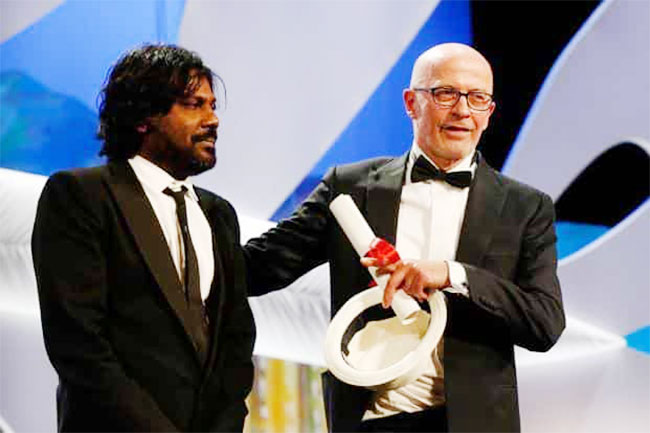
Celebrated French film Director Jacques Audiard with actor Antonythasan Jesuthasan (left). One-time child soldier, Jesuthasan, who has been reported ‘missing’ is perhaps one of the most famed ex-LTTE cadres today.

By Shamindra Ferdinando

The Metropolitan Police Service, UK, has said that a person ,recently arrested in the UK over his alleged involvement in the killing of journalist Mylvaganam Nimalarajan, 39, in his Jaffna home on Oct 19, 2000 is a Sri Lankan national.

Jack Griffith, Press Officer – Specialist Operations at the London Metropolitan Police Service said so in response to the writer’s query whether the 48-year-old suspect is a UK national or a citizen of Lankan origin or a political asylum seeker from Sri Lanka.

The response was received on Feb 25th, the same day The Island posed the question to the Metropolitan Police Service. Appreciating the swift response from the British, it would be pertinent to question the status of the suspect as the Press Officer’s response suggested that the unnamed person hadn’t secured British citizenship yet.

The media, including the Tamil Guardian, on Feb 24th, reported the arrest of the suspect at an address in Northamptonshire on Feb 22. The media quoted the police as having declared the arrest ‘as part of a proactive operation’ and the first arrest made by the UK in connection with war crimes allegedly committed in Sri Lanka. Sri Lanka brought the war to a successful conclusion in May 2009.

The Sri Lankan has been arrested on suspicion of offences under Section 51 of the International Criminal Court Act 2001. “This is a significant update in what is a sensitive, complex investigation,” the media quoted Commander Richard Smith as having declared. Smith leads the Met’s Counter Terrorism Command. However, the British police hadn’t explained how the first suspect, taken into custody in connection with such a high profile probe, could be released within 48 hours, pending further investigations.

In fact, by the time the media reported the arrest on Feb 24, the suspect has been quietly released. Unidentified persons killed Nimalarajan who contributed to the BBC Tamil and Sinhala services, the Tamil daily Virakesari and the now defunct Sinhala weekly Ravaya. The EPDP was accused of killing Nimalarajan, an accusation strongly and repeatedly denied by the political party.

Sooka hails UK action

NGO activist Yasmin Sooka hailed the British action though by the time she issued a statement in this regard the suspect has been freed. Sooka of the International Truth and Justice Project (ITJP), which investigates alleged Sri Lankan war crimes and crimes against humanity declared: “The proactive investigation which led to the arrest demonstrates the commitment of the Metropolitan Police to justice and accountability even 22 years later. Those who kill journalists are not safe anywhere in the world. It is abhorrent that an alleged killer of a BBC journalist should hide in the UK.”

The writer raised the issue at hand with Foreign Secretary retired Admiral Jayanath Colombage over the last weekend. One-time Navy Commander Admiral Colombage said that the Foreign Ministry was following the case. The official indicated that every aspect of the case would be examined.

Had he been involved in the actual killing of Nimalarajan or provided support for the dastardly act in some way? Would he be extradited to Sri Lanka? Or had the UK sought Sri Lanka’s support to conduct the investigation? Had he been a member of the EPDP, or some other Tamil group or perhaps a member of a paramilitary group? At the time of Nimalarajan’s killing, the suspect had been 26 years of age.

Against the backdrop of Sooka expressing disgust at a person responsible for a BBC journalist’s death taking refuge in the UK, wouldn’t it be pertinent to question the status of Adele Balasingham, the Australian-born wife of the late LTTE ideologue Anton Balasingham. One-time British High Commission employee and Virakesari staffer Balasingham, who received and enjoyed the status of a British citizen in spite of being the chief advisor to the proscribed terrorist group passed away in Dec 2006 in the UK. Perhaps ITJP should state its position on Adele Balasingham who had been directly involved with the LTTE and even pictured at terrorist parades handing over cyanide capsules to female LTTE cadres. Perhaps, even Subha and Dhanu, who had been assigned for Rajiv Gandhi’s assassination, received their cyanide capsules from Adele Balasingham in the northern jungles of Sri Lanka. Dhanu carried out the suicide mission on the night of May 21, 1991 at Sriperumbudur, Tamil Nadu. Nearly 60 other innocents perished in the attack.

The recent British police action and the claim of the first arrest in the UK in connection with war crimes should be examined taking into consideration the failure on their part to take action against those promoting terrorism and ex-members of various Sri Lankan terrorist groups (some of them are now in Parliament) given citizenship.

Zooka, who had been a member of the Darusman Panel (Report of the Secretary General’s Panel of Experts on Accountability in Sri Lanka) that accused Sri Lanka of war crimes in March 2011, five years later acknowledged the presence of ex-LTTE cadres in several countries, including the UK. Had there been a specific procedure to accommodate ex-Sri Lankan terrorists beginning with those trained by India?

Had the British treated those who fought for the LTTE differently from the ones that served other groups? The tainted ITJP survey released in June 2016 inadvertently revealed the existence of clandestine networks, facilitating Sri Lankans of Tamil origin, including former members of the LTTE, to reach Europe through illegal means. Did the person, arrested by the Metropolitan Police Service, too, reach the UK through illegal means? The Sri Lanka Foreign Ministry should ask the British to reveal the status of the suspect and most importantly how and when he reached the UK.

The release of the expensive survey, titled ‘Forgotten Sri Lanka’s exiled victims’ by the ITJP, affiliated to the Foundation of Human Rights in South Africa, coincided with the commencement of 32 sessions of the Geneva-based United Nations Human Rights Council (UNHRC). The much-touted study disclosed that LTTE personnel, including those who had been with Shanmugalingam Sivashankar alias Pottu Amman’s dreaded intelligence service, had secured citizenship in European countries, including the UK. That report was meant to intensify pressure on Sri Lanka on the Geneva UNHRC front, but ended up inadvertently exposing an ugly truth. But, Sri Lanka lacked a cohesive strategy to exploit such lapses.

The report dealt with information obtained from 75 Tamils, living in the UK, France, Switzerland and Norway. Almost all of them had fled Sri Lanka after the conclusion of the war, in May, 2009. The vast majority of interviews had been conducted in the UK. The ITJP claimed that those ex-LTTE cadres, based in Germany, had declined to contribute to the survey.

The architects of the project and their sponsors owed an explanation why those who had taken refuge in India during the conflict and post-conflict period were not included in the project. Actually how many ‘disappeared’ in India having gone there by boat across the Palk Strait and conveniently listed as missing and put on Sri Lanka account over the years?

On the basis of the interviews conducted, with the help of Sri Lankan Tamil interpreters, who had either worked for the UN or other International NGOs, in the Vanni, during Eelam War IV, the report estimated that the vast majority had served various LTTE units. The report named those combat and support units as Radha, Sothiya, Imran Pandiyan and Malathy regiments as well as the Intelligence Wing. The non combat units included the LTTE Media Unit, the TV station, the Political Wing, the Peace Secretariat, the International Secretariat, the Medical Wing, the Transport Unit, the IT division and the Education Section.

New identities for ex-terrorists

The Office of Missing Persons (OMP) should seek the cooperation of foreign governments to establish the whereabouts of those who had been categorised as missing. The Foreign Ministry should check with British authorities to find out whether the 48-year-old person suspected to be involved in the Jaffna journalist’s killing, too, has been categorized as a missing person. Had he been given an opportunity to change his identity? The possibility of Sri Lanka facilitating the suspect’s arrival in the UK, too, cannot be ruled out. It would be pertinent to mention that the UK humiliated Sri Lanka by exposing the issuance of a diplomatic passport to one-time LTTE commander Vinayagamoorthy Muralitharan aka Karuna Amman after he rebelled against the LTTE. At that the time British officials arrested him, Karuna carried an official passport issued to Kokila Dushmantha Gunawardena whose occupation on the passport was given as Director General of Wildlife Conservation. Better known as ‘Colonel’, Karuna was deported in July 2008 to Sri Lanka, having been arrested and detained since Sept 2007. What made Sri Lanka issue a diplomatic passport to Karuna though he played a significant role in the overall strategy against the LTTE?

In spite of the OMP being created in terms of the 2015 Geneva accountability resolution, Western powers haven’t helped Sri Lanka to track down those living overseas under new identities while they remained categorised as ‘missing’ persons generally blamed on Colombo. The contentious issue of missing persons or those disappeared continue to undermine post-war national reconciliation efforts. Unfortunately, successive governments haven’t addressed the issue in earnest without the cooperation of relevant Western countries, who are obviously part of the conspiracy against Sri Lanka. This failure to properly investigate war time disappearances has allowed interested parties to harass the country at international forums and Geneva sessions in particular.

Lord Naseby once questioned the UK’s failure to prosecute Adele Balasingham in spite of the accountability on her part for child and suicide cadre recruitment. The Conservative Party veteran blamed his government for allowing freedom for Adele Balasingham whom he described as an LTTE leader living in the UK.

The recent arrest in the UK of a key suspect in the Nimalarajan killing should prompt Sri Lanka to freshly examine the contentious issues of missing persons and impunity provided to terrorists living overseas. There is no point in denying some excesses on the part of the Sri Lankan military and the police during the nearly 30 year cruel internecine war, as all wars are. There had been reprisals, deaths in custody and extra judicial killings during the conflicts in 1971 (JVP led insurgency), 1987-1999 (the second JVP led insurrection) and 1983-2009 (war in the North and East). However, Sri Lanka hadn’t resorted to genocide or war crimes as alleged by interested parties. It wouldn’t be fair to examine the accountability issue without taking into consideration the Indian military intervention (July 1987 to March 1990) and the period before when India trained armed and deployed thousands of Tamil terrorists in a large scale destabilisation project here to counter JRJ’s obvious pro-Western stance and it was meant to pave the way for the ultimate deployment of the Indian Army here. New Delhi achieved its objective in July 1987. But, by the time, India terminated its military mission here thousands of LTTE terrorists and Tamil civilians perished. Those who demand justice for Tamils are conveniently silent on victims of the Indian military action. Today, no one remembered how a group of PLOTE (People’s Liberation Organisation of Tamil Eelam ) cadres died while fleeing the Maldives in early Nov 1989 following an abortive bid to assassinate the then Maldivian President Gayoom. The Indian Navy sank the vessel commandeered by PLOTE cadres in the high seas.

TNA seeks media attention

The Tamil National Alliance (TNA) at the forefront of the ongoing campaign against the government last week demonstrated opposite the Presidential Secretariat demanding solutions to their grievances. Having recognised the murderous LTTE in 2001 as the sole representative of the Tamil speaking people, the TNA solidly backed its terrorist cause until the very end, thought it today demands justice for the Tamils. The TNA leadership never bothered to issue a public statement in 2009 against the LTTE employing human shields of its own people on the Vanni east battlefield. The Western powers never found fault with the TNA for its despicable role during the war. Throughout the war, the TNA served the LTTE, diligently. In fact, the LTTE-TNA alliance set the stage for the final war by engineering the defeat of Ranil Wickremesinghe at the 2005 presidential election. The rest is history. Years later, Wickremesinghe in his capacity as the yahapalana Prime Minister declared that those who had been categorised as missing were either killed in the battlefield or were living abroad. Unfortunately, even this government never exploited Wickremesinghe’s statement to our advantage.

****

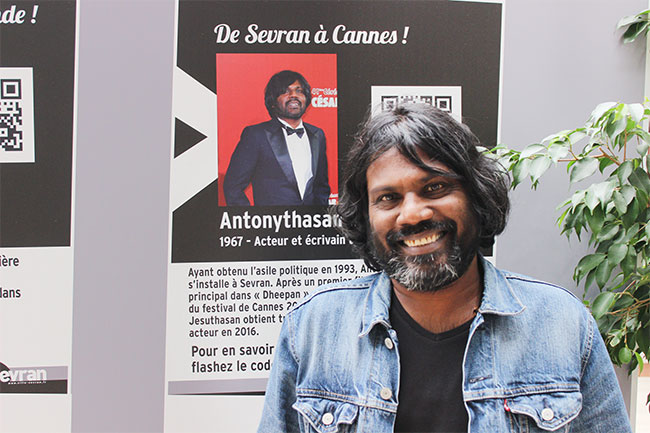
Antonythasan Jesuthasan is perhaps the only ex-LTTE cadre to receive international acclaim as an actor after fleeing Sri Lanka during an early phase of the war. In an interview with Tom Seymour (Dheepan’s Antonythasan Jesuthasan: from Tamil Tiger to star of a Palme d’Or winner in The Guardian) posted online on March 31, 2016, Jesuthasan, perhaps, unwittingly revealed how he deceived the United Nations High Commissioner for Refugees (UNHCR) to secure political asylum. Seymour said that Jesuthasan after having shown him a dense lattice of scars on his forearm declared: “I did those to myself. I was 22, and I had spent years trying to come to the west. I wanted to get a fake French passport, but I had to be accepted as a refugee. I went to the UNHCR [the UN High Commissioner for Refugees], but they wouldn’t believe my story. So I cut myself, and held up my arm, and said to them: ‘Look at my blood. This is my word.” Jesuthasan is just one among thousands who obtained political asylum on false claims. Jesuthasan ended up as the star of Dheepan, directed by Jacques Audiard, possibly France’s most celebrated modern director. There cannot be a better example than Jesuthasan to highlight the web of deceit pertaining to the vast majority of those who successfully secured political asylum. But, Sri Lanka Foreign Ministry never bothered to set the record straight. Born in Allaipiddy, on the Velanaitivu islet, Jesuthasan claimed he fought the Sri Lanka Army in August 1990 and subsequently fled the country and managed to reach France.
Wednesday, 23 February 2022

Push against PTA gathers momentum

 SPECIAL REPORT : Part 408

Published

  
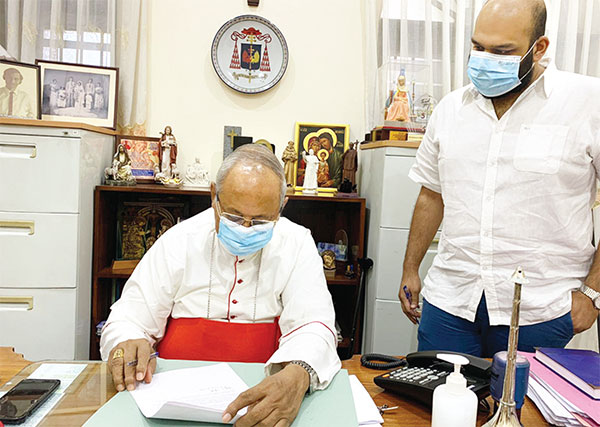
Archbishop of Colombo Malcolm Cardinal Ranjith signs a petition demanding the abolition of the PTA. TNA lawmaker Rasamanikkam looks on.

In terms of the Ceasefire Agreement (CFA) arranged by Norway in Feb 2002, Sri Lanka suspended the Prevention of Terrorism Act (PTA). The then Premier Ranil Wickremesinghe went ahead with the controversial move, though some sections of the armed forces, and the police, opposed the move. Let me reproduce the relevant section from the CFA: 2:12: The parties agree that search operations and arrests under the Prevention of Terrorism Act shall not take place. Arrests shall be conducted under the due process of law in accordance with the Criminal Procedure Law.” The CFA failed to take concerns of the armed forces into consideration. Those who bent backwards to appease the LTTE neglected national security. The Yahapalana government sought to replace the PTA with a new antiterrorism act. Now, the HRCSL has gone further. It wants to do
away with the PTA. Well over a decade after the elimination of the LTTE, the threat of terrorism remains, though the enemy will never regain a conventional fighting capability. But those wielding
political power have to be cautious. Let us not grant something
the enemy couldn’t win militarily.

By Shamindra Ferdinando

Political weekly ‘Anidda’, on its front-page (Feb 20, 2022 edition), carried a photograph of Archbishop of Colombo Rt. Rev. Malcolm Cardinal Ranjith signing a petition demanding the abolition of the Prevention of Terrorism Act (PTA). Standing next to the Archbishop was Tamil National Alliance’s (TNA) Batticaloa district lawmaker Shanakiyan Rasamanikkam.

According to ‘Annida,’ the high profile signature campaign against the PTA has been spearheaded by the ‘Justice for All’ organisation.

The Archbishop signed the petition before the launch of ‘Thitha’ at the BMICH by Rev. Father Lal Pushpadeva Fernando on behalf of the Catholic Church. The editorial board comprised Maximus Linton Fernando, Dr. Sachitha Mendis and Ajith Mendis. The Catholic Bishops’ Conference in Sri Lanka assailed the current dispensation with the focus on Attorney General Sanjay Rajaratnam and the Attorney General’s Department over the handling of the 2019 Easter Sunday case.

Although absolutely no reference was made at the book launch pertaining to the acquittal and release of the then Secretary Ministry of Defence Hemasiri Fernando and IGP Pujith Jayasundera charged over the Easter Sunday carnage, to be fair by Rajaratnam, the public shouldn’t forget that the indictments were filed by former AG Dappula de Livera, PC. So will Hemasiri and Pujith go scot-free because of the bungling by the Attorney General’s Department?

The Church owed an explanation as regards its backing for the ‘Justice for All’ project meant to pressure the government to repeal the PTA. The project got underway opposite the Fort Railway station early last week with the participation of several political parties, including the TNA and the Sri Lanka Muslim Congress. Among those who signed the petition were TNA Jaffna district lawmaker M.A. Sumanthiran, PC and SLMC leader Rauff Hakeem.

Can Sri Lanka do away with anti-terrorism laws? The Easter Sunday carnage, perpetrated by the National Thowheed Jamaat (NTJ) in April 2019, a decade after the eradication of the Liberation Tigers of Tamil Eelam (LTTE), underscored the importance of anti-terrorism laws. Sri Lanka cannot, under any circumstances, ignore the constant threats posed by various extremist /terrorist organisations. The devastating NTJ terror project underscored the responsibility on the part of the government to ensure an adequate legal cover for anti-terrorist operations. Unfortunately, political parties here seemed to have treated national security just as a another political issue. Western powers have exploited the political party system and the civil society setup here to advance their cause. The PTA has become an ideal issue for the Western powers to hammer this country, even though countries like the USA and the UK have some of the most draconian laws to fight terrorism. The Homeland Security Act introduced in the USA in the aftermath of the 9/11 attacks that claimed several thousand innocent lives, for example gave law enforcement there a virtual carte blanche to tackle the problem of terrorism. How is it that the US can still hold people without trial for years at a place like Guantanamo Bay detention centre and the UNHRC simply turns a blind eye to so many such grave violations committed by the Americans there and elsewhere? Then how is it that when the UK passed laws to give immunity to its soldiers who had committed war crimes in West Asia again UNHRC simply swept them under the carpet. Then what has the UNHRC done about the highly publicised war crimes committed by Australian troops also in West Asia? The UK heads Sri Lanka Core Group in Geneva.

The ongoing petition campaign undertaken by the ‘Justice for All’ project underscores the failure on the part of the government to recognize the growing threat posed by the Geneva project. No wonder people keep asking whether our Foreign Service officers, in general, are working for us or Western interests. Do any of them at least write a letter even to a local newspaper defending the country when it is unfairly hounded by the Western funded NGO mafia here, leave alone them taking any measures to counter UNHRC doing a hatchet job against the country on behalf of the West.

The stepped up campaign to get rid of the PTA should be examined against the backdrop of the Easter Sunday carnage and various political developments taking place. The Cardinal’s backing for the ‘Justice for All’ project should be examined, carefully. Why did the Cardinal endorse the petition knowing well the PTA is needed to neutralize threats posed by extremists/terrorists? In the wake of the Easter Sunday carnage, the then government used the PTA against the NTJ and other groups. It might be a case of him getting increasingly carried away by the public spotlight. But, the deterioration of once cordial relations between the government and the Catholic Church over the former’s failure to implement the recommendations of the Presidential Commission of Inquiry (PCoI) that inquired into the Easter Sunday carnage may have influenced the Cardinal. The government cannot absolve itself of the responsibility for the rift caused by an inordinate delay in implementing PCoI recommendations. Interested parties have exploited the situation.

Shocking TNA declaration

The TNA is the only political party to justify the Easter Sunday carnage. TNA spokesperson Mathiaparanan Abraham Sumanthiran did so at the first anniversary of ‘Annidda’ at the Jasmine Hall, a week after the Easter Sunday massacre.

The writer was among the media therein. The event took place amidst security concerns of fresh NTJ attacks. However, except The Island, all other print and electronic media conveniently refrained from reporting lawmaker Sumanthiran’s threat. It was nothing but a threat.

In that background, the Church backing for the repealing of the PTA is certainly questionable. Having recognized the LTTE in late 2001 as the sole representative of the Tamil speaking people thereby encouraging the LTTE to declare war, the TNA is waging a different kind of war today.

Addressing the ‘Annidda’ anniversary, Sumanthiran alleged that the Easter Sunday carnage was caused by Sri Lanka’s failure to ensure certain basic values. The MP warned of dire consequences unless the government addressed the grievances of the minorities. At the onset of the programme, Annidda editor Attorney-at-Law K.W. Janaranjana requested speakers Prof. Jayadeva Uyangoda, the then Human Rights Commissioner Dr. Deepika Udagama, MP M.A. Sumanthiran PC, J.C. Weliamuna PC, and then Constitutional Council member Attorney-at-Law Javid Yusuf and filmmaker Asoka Handagama to take the Easter Sunday carnage into consideration. They dealt with the topic ‘Sri Lanka beyond 2020.’

Top law academic Dr. Udagama functioned as the Chairperson of the Human Rights Commission of Sri Lanka (HRCSL) at that time. Among those who had been present on that occasion were the late Professor Carlo Fonseka, former President Chandrika Bandaranaike Kumaratunga, then Speaker Karu Jayasuriya, then Minister Mano Ganesan, then MP. Dr. Jayampathy Wickramaratne, then MP Dr. Nalinda Jayatissa, one-time MP Lal Kantha and a large group of civil society activists, including Ven. Dambara Amila Thera, Gamini Viyangoda, Prof. Sarath Wijesuriya, Saman Ratnapriya, Chandragupta Thenuwara and Sandya Ekneligoda.

The Archbishop of Colombo, however, strongly rejected MP Sumanthiran’s claim that the failure on the part of successive governments to address the grievances of minorities over the past several decades had led to the Easter Sunday carnage. The Archbishop was responding to the writer at a media briefing jointly called by the Catholic Church and the Buddhist clergy at the Bishop’s House, Borella. The Buddhist clergy was represented by the Most Ven. Ittapane Dhammalankara Nayaka Thera, of the Kotte Sri Kalayani Samagri Dharma Maha Sangha Sabha of Siyam Maha Nikaya.

When The Island sought Malcolm Cardinal Ranjith’s response to lawmaker Sumanthiran’s claim, the Catholic leader asserted that the situation had been wrongly interpreted. But, the Church has ended up backing a TNA-led project. The PCoI never bothered to secure an explanation from the TNA heavyweight Sumanthiran. Terrorism cannot be justified under any circumstances. There shouldn’t be any dispute over that. The ‘Justice for All’ project perhaps has no concern for those who had perished in the hands of terrorists.

HRCSL takes controversial stand

The HRCSL caused quite a controversy recently by calling for the repealing of the PTA. In a statement dated Feb 15, issued by its Chairperson Rohini Marasinghe, the HRCSL declared that terrorism should be dealt in terms of the Penal Code. The five-member outfit stressed the need for a new definition for terrorism.

The HRCSL asserted that terrorism should be investigated under the General Law of the country with necessary amendments. The announcement was made following consultations between the HRCSL and a section of the Colombo-based diplomatic community. The consultations seemed to be in line with the overall government policy in dealing with post-war accountability issues. Those who propagated the view that Sri Lanka didn’t require PTA should be asked to explain whether they can guarantee there wouldn’t be any further terrorist attacks. The NTJ struck a decade after the successful conclusion of the war against the LTTE. The NTJ succeeded in carrying out a near simultaneous coordinated suicide bombing campaign. The LTTE never managed to stage a similar mission though it targeted individuals (both political and military).

Acknowledging the importance of the HRCSL role in the post-war scenario, it would be necessary to point out that the outfit has taken a position contrary to that of the government. The HRCSL’s push for repealing of anti-terrorism law comes as the government seeks consensus with other political parties and the civil society as regards the amendments to it suggested by the government.

Extremely tough security laws are required to meet severe challenges. Countries threatened by terrorism (domestic and backed by external powers) have no option but to adopt laws which sometimes hinder and undermine civil liberties. The PTA that had been introduced in 1979, a couple of years after the crushing of the first JVP-led insurrection was required to meet the northern terrorist challenge (1983-2009) as well as the second JVP insurgency (1987-1990). The PTA was required again when the NTJ mounted suicide missions in Colombo, Katana and Batticaloa. Now, an influential section of the political setup, Western-funded civil society outfits, the Tamil Diaspora wanted to do away with the PTA. The HRCSL backing for the far reaching project appeared to have caught the government by surprise. Perhaps, the government hasn’t consulted the HRCSL as regards the amendments it proposed to the PTA.

Interestingly, the civil society is also sharply divided over the ongoing consultations between the government and a section of the civil society as regards post-war national reconciliation. The group that had been engaged in a dialogue with the government recently received an opportunity to have one of its members in the HRCSL. Venerable Kalupahana Piyarathana Thera is the civil society group nominee. The Ven. Thera succeeded prominent civil society activist Harsha Kumara Navaratne, who received appointment as Sri Lanka’s High Commissioner to Canada.

The project to repeal the PTA seems to be gathering momentum. There is no point in denying the fact that successive governments, including the current dispensation, had used it for political expediency. Anti-terrorism law should never have been used against political opposition or to suppress those pursuing a different line. Instead of diluting the law, the political leadership shouldn’t exploit the PTA for political purposes.

Member of the nine-member team, tasked with drafting a new constitution, Manohara de Silva, PC declared that the HRCSL had absolutely no right to interfere in national security matters. The civil activist’s stand should receive the appreciation of people enjoying a country free of terror, notwithstanding the Easter Sunday carnage.

The senior lawyer said so when the writer sought his opinion on the HRCSL’s call for the abolition of the Prevention of Terrorism Act (PTA). The outspoken lawyer said: “That’s not their business. If there is any clause which is against any UN convention on human rights, including the UN declaration of HR, the HRCSL can point them out. Enacting legislation is a sovereign right of the people of Sri Lanka. Not only that we have a right to enact legislation against terrorism, it is our duty to do so to free the world of terrorism,” he said.

Referring to the HRCSL call to include provisions against terrorism in the Penal Code, the PC emphasized that the outfit had been obviously influenced by those who couldn’t stomach Sri Lanka’s triumph over LTTE terrorism.

Tamil Nadu terror project

The TNA and the GTF recently issued a comprehensive statement on its expectations and objectives. The statement titled ‘Chief Minister Stalin is heralding a new era of pride and optimism among global Tamils’ dated Feb. 18 sought the guidance and support from India and Tamil Nadu. Having published the entire joint statement in the Feb 21, 2022 edition of The Island, it would be necessary to highlight the circumstances leading to the assassination of one-time Indian Prime Minister Rajiv Gandhi at Sriperumbudur, Tamil Nadu, on the night of May 21, 1991.

Having praised CM Stalin’s father, the late TN Chief Minister M. Karunanidhi for his initiatives for the benefit of Sri Lankan Tamils, the TNA-GTF grouping stated: “We are also conscious that the DMK (Dravida Munnetra Kazhagam) support for the Tamil cause continued despite many challenges it faced in the Indian Union, including the dismissal of the DMK government in 1991 relating to the Tamil people’s problems in Sri Lanka.”

The alliance now seeking fresh impetus from India, has conveniently forgotten how Tamil Nadu, with the backing of the Indian government, destabilized Sri Lanka. The assassination of Gandhi by the LTTE, a group that had been trained, financed, armed and deployed against a smaller friendly country, took place a few months after India dismissed Karunanidhi’s government. India dismissed the TN administration on January 30, 1991. The LTTE blew up Gandhi on May 21, 1991. Did the LTTE decision to eliminate their one-time benefactor had been influenced by Karunanidhi’s dismissal? Had there been any consultations between DMK elements and the LTTE at any level as regards the Sriperumbudur assassination that shocked the world? Only thereafter the UK banished the Tiger International Secretariat from London. So the British too cuddled the terrorist outfit claiming that it had not violated UK laws. And they continue to do so through more subtle means. Can anyone imagine how London would have treated us if we had given the IRA an opportunity to even open an office in Colombo claiming they have not violated our laws?

The alliance’s reference to 1983 anti-Tamil riots and the late Karunanidhi’s role in support of the Tamil community here should be examined keeping in mind that it was no one but the current CM’s father who paved the way for the massive destruction in Sri Lanka. If not for Indian trained terrorists killing 13 soldiers at Thinnaveli, Jaffna, in July 1983, there would never have been a Nanthikadal situation. The TNA-GTF alliance has also forgotten how Indian trained terrorists killed Tamil lawmakers. They can ask lawmaker Dharmalingam Siddharathan (PLOTE) why he alleged TELO (another Indian trained terrorist group) of killing his father, V. Dharmalingham, ex-MP and M. Alalasunderam, ex-MP.

Dharmalingam Siddharathan has alleged that TELO assassinated them in early September 1985 at the behest of the Research and Analysis Wing (RAW). The TNA and the GTF should be reminded that Karunanidhi and decision-makers in New Delhi created an environment necessary for Indian military intervention. The project ended in disaster with India losing nearly 1,500 officers and soldiers as the LTTE turned its guns on the Indian Peace Keeping Force (IPKF) deployed here under the Indo-Lanka Accord forced on the JRJ government by New Delhi, while nearly twice that number received injuries.

Sri Lanka should at least now set the record straight. Successive governments failed to do so in spite of a section of the international community taking advantage of accountability issues to abolish Sri Lanka unitary status. The abolition of the PTA should be considered with the failed bid to introduce a new Constitution during the yahapalana administration. That bid had the backing of the then Joint Opposition, now the largest group in Parliament with a near 2/3 majority. The Sri Lanka Podujana Peramuna (SLPP) is its name.

Wednesday, 16 February 2022

BR’s NK weapons claim, displaying of LTTE image at Ind. Day galvanize media et al

 SPECIAL REPORT : Part 407

Published

  
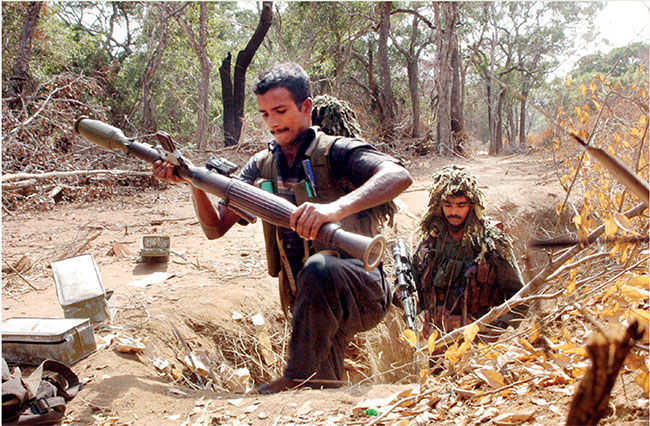
The controversial photograph that adorned a military float. Did they die in action on the battlefield or end up in the West as so many other combatants during and after the conflict?

By Shamindra Ferdinando

A section of the international media pounced on Finance Minister Basil Rajapaksa’s declaration that Sri Lanka procured weapons from North Korea during the Eelam War IV (2006-2009). Sri Lanka’s ‘Independence Day’ parade, too, drew public attention after The Tamil Guardian, UK reported how a military float, carrying the war wounded, was decorated with a photograph of LTTE cadres. The Tamil Guardian revelation caused quite a controversy. The inclusion of that particular picture is nothing but a slip-up.

The war-winning Army shouldn’t be overly concerned over some sections of the media, both here and abroad, and other interested parties seeking to exploit a simple mistake.

Let us not give an opportunity to those who cannot stomach Sri Lanka’s triumph over the Liberation Tigers of Tamil Eelam (LTTE) to gloat over a blunder.

The image in question is among a set of photographs released by the LTTE in early Sept. 2008 to the media. The pictures captured by an LTTE photographer on Sept 2, 2008 were of fighting at Vannearikku’lam, west of Kilinochchi. The Army suffered heavy losses in the Vannearikku’lam battle but the LTTE couldn’t prevent the fall of the village and the subsequent collapse of their much larger Nachchikudah defences.

The Tamil Guardian

, in Feb 05, 2022 revealed the mistake made by the Army in a report headlined ‘Saluting the LTTE? Sri Lankan military features LTTE commandos in Independence Day parade.’

Whoever had been tasked to choose the required photographs has been quite clearly careless as the combatant, carrying a Rocket Propelled Grenade (RPG) launcher, wore a short sleeved shirt.

What really astonished the writer is in spite of the military float being there for several days, in the run-up to the Independence Day parade, no one recognised the pic of two LTTE’ers – the lead person wearing slippers carrying a RPG launcher, probably of Chinese origin, and the other person armed with a sniper weapon.

The Tamil Guardian

headline described the two men as LTTE commandos though the TamilNet report, headlined ‘Tigers locate 29 SLA bodies, 75 SLA killed, 100 wounded in Vanni’, posted online on Sept. 2, 2008, did not make any reference to LTTE commandos. There had been three other TamilNet reports, headlined ‘Fighting intensifies at Vannearikku’lam (Sept. 2, 2008), ‘LTTE confronts, recovers seven bodies (Sept. 2, 2008) and ‘Tigers seize a large number of SLA in Vanni clashes’ (Sept. 3, 2008). Those reports, too, didn’t make any reference to LTTE commandos. The reportage of the action along Nachchikudah-Vannearikku’lam-Akkarayan kulam line indicated that the LTTE believed the Army could have been overwhelmed.

In spite of fierce resistance, the LTTE couldn’t hold Vannearikku’lam. The collapse of LTTE defences at Vannearikku’lam and then Nachchikudah escalated overall deterioration of their conventional fighting capability on the Vanni west region. Now that The Tamil Guardian staff had earned the appreciation of the like-minded persons for highlighting the LTTE’s success at some of the confrontations at Vannearikku’lam, it would be pertinent to discuss the operations undertaken by the 58.2 Brigade to capture the village on Oct 20th, 2008. The 58.1 Brigade brought Nachchikudah under its control on Oct. 29, 2008. The two Brigades were assigned to the 58 Division.

Present Army Commander General Shavendra Silva, commanded the 58 Division (initially known as Task Force 1). The celebrated Division, having launched operations in Sept. 2007 under the command of the then Brigadier Chagi Gallage, played a significant role in the overall campaign, both west and east of the Jaffna-Kandy A9 road until the war was brought to a successful end. The Division engaged in some of the fiercest fighting for Vannearikku’lam and Nachchikudah. (Gallage was replaced by Shavendra Silva soon after the capturing of Silavathurai. The change took place after Gallage suffered a heart attack)

Battle for Vannearikku’lam

The LTTE had strong defences that included an earth bund that extended from Nachchikudah on the north-west coast to Akkarayan kulam via Vannearikku’lam. The LTTE defences comprised dense minefields and booby traps. Constructed in a zig zag line, the earth bund posed a huge challenge as those attacking the enemy positions were constant target of the artillery and mortars. The 58.2 troops fought several hundred defenders for several weeks. In spite of the 58.2 assigned the task, the 58.1 and 58.2 Brigades, too, were brought in to neutralise enemy positions. Still, the three Brigades couldn’t evict the defenders, who fought back, fiercely. In fact, they made several unsuccessful attempts to overrun the LTTE line.

Finally, the 9th battalion of the Gemunu Watch (9GW) made the breakthrough. After fierce confrontations, the 9 GW captured about 300 meters, west of Vannearikku’lam. During a period of five days, the LTTE made 18 abortive attempts, backed by heavy artillery and mortar fire, to overrun the positions held by 9 GW. Then, the troops of the 10 battalion of the Gajaba Regiment (10 GR) fought their way into the area west of the 300 meters seized by 9 GW and stabilised the newly captured area. The 10 GR achieved success five days after the breakthrough made by the 9 GW.

Demoralised defenders pulled back as troops of 11 SLLI (11 battalion of Sri Lanka Light Infantry), 6 GW and 12 GW overran the earth bund east of the Vannearikku’lam. For the first time during the Vanni offensive, the LTTE carried out gas attacks on 12 GW troops though it could not prevent the fall of Vannearikku’lam. Troops of 6 GW, 9 GW and 12 GW finally brought Vannearikku’lam under government control.

Why on earth did the Army peruse the social media for pictures from the conflict zone? Had the Army checked their own albums and video footage, they could have found plenty of action pictures from different theatres and major operations conducted over the years. Pictures of ‘Operation Liberation,’ ‘Riviresa’ Jayasikurui, ‘Balavegaya’et al could have been included. Instead, pictures were selected from the internet, obviously. There is no doubt in previous years, too, pictures were selected that way. Perhaps, one or two pictures of LTTE cadres had been displayed in previous years, too.

It would be pertinent, at least, to briefly discuss the battle for Nachchikudah that brought offensive action, directed at the earth bund, extending from the northwest coastal town to Akkarayan kulam via Vannearikku’lam, to a successful conclusion. Actually, the collapse of the LTTE defence line by the last week of Oct 2008 opened the remaining Vanni west region to the advancing Army. The 58.1 Brigade had been engaged in action for over two months against LTTE positions at Nachchikudah before entering the village on Oct 29, 2008. The 11 SLLI (11battalion, SLLI) played a crucial role in the operation. The 11 SLLI successfully attacked the earth bund from the direction of Mulankavil, in spite of heavy artillery, mortar, 12.7 mm and General Purpose Machine Gun (GPMG).

LTTE loses Vanni west

The Vanni campaign reached a crucial point on June 30, 2008 (four months before the total collapsing of the Nachchikudah-Akkarayan kulam defence line via Vannearikku’lam) when the 58 Division linked up with the 57 Division southwest of Periyamadu. That created the largest ever battlefront on the western flank in the entire Eelam war. Lt. Gen. Sarath Fonseka tasked Maj. Gen. Jagath Dias’s 57 Division to liberate Kilinochchi whereas the 58 Division was to sweep the Vanni west. Having linked up, the 57 Division pursued its objective. The 58 Division advanced towards the northwestern coast. After a series of fierce confrontations, troops captured the strategically located Sea Tiger base at Vidathalthivu on July 16.

The fall of Vidathalthivu and Nachchikudah in mid-July and late Oct, 2008, respectively set the stage for the 58 Division to rapidly advance towards the Jaffna lagoon. The 57 and 58 Divisions launched in early March 2007 and early Sept 2007, respectively began making territorial gains in April 2008.

Task Force I (58 Division)

*  Adampan on May 9

*  Mullikkandal, Minnaniranchan and Marattikannaddi situated north of Adampan on June 24.

*  Mannar ‘Rice Bowl’, an area extending over 120 square kilometres on June 29 thereby bringing Alankulama, Andankulama, Alakaddiveli, Parappakandal, Parappukadatan, Papamoddai, Odupallam, Neduvarampu, Kannaputtukulama and Vannakulama.

*  On June 30 TF I links up with 57 Division southwest of Periyamadu creating the largest ever battlefront on the western flank in the entire Eelam war.

*  Vidathalthivu on the northwestern coast on July 16

*  Illuppaikkadavai on July 20.

*  Vellankulam on August 2.

*  Mulankavil and Pallavarayankaddu on August 12.

*  Maniyankulama on October 16.

*  Vannerikkulam on October 20.

*  Nochchimodai on October 28

*  Jeyapuram on October 29.

*  Nachchikuda on October 29

*  Kiranchi on November 10

*  Devil’s Point and Vallaipadu on November 13

*  Pooneryn regained on November 15

*  Paranthan regained on January 1 and 2, 2009 (almost simultaneously Elephant Pass and Kilinochchi north, too, were brought under control)

57 Division

*  Madhu church complex on April 24

*  Palampiddi on May 16

*  Mundumurippu on May 23

*  Periyamadhu on June 15

*  Naddankandal on July 11

*  Kalvilan on August 13

*  Thunukkai and Uilankulam on August 22

*  Mallavi on September 2

*  29 October troops dominate Akkarayankulam tank bund

*  Overrun Akkarayankulam built-up in Kilinochchi on November 5

*  Kokavil on December 1

*  Terumurikandy junction regained on Dec 10

*  Iranamadu junction liberated on January 01, 2009

*  Kilinochchi on January 2

North Korean weapons

Some sections of the international media exploited Basil Rajapaksa’s declaration of Sri Lanka acquiring North Korean weapons. Foreign Minister Prof. G.L. Peiris was compelled to deny media reports based on an interview given by the Finance Minister to Shyam Nuwan Ganewatte of Divaina. Perhaps, the SLPP founder and political strategist felt such a claim would have helped to justify the existence of unauthorised foreign exchange setups. There hadn’t been any issue with Ganewatte’s reporting, certainly an expert in financial matters. Those who had been waiting for an opportunity to discredit Sri Lanka, particularly ahead of the 49th sessions of Geneva-based United Nations Human Rights Council (UNHRC), seized the opportunity.

Sri Lanka never bought weapons from North Korea during any phase of the war against Tamil terrorist groups (1983-2009) though several Fast Attack Craft (FACs) were brought from South Korea. There was no requirement to do so as major military powers, including China, the US, Russia, Pakistan and Israel, provided a range of arms, ammunition and equipment required by the Sri Lankan military. Other suppliers included Czechoslovakia and India. At the onset of the war, India strongly opposed weapons supply to Sri Lanka. However, India quietly gave up its opposition after its disastrous military mission in Sri Lanka (1987-1990) and the assassination of former Indian Prime Minister Rajiv Gandhi at Sriperumbudur in May 1991.

The LTTE used funds raised in the West to procure weapons from various sources after India stopped supplying weapons. The LTTE even targeted the US. The US revealed attempts made by the LTTE to procure a range of weapons, including shoulder fired anti-aircraft missiles, night vision devices and machine guns. Among those who had been arrested for the abortive bid to procure US weapons were several foreigners, including a retired Indonesian Marine Corps General. However, the LTTE succeeded in procuring Chinese weapons over a period of time. The weapons, the LTTE had acquired from China, were routed through North Korea over a period of time quiet successfully. The procurement of Chinese weapons, moved via North Korea, came to light after the Navy acting on information provided by the Directorate of Military Intelligence (DMI), intercepted LTTE floating arsenals on the high seas.

Western powers conveniently turned a blind eye to uninterrupted sea supply route though they knew that funds raised in their countries were used to procure weapons. The LTTE arsenal included a range of artillery and mortars of Chinese origin. They also had ZPU type dedicated anti-aircraft guns as well as heat seeking missiles. But, it would be necessary to stresses that China hadn’t been the only source and absolutely no official involvement. China acted swiftly and decisively after Sri Lanka brought the clandestine weapons route to their notice. China detained a shipload of weapons bound for the LTTE. The LTTE had used North Korea to transfer weapons on the basis of false end-user certificates. Acting on specific information provided by the DMI and satellite images provided by the US, subsequently, the Navy hunted down LTTE floating arsenals. The LTTE suffered a debilitating setback due to the disruption of the sea supply route. Interested parties have sought to exploit Minister Rajapaksa’s unsubstantiated claim to cause further trouble for Sri Lanka.