Wednesday, 15 June 2022

How political instability undermined national security

 SPECIAL REPORT : Part 423
Published

  
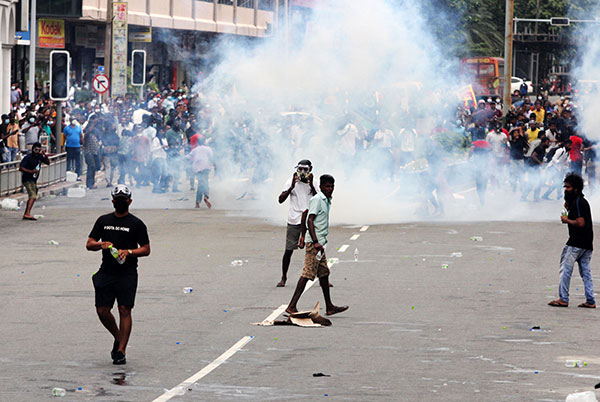
Frequent ‘confrontations’ between the police and anti-government activists cause turmoil. Nishan S. Priyantha captured this scene outside Police Headquarters June 09.

By Shamindra Ferdinando

The Institute of National Security Studies (INSS) recently dealt with the relevance of political stability for national security. Dr. Prathibha Mahanamahewa, and Director/CEO Hector Kobbekaduwa Agrarian Training Institute Malinda Seneviratne, a former colleague of ours at The Island editorial, addressed the issues at hand. Acting Director General of the INSS Rear Admiral Dimuthu Gunawardene, who is also the Director of Communications and Publications of the outfit, moderated the event.
Defence Ministry Media spokesperson Colonel Nalin Herath, in a statement issued on June 09, quoted Dr. Mahanamahewa as having told the gathering that the mismanagement of resources, absence of timely decisions, and corruption, caused political instability. The academic was further quoted as having stressed that political stability would automatically ensure national security. A former Commissioner of the Human Rights Commission asserted that a new Constitution would help maintain political stability.

Political commentator Seneviratne had focused on external threats, primarily the LTTE rump/Tamil Diaspora. Seneviratne had been quite convincing in his arguments. The brief Defence Ministry statement on the event held via zoom on June 07 obviously covered just a fraction of what Dr. Mahanamahewa and Seneviratne had said.

The INSS probably wouldn’t have taken up this particular subject if not for the current economic-political and social crisis that has totally eroded public confidence in the incumbent dispensation. In fact, the public has lost faith in the utterly corrupt entire political party setup with a large segment of the population loudly questioning the dependability of the parliamentary system. The INSS aptly titled the event ‘importance of political stability for national security.’

The INSS can inquire into how the recent Aeroflot drama, at the Bandaranaike International Airport (BIA), undermined Sri Lanka’s relations with Russia, thereby impacting the overall stability. Can Sri Lanka afford to antagonize a friendly UN Security Council member, one of the two who have always stood by us, the other being China, always supportive of Colombo, regardless of the party in power here. If not for their veto power, the West would have bulldozed us into accepting their terms through resolutions at the powerful UN Security Council, especially on so-called war crimes where they have been out to nail our victorious security forces on, for unbelievably defeating LTTE terrorists, in the battlefield, against their wishes.

It would be pertinent to ask whether INSS in any way had inquired into the political, economic and social developments in the run-up to the massive explosion of public anger in late March this year. The intelligence services, too, seemed to have completely ignored the swelling up of public anger over shortage of essential items, including food, and the skyrocketing cost of living, until it was too late.

The INSS should have factored in Speaker Mahinda Yapa Abeywardena’s declaration that the country is fast heading towards an unprecedented famine. PM Wickremesinghe and many others say the same though they do not provide solutions.

Can the current crisis be simply addressed by restoring political stability? What really caused the current and still worsening crisis that has bankrupted the country? The political as well as the military leadership should realize political stability achieved by a near 2/3 majority in Parliament in the wake of an overwhelming triumph for the same party at the presidential election contributed to the catastrophe. That is the undeniable truth.

Having secured the Nov 2019 presidential election with an overpowering majority, the SLPP won a commanding 145 seats in the 220-member Parliament at the Aug 2020 parliamentary election. The Colombo Port City Economic Commission Bill received 149 votes in May 2021. Seven months before, the 20th Amendment to the Constitution received a staggering 156 votes. The SLPP acted as it didn’t expect any trouble. The electorate was repeatedly told the 20th Amendment would ensure political stability while the passage of the Colombo Port City Commission Bill would attract the required foreign direct investments.

The arrogant and over confident SLPP leadership ignored warning signals. Perhaps the government could have managed to sustain the national economy if the Covid-19 pandemic didn’t almost totally disrupt the tourism sector, with the crippling of international travel, and also caused a sharp drop in foreign remittances, with a large number Sri Lankan migrant workers having to return home. Even those who retained their jobs in West Asia often got their wages reduced or got them after delays. Things were further compounded by the government having to repatriate workers and having to spend valuable foreign exchange to procure vaccines and other related pharmaceuticals.

Now, adding to the country’s woes, is the fallout from Russia’s incursion into Ukraine and the US rather foolishly using that to blead Kremlin to death. That is already endangering world food security and disrupting the supply of other essentials, like oil, coal etc., while also causing record inflation worldwide.

Still, the government could have successfully addressed the growing threat if it responded positively to a warning issued by the International Monetary Fund (IMF) in early 2020. But, the Cabinet of Ministers, chaired by President Gotabaya Rajapaksa, turned a blind eye to the IMF call for an immediate debt restructuring programme. The IMF response was to Sri Lanka’s request for a Rapid Financing Instrument (RFI) made in early 2020. The outspoken Governor of the Central Bank Dr. Nandalal Weerasinghe is now on record as having told the Committee on Public Enterprises (COPE) that Dr. P.B. Jayasundera, the then Secretary to the President, finally decided against the IMF’s intervention.

Who should accept the blame for the current crisis? Would it be fair to hold Dr. PBJ accountable for an utterly irresponsible course of action that has caused immense political instability?

Basil on IMF

Having given up the SLPP National List slot and the finance portfolio, SLPP founder Basil Rajapaksa addressed the media at the Nelum Mawatha party office. The revelation made by Basil Rajapaksa, perhaps unwittingly, showed the SLPP had addressed the economic crisis. At the time, the IMF advised Sri Lanka to undertake a debt restructuring programme and drop plans to grant massive tax cuts, while Premier Mahinda Rajapaksa held the finance portfolio. Basil Rajapaksa, who took over finance in July 2021, in response to a media query last week explained how the IMF divided the government. According to him, when Indian Finance Minister Nirmala Sitharaman raised the issue, Basil Rajapaksa, turning towards the then Finance Secretary S.R. Attygalle has said that he was among those who opposed seeking IMF intervention. Basil Rajapaksa has pointed out that Sri Lanka’s High Commissioner in New Delhi Milinda Moragoda favoured the move.

The government played in what could aptly be termed in local parlance as pandu with the national economy. By the time Basil Rajapaksa took over the Finance Ministry, in July 2021, irreparable damage had been done and the finalization of the Yugadanavi deal, two months later, divided the SLPP. The SLPP and a minority in the CEB hierarchy wielding power, defended the controversial deal struck at midnight to the hilt. CEB Chairman M.C. Ferdinando, on the invitation of the then presidential spokesman Kingsley Ratnayake, sought to paint a rosy picture at a media briefing arranged at the Presidential Media Division (PMD). Kingsley Ratnayake, formerly of Sirasa, has quietly left the PMD. Ratnayake has left the country at the onset of a public protest campaign and is believed to be in Australia. Sudewa Hettiarachchi, who joined the PMD as its Director General, remains as the government continues to struggle on the media front.

The explosion of public anger whether pre-planned or not, at the approaches to President Gotabaya Rajapaksa’s private residence at Pengiriwatte, Mihihana, on March 31, 2022, should be investigated, taking into consideration the following factors: (1) dismissal of IMF’s advice on the need to go for an immediate debt restructuring programme, the need to drop plans to implement massive tax cuts and fixing the Rupee rate at 203 at the expense of the overall economy (2) ruination of the agriculture sector as a result of unilateral and abrupt decision taken by President Gotabaya Rajapaksa to ban chemical fertiliser and agro chemicals. The unprecedented move resulted in the decimation of the country’s agriculture output (3) Causing irreparable damage to Sri Lanka’s diplomatic ties with Japan by cancelling already agreed projects, including a light trail venture, a strategic foreign policy blunder (4) explosions of domestic gas cylinders caused by change of the formula by foreign suppliers possibly done deliberately to further worsen the situation here (5) disputed Yugadanavi deal. The agreement with the US energy firm divided the SLPP, with three ministers challenging the move in court along with many others (6) turning a blind eye to waste, corruption, irregularities and mismanagement (7) failure on the part of the government to discipline revenue collection setup, comprising the Inland Revenue Department, Customs and Excise Department and turning a blind eye to illegal money transferring methods, such as Hawala and Undiyal.

Then Finance Minister Basil Rajapaksa, in an interview with Shyam Nuwan Ganewatta of Divaina, foolishly declared his faith in illegal methods, little realizing that it was depriving the country of its precious foreign exchange (8) the continuing dispute over the handling of the 2019 Easter Sunday massacre by Muslim extremists (9) pathetic response to accountability accusations pertaining to Sri Lanka’s triumph over Tamil terrorism.

Can Basil Rajapaksa’s departure from Parliament or business tycoon Dhammika Perera’s entry in his place give overnight boost to a failed economy? Having promised a system change, the SLPP has lost its way and brought in Ranil Wickremesinghe, accused of being the alleged mastermind of the Treasury bond scams by the then Joint Opposition, and Perera, embroiled in tax issues, to manage the political and economic fronts.

Perhaps, INSS should seriously consider receiving a briefing from heads of parliamentary watchdogs, the Committee on Public Enterprises (chaired by Prof. Charitha Herath, MP), Committee on Public Finance (Anura Priyadarshana Yapa, MP) and Committee on Public Accounts (Prof. Tissa Vitharana) regarding the threat posed to political stability and national security by unbridled public and private sector corruption.

The COPE probing into the CBSL and the Finance Ministry appearance before the watchdog by its former members of the Monetary Board comprising Prof. W.D. Lakshman (Dec 2019-Sept 2021/Ajith Nivard Cabraal (Sept 2021-March 2022), Treasury Secretary S.R. Attygalle and nominated members Sanjeeva Jayawardena, PC, Dr. Ranee Jayamaha and Samantha Kumarasinghe caused the current crisis. In addition to the Monetary Board, the then Premier Mahinda Rajapaksa, who served as the Finance Minister (Dec 2019-July 2021) and Dr. P.B. Jayasundera, too, are accountable, with the latter being blamed for blocking the government securing IMF intervention.

Probe on security flop

Sri Lanka witnessed what can be described as a countrywide breakdown of law and order on May 09, following the SLPP goon attack on the Galle Face public protest, demanding the resignation of President Gotabaya Rajapaksa and the entire Cabinet of Ministers, including Premier Mahinda Rajapaksa.

The month-long campaign had the backing of both external and internal forces hell-bent on a system change. The security forces, as well as the police, failure to prevent it as well as the meticulously organized military type retaliation, should be discussed against the backdrop of the Rambukkana shooting where a person died and two dozen others were wounded.

No one bothered to point out that the police opened fire nearly 15 hours after those protesting against fuel price hike blocked main roads as well as the Rambukkana railway line for 15 hours. Can protesting public block roads thereby inconvenience other ordinary people? And police resorted to use lethal force only after protesters turned violent and nearly blew up a petrol bowser by setting fire to it.

Unfortunately, the rapid deterioration of the economy against the backdrop of the government acknowledging insolvency has given an opportunity to various interested parties to undermine the rule of law. The continuing blockade on the Presidential Secretariat situated at Galle Face signifies a pathetic state of affairs. Dr. Nalaka Godahewa, who held the media portfolio at the time of the May 09 violence, raised the disgraceful failure on the part of the government to thwart organized attacks on a selected group of ruling party lawmakers, numbering over 70. The Gampaha District MP, whose Gampaha home suffered heavy damage, drew the attention of both President Gotabaya Rajapaksa and Premier Ranil Wickremesinghe to the crisis, while warning of a 1987-1990 type insurgent campaign.

Obviously, the incumbent political leadership is furious with the military for not stepping in immediately. They are of the view that retaliatory attacks could have been thwarted if the military acted swiftly and decisively. Naturally, some have found fault with the then Commander of the Army General Shavendra Silva, who also functioned as the Chief of Defence Staff (CDS). The appointment of a three-member committee headed by Admiral of the Fleet (retd.) Wasantha Karannagoda to inquire into the lapses on the part of the military should be viewed in the context of a volatile political-economic-social environment.

Could military intervention have saved Mahinda Rajapaksa’s premiership even at the expense of bloodshed? Had there been a large-scale military response to countrywide retaliatory attacks, the country would have been in a much bigger crisis today. There cannot be any dispute over that. No one would have desired Rathupaswela type incident at a time the government was pleading before the international community for food assistance. The incident in the first week of August 2013 shocked the country. It brought shame on the war-winning Army, though it too was instigated by mysterious forces.

In fact at the onset of the trouble, Gen. Silva, the celebrated GoC of the 58 Division, assured Colombo-based defence attaches that the military wouldn’t intervene. Had that happened, it would have definitely helped those who had been campaigning for the ouster of the Rajapaksas.

The Army earned the wrath of the public for opening fire on people demanding clean water at Rathupaswela. Three died in indiscriminate shooting. It would be pertinent to mention that the public had been protesting against the Dipped Products factory over the alleged releasing of chemicals into the environment. The villagers had been seriously concerned about their water supply for some time as they were dependent on groundwater. Their complaints had fallen on deaf ears. Obviously, those in authority hadn’t been interested at all in inquiring into the issue at hand.

Had they bothered to conduct an investigation in a timely and transparent manner, the accusations could have been ascertained and remedial measures taken. Then, why was it not done? Well, one cannot help but think that it is because the factory is owned by Hayleys controlled by Dhammika Perera, the latest entrant into parliamentary politics. In a way, Perera’s entry into active politics can be compared with Gotabaya Rajapaksa entering national politics at the highest level against the backdrop of widespread criticism of all members of Parliament.

Secretary to the Public Administration Ministry Attorney-at-Law Priyantha Mayadunne recently explained how the political party system ruined the country. Mayadunne didn’t hesitate to declare that the mother of all problems is the oversized public service that has been an unbearable burden on the national economy for a long time. One-time Justice Ministry Secretary Mayadunne asserted that Sri Lanka can manage with half a million strong public service though the actual figure is 1.5 mn. Isn’t it a destabilizing factor? If the INSS is really keen to ascertain the truth, it may undertake a thorough examination of destabilizing factors as the country slips further into foreign debt.

The economic crisis, as explained by Governor of the CBSL Dr. Nandalal Weerasinghe, is so acute today, Sri Lanka is vulnerable to external machinations. The external threats can be quite deadly as those directly involved in the decision, making process here, too, have been part of various such anti-national projects. Yugadanavi deal can be cited as just one such example.

Wednesday, 8 June 2022

Was it part of continuing destabilisation project here?

 SPECIAL REPORT : Part 422

Published

  
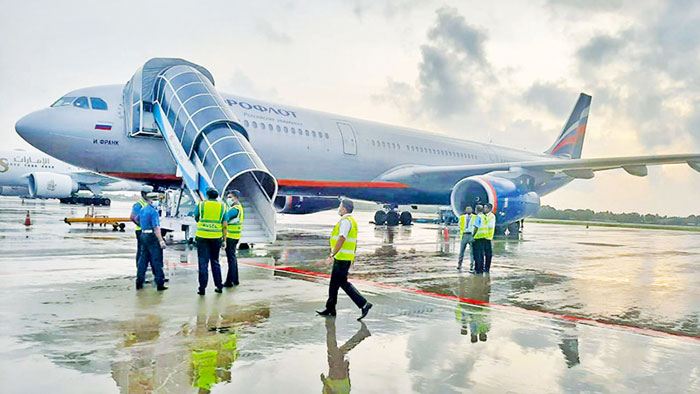
The detained Aeroflot Airbus A 330-300 at the BIA

The Aeroflot affair:

Justice Ministry yesterday interdicted the court official while recommending to Chief Justice Jayantha Jayasuriya that action should be taken against the lawyer concern. The BASL is yet to comment on the issue at hand

By Shamindra Ferdinando

Aeroflot flight SU 289 was preparing to take off from the Bandaranaike International Airport (BIA), on June 02, when a fiscal officer, from the Commercial High Court of the Western Province, walked in around 12.15 pm, soon after the end of day’s proceedings. The official was accompanied by Attorney-at-Law Aruna de Silva, who appeared for the plaintiff, along with Avindra Rodrigo, PC. They were instructed by F.J. & G. de Saram, the leading law firm from the colonial times.

The fiscal officer delivered a copy of the order issued by High Court judge S.M.H.S.P. Sethunge. The recipient of the court order was Acting Head of Air Navigational Services N.C. Abeywardena. The BIA was ordered to detain the aircraft, pending a case filed by Ireland-based Celestial Aviation Trading 10 Ltd., against the Russian state-owned Public Joint Stock Company Aeroflot. According to Justice Minister Wijeyadasa Rajapaksa the fiscal officer and lawyer Aruna de Silva had no right to threaten Mr. Abeywardena, with contempt of Court proceedings, if he allowed the Aeroflot flight to take off as there was no court order against him.

Justice Minister Rajapakse, being a veteran lawyer and a former President of the Bar Association of Sri Lanka, did not entirely spare the High Court Judge responsible for the exparte order. He said judges should be more mindful when issuing such exparte orders.
At the time the court officer delivered the warning, 191 passengers and 13 crew of the Airbus A 330-300 were on board. They were asked to get off the plane. The Aeroflot drama transpired in the Commercial High Court of the Western Province on June 03. The airline’s regional manager, for India and Sri Lanka, Sergey Evgenievich, was present in court.

On the following day, Russia summoned Sri Lanka’s Ambassador in Moscow, Prof. Janitha Abeywickrena Liyanage, to the Foreign Ministry, where Sri Lanka’s action was condemned. Russia demanded Sri Lanka to resolve the issue at hand, soon, to avoid having a negative impact on the traditionally friendly bilateral relations. What Moscow said was that there would be serious repercussions.

Viyathmaga activist Liyanage received appointment as Sri Lanka’s Ambassador in Moscow last October. Married to Prof. Sudantha Liyanage, she served as Vice Chancellor of the Gampaha Wickramarachchi University of Indigenous Medicine, prior to her taking up Sri Lanka’s top diplomatic post in Russia.

There hadn’t been a previous instance of a Sri Lankan Ambassador in Moscow being summoned to their Foreign Ministry. The Aeroflot affair has caused irreparable damage to Sri Lanka-Russia ties at a time Colombo needs retain its perennial friends among the international community.

Perhaps the crux of the issue, at hand, is there hadn’t been an enjoining order issued in respect of the second defendant Acting Head of Air Navigational Services N.C. Abeywardena. After having heard submissions by both parties, the court reiterated, on June 03, that there hadn’t been an enjoining order issued in respect of the second defendant. The public Joint Stock Company Aeroflot is the first defendant.

The court was told how Aeroflot flight was detained in spite of an assurance given by Sri Lanka to Russia that Aeroflot could operate to and from Colombo without an issue. The Counsel for the first defendant raised the issue while highlighting the embarrassment caused to Russia.

On behalf of the government, the Foreign Ministry issued the following statement on June 04: The Ministry of Foreign Affairs wishes to state the following with reference to the Aeroflot passenger aircraft flight SU-289 which is currently at the Bandaranaike International Airport (BIA).

On 2 June 2022, the Commercial High Court of the Western Province issued an Enjoining Order on the Aeroflot flight restraining it from taking off from Bandaranaike International Airport. The case relates to a commercial dispute between the Plaintiff, Celestial Aviation Trading 10 Limited, an Irish Company, against the first Defendant the Public Joint Stock Company Aeroflot and the second Defendant, Mr. N. C Abeywardene/Acting Head of Air Navigation/Airport and Aviation Services of Sri Lanka (AASL), Katunayake.

The matter is still pending final determination of the Court. This matter is also under consultation through normal diplomatic channels.”

Obviously, the Foreign Ministry hasn’t perused the Court proceedings or at least inquired from relevant parties before issuing the media statement. Had the Foreign Ministry done so, the shocking manipulation of the Court proceedings to pressure the Acting Head of Air Navigation would have come to their notice. The question is whether some of our officials are just playing dumb having been part of a foreign conspiracy to embarrass Russia and to exacerbate the dire situation in the country, already beset with a myriad of problems.

The Chief Justice, the Justice Ministry and the Bar Association of Sri Lanka (BASL) should also inquire into the highly contentious issue.

Angry reactions

Close on the heels of Russia’s angry reaction, SLPP lawmaker Rear Admiral Sarath Weerasekera took up the issue at hand with President Gotabaya Rajapaksa. In a two-page letter, the former Public Security Minister pointed out that the fiscal officer’s action against the backdrop of High Court judge Sethunge’s declaration that he didn’t issue an enjoining order in respect of the government or the Airport and Aviation Services Ltd.

The Colombo District MP questioned the detention of the Aeroflot flight in spite of Sri Lanka’s written assurance to Russia that Aeroflot was free to operate to and from the BIA without hindrance. The former Navy Chief of Staff warned that Sri Lanka shouldn’t be surprised if Russia felt that the government guaranteed Aeroflot freedom to operate to and from the BIA to lure them.

Lawmaker Weerasekera challenged Prime Minister Ranil Wickremsinghe’s assertion that the issue was a matter between two private parties. How could that be when all know Aeroflot operated flights to the BIA on written assurance given by the government?

Rear Admiral Weerasekera reminded the President of the support provided by Russia during the war against the LTTE and the constant backing Sri Lanka received at the Geneva-based United Nations Human Rights Council (UNHRC). The war veteran said that even after the war, China and Russia always stood by Sri Lanka as Western powers pursued Sri Lanka on the human rights front as they were smarting over the defeating of the LTTE. The MP declared that unless remedial measures were taken the country would have to face the consequences.

Lawmaker Weerasekera told the writer that there should be a wider investigation to ascertain whether utterly disruptive and manipulative action taken against Aeroflot was meant to cause a rift between Sri Lanka and Russia in line with the overall destabilization plan here mounted by the West. Weerasekera pointed out how disruption of Aeroflot flights could deprive Sri Lanka of much needed foreign currency and Russia being a key market for our tea that, too, would be in jeopardy. Sri Lanka’s economy couldn’t take any more shocks, MP Weerasekera said, emphasizing the responsibility on the part of President Gotabaya Rajapaksa to reverse the destabilization project.

Amidst heavy pressure, Sri Lanka, on Monday (06) lifted the alleged restriction imposed on the Aeroflot flight. But, the matter should not end there. The government should investigate the Aeroflot affair. Many believe it was certainly not isolated but part of a well-orchestrated campaign.

Sri Lankan Airlines suspended flights to Moscow, on March 26 citing ‘operational restrictions that are outside of the airline’s control.’

“The restrictions are in the form of international financial and aircraft insurance limits which have been imposed on Russia due to the ongoing Russia-Ukraine war, and directly impact SriLankan Airlines’ flight operations to Russia,” the airline said in a statement.

The airline maintained two weekly flights between Colombo and Moscow before the cessation of operations.

In spite of continuing sanctions, Aeroflot, on April 08, resumed regular flights to Colombo. Until the June 02 incident, flights arrived here three times a week, on Wednesday, Friday and Saturday, while the flights back to Moscow were operated on Thursday, Saturday and Sunday. Aeroflot suspended all flights on April 08 following US and EU sanctions.

Wimal issues warning

Federation of National Organisation, comprising the Patriotic National Movement (Dr. Wasantha Bandara), Patriotic National Front (Attorney-at-Law Nuwan Bellanthudawa), People’s Responsibility Centre (Wasantha Alwis) and People’s Voice for Justice and Sovereignty (Attorney-at-Law Madhaumali Alwis), in a joint letter, dated June 04, has sought President Gotabaya Rajapaksa’s intervention.

The grouping has explained how various interested parties exploited the country and pursued strategies, detrimental to the Sri Lankan State. Dr. Wasantha Bandara told the writer the government seemed to have lost its bearings and was quite incapable of looking after Sri Lanka’s interests. Dr. Bandara said that the Aeroflot issue should be examined against the backdrop of Sri Lanka having entered into a controversial agreement with US-based New Fortress Energy last September. “Don’t forget the government finalized that deal at midnight. Our legal challenge failed to convince the Supreme Court.”

National Freedom Front (NFF) leader Wimal Weerawansa, who challenged the US energy deal in Court along with Vasudeva Nanayakkara and Udaya Gammanpila in spite them being members of the Cabinet at that time on Sunday (05) questioned the culpability of the executive, the legislature and the judiciary over the Aeroflot affair. The outspoken politician didn’t mince his words when he asserted the executive, then legislature and the judiciary were working together to transform the economic and political crisis to a human tragedy. MP Weerawansa declared that the government has allowed the situation to develop and those in authority were yet to take tangible measures to stabilize the economy.

At the onset of the briefing, MP Weerawansa said that the government was busy jeopardizing Sri Lanka’s relations with Russia after having antagonized China, two of Sri Lanka’s closest friends. The Aeroflot dispute is perhaps the worst during 65 years of diplomatic relations.

President of Sri Lankan Business and Professionals Society in Russian Federation, Jagath Chandrawansa, in a letter to President Gotabaya Rajapaksa, alleged that a deliberate attempt was being made to cause a rift with Russia. Chandrawansa alleged that the operation was meant to cause economic deterioration.

Chandrawansa, too, drew the President’s attention to the fiscal officers’ super-fast action and the government’s pathetic failure to thwart the clandestine project. Chandrawansa told the writer that Sri Lanka should be ashamed of the way the Aeroflot flight was handled after having requested the Russian national carrier to fly here.

Lawmaker Vasudeva Nanayakkara didn’t hesitate to speculate the possibility of the US being behind the Aeroflot affair. Declaring the incident at the BIA a conspiracy, the veteran politician alleged that the US wanted to deprive Sri Lanka an opportunity to procure crude oil from Russia at a much lower cost.

MEP Leader and Chief Government Whip Dinesh Gunawardena, too, declared that the Aeroflot issue should be addressed quickly. The Minister warned that remedial measures should be taken before the incident caused serious damage to bilateral relations and to the country’s economy through loss of vital tourist arrivals from Russia.

Former General Secretary of the Communist Party Dew Gunasekera has demanded an explanation from Premier Wickremesinghe over his alleged bid to downplay the incident. Gunasekera asserted that Sri Lanka was experiencing an extraordinary threat. The incident involving the Aeroflot flight underscored our vulnerability.

Russian backing for war effort

Russia and Ukraine were among the few countries that readily threw their weight behind Sri Lanka’s war effort. Sri Lanka acquired Soviet era Mi24 helicopter gunships from Ukraine and Mi-35 Hind copters from Russia. Mi-24 arrived in Sri Lanka in the first week of Nov 1995. Russian military personnel flew three gunships acquired on a wet lease from Colombo to Hingurakgoda air base. The Russians carried out actual combat operations beginning Nov 17, 1995. The Russians carried out missions along with the Air Force till February 1996. However, the Russians provided the required flying training till 2000. The Hingurakgoda headquartered famed No 09 squadron played a critical role in the overall war against the LTTE.

Sri Lanka sought superior helicopter capable of providing close air support against the backdrop of losing two Avros in April 1995 and one Pucara ground attack aircraft in July 1995. The LTTE changed the military environment with the introduction of heat-seeking missiles. Sri Lanka responded by deploying Mi-24s and subsequently Mi-35 capable of operating against missile attacks. As ground troops required close air support, the then government delayed ‘Operation Riviresa’ until the arrival of helicopter gunships. The deployment of Soviet gunships paved the way for the successful conclusion of ‘Operation Riviresa’ that brought the Jaffna peninsula under control by early 1996.

The celebrated No 09 attack helicopter squadron flew 222 combat missions during ‘Operation Jayasikurui’ conducted through May 1997 to Dec 1998. In addition to the three Mi 24 deployed in Nov 1995 and sent back to Ukraine for overhaul three years later, Sri Lanka during 1996-2001 period inducted 23 Mi 35 Hinds.

The No 09 attack squadron played a pivotal role during the successful Eelam War IV (Aug 2006 to May 2009). The LTTE never managed to neutralize the formidable No 09 attack squadron that quite clearly damaged their fighting capability.

In response to The Island queries, former Foreign Minister Rohitha Bogollagama said that he was quite perplexed at the way the government handled the issue, particularly the absence of an immediate initiative by the Ministry of Foreign Affairs to redress the colossal damage that has been caused to the bilateral relationship that existed at its best terms between the two friendly countries.

Bogollagama issued the following statement: “Russia has remained a steadfast friend of Sri Lanka during the post-independence era and shadowing us against many a hurdles we confronted during the time of countering terrorism in Sri Lanka.

In the post period of defeating terrorism, Russia helped us to navigate through the International pressure and the accusations that were directed at us, by certain influential members of the UN body. Our regular visits and the reciprocity that was extended by Russia at the Heads of State and the Foreign Ministers level on a throughout basis was a clear manifestation of the closeness between our two countries.

Having said that the Aeroflot services had resumed to Sri Lanka at the behest of Sri Lankan Authorities giving an explicit assurance that their Aircraft shall not be detained or seized in Sri Lanka. On this undertaking, Aeroflot has commenced their services bringing us the much needed tourists and the foreign exchange.

The very enjoining order been vacated on the 6th of June itself clearly demonstrates the very point that if the Court intervention was sought immediately and efficaciously on 3rd of June itself, the protracted delay and the embarrassment caused could have been well mitigated. It would have definitely given a message with clarity that we stand well by Moscow, though there are procedures one may entail like that of the Judicial Process.

Furthermore, we have not witnessed a direct engagement at the highest echelon of power as a mitigatory step for the blow that shattered our friendship

I am rather disappointed that the authorities have failed to look at the overall impact of the repercussions associated in the Aeroflot now withdrawing their services to Sri Lanka over this incident, thus denying our country the much needed tourists arrivals and a global connectivity that Russia was maintaining.

It must be noted that Russia, China, India and Japan commands both Universal influence and connectivity, being four giants in Asia.

As an Asian Country, when the West is turning against Russia we could have easily enhanced our traditional relationship, which opportunity was completely lost, due to the mishandling of a trivial private litigation.

I stand to disagree with Prime Minister Ranil Wickremesinghe stating that the Aeroflot case is not an issue between the two Countries, but a private legal issue. But unfortunately the fact that it is a state Aircraft of the Russian Government visiting Sri Lanka, at the explicit undertaking given by the Governmental Authorities in Sri Lanka has not been addressed and taken into account by the Hon Prime Minister in making this statement.

It is time, Sri Lanka assured our highest consideration and regret over this particular incident, by the Prime Minister to the Foreign Minister of Russia Sergey Lavrov, as a prudent means to restore the devastated bi-lateral Relations.

Thereby it is time to mature as a Country, to put “Sri Lanka First” and advance to become part of the Global Diplomacy as practiced by many countries, though small in size but mighty, in terms of one’s philosophy.”

Wednesday, 1 June 2022

Developing economic crisis:Truth unravelled before COPE

SPECIAL REPORT : Part 421

Published

  
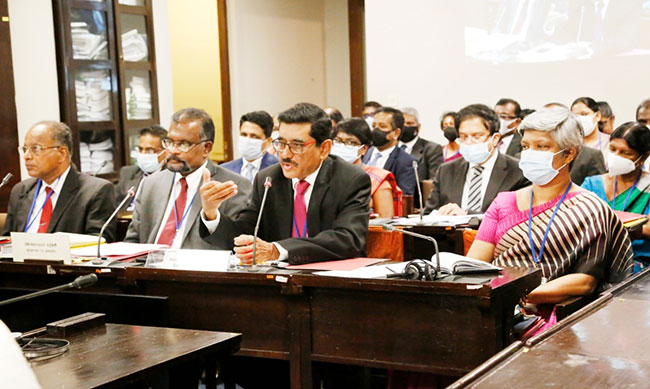
(From Left): Chief Financial Officer, Finance Ministry B.K.R. Balasooriya, Finance Secretary K.M. Mahinda Siriwardana, CBSL Governor Dr. Nandalal Weerasinghe and Deputy CBSL Governor T.M.J.Y.P. Fernando

By Shamindra Ferdinando

A COPE (Committee on Public Enterprises) meeting on May 25, chaired by Prof. Charitha Herath (SLPP National List), revealed the devastating truth about the utterly irresponsible public finance management that led to the ruination of the national economy.

A two-page press release in Sinhala issued by Janakantha Silva, Director Legislative Services and Acting Director of Communications, on the same day, disclosed how the incumbent dispensation caused the unprecedented meltdown.

But, the releasing of video footage of the entire meeting by the Parliament helped the public to clearly understand how the Finance Ministry, the Central Bank of Sri Lanka (CBSL), the Monetary Board, the then Presidential Secretary Dr. P.B. Jayasundera, the Cabinet of Ministers and the Parliament contributed to the debilitating economic-political and social crisis. The COPE meeting should attract Attorney General Sanjay Rajaratnam’s immediate attention. The Bar Association of Sri Lanka (BASL), too, cannot turn a blind eye to the shocking exposure of a seriously flawed public finance system and nothing but a negligent and incompetent Parliament.
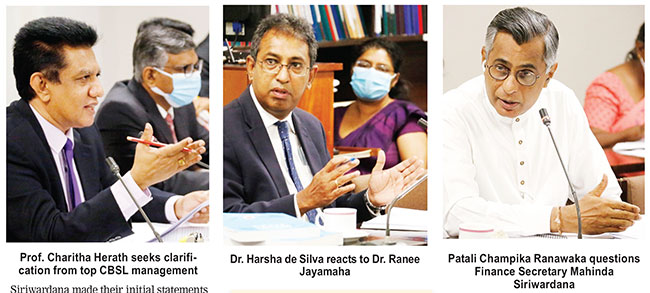
During the proceedings, top Samagi Jana Balavegaya (SJB) member of the parliamentary watchdog committee, Dr. Harsha de Silva declared the appointment of ‘RW’ as the Finance Minister in addition to being the PM. When the former UNPer’s COPE colleagues raised eyebrows, Dr. de Silva quickly said: “Sorry. Mr. Ranil Wickremesinghe.’ A smiling Prof. Herath reminded that PM Wickremesinghe was Dr. de Silva’s former boss. The SJB’s economic guru de Silva functioned as State Minister for National Policies and Economic Affairs.

The then yahapalana premier held the Cabinet portfolios of those subjects. At the time the Treasury bond scams that had been blamed on Wickremesinghe and Company were perpetrated in Feb 2015 and March 2016, the CBSL functioned under the purview of Wickremesinghe’s ministry. So in actual fact Dr. Harsha de Silva, having been part of that yahapalana team that messed things up at the time in style, is in no position to take a ‘holier than thou stand’ now.

Similarly Champika Ranawaka, too, is under many a cloud. When he was the Power and Energy Minister, his bosom pal, then Chairman of the CEB, figured in the notorious Panama papers. So whose money had the then CEB Chairman Anura Wijepala banked in hidden accounts offshore?

Among those who had been at the meeting, summoned by the COPE, were Director General, Internal Audit, Finance Ministry Mrs. Deepika Colombage, Chief Financial Officer, Finance Ministry B.K.R. Balasooriya, Finance Secretary K.M. Mahinda Siriwardana, CBSL Governor Dr. Nandalal Weerasinghe, Deputy CBSL Governor T.M.J.Y.P. Fernando, Director General, Finance Ministry Hemal Kasthuriarachchi, Assistant Governor, CBSL Ananda Jayalath, Director, International Operations Department, CBSL Dr (Ms) D.S.T. Wanaguru, Monetary Board member Sanjiva Jayawardena, PC, Monetary Board member Dr. Ranee Jayamaha, Assistant Governor, K.M. A.N. Daulagala (Secretary to the Monetary Board), Assistant Governor, CBSL K.G.P. Sirikumara, Director, Economic Research, CBSL P.K.G. Harischandra, Director, Human Resources, CBSL A.M. Gunatilake, Director, Payment and Settlement Department, CBSL M.R. Wijewardena, Director, Legal and Compliance Department, CBSL Dr. (Mrs) A.A.I.N. Wickramasinghe , Director, Domestic Operations Department, CBSL Dr. R.A.A. Perera, Additional Director, Facilities Management Department, CBSL S.K.P. Vitharana, Additional Director, International Operations Department, CBSL S. Obeysekara, Chief Accountant, CBSL Mrs D.S.L. Sirimanne, Director, Department of Foreign Exchange Mrs. D.R. Karunaratne and Director, Department of non-bank financial institutions R.M.C.H.K. Jayasinghe.

Of them, only Governor Dr. Weerasinghe, Treasury Secretary Siriwardana and Monetary Board members Jayawardena and Jayamaha responded to the queries raised by the COPE. On behalf of the parliamentary watchdog, its Chairman Prof. Herath, Eran Wickremaratne (SJB), Rear Admiral (retd.) Sarath Weerasekera (SLPP), Rauff Hakeem (SLMC), Madura Vithana (SLPP), Jagath Pushpakumara (SLPP) and Premnath C. Dolawatta (SLPP) raised questions and also commented on the issues at hand. But, the day certainly belonged to SJB lawmakers, Patali Champika Ranawaka, who is also the leader of ’43 Brigade’ and Dr. Harsha de Silva.

At the onset of the proceedings, Prof. Herath, while underscoring the sensitive nature of the impending discussions, declared the 2018 and 2019 Auditor General’s reports on the CBSL were to be examined with the focus on the current status of the apex operation.

SJB MPs on the offensive

After Dr. Weerasinghe and Mahinda Siriwardana made their initial statements and responded to queries raised by Prof. Herath, lawmaker Ranawaka questioned the accountability on the part of the CBSL as well as the Monetary Board for the current crisis. The former minister Ranawaka emphasized that senior officials of both institutions couldn’t, under any circumstances, absolve themselves of the responsibility for bankrupting the country. The Colombo District MP didn’t mince his words when he declared that the top management officers of the CBSL were a handsomely remunerated lot whose culpability in the whole sorry state of affairs couldn’t be ignored.

Pointing out that the government has officially accepted Sri Lanka’s bankrupt status, MP Ranawaka compared how the financial meltdown finally led to street violence, including death of a lawmaker whereas senior CBSL and Monetary Board members who oversaw the ruination of the national economy seemed not to have attracted public attention.

The former JHU heavyweight Ranawaka posed several pertinent questions to those who had been summoned before the COPE regarding the role and conduct of the Secretary to the Treasury, CBSL and the Finance Ministry. Dr. de Silva, too, raised contentious issues at hand relating to the crisis, particularly how the SLPP handled the economy during the March/April 2020 to March 2022 period when CBSL Governor Ajith Nivard Cabraal suddenly resigned after having floated the Rupee. The much delayed decision to float the Rupee caused a catastrophe as it then immediately nosedived against the dollar and other major currencies.

Their relentless probing questions exposed an ugly truth. The shocking exposure of the then Prime Minister Mahinda Rajapaksa who handled the finance portfolio, the then Presidential Secretary Dr. P.B. Jayasundera, himself a former top Central Banker and ex-Treasury Secretary, Governors of the Central Bank Prof. W.D. Lakshman and Ajith Nivard Cabraal, Monetary Board member and Treasury Secretary S.R. Attygalle, the entire Cabinet-of-Ministers chaired by President Gotabaya Rajapaksa and the Parliament to varying degrees has sent shock waves through the political establishment.

COPE proceedings revealed how those who had been responsible for public wellbeing, both at ministerial and official level, simply allowed the situation to deteriorate to such an extent today the government lacked the wherewithal to meet basic requirements. They were most probably waiting for India and China, in rivalry, come to their rescue. The Indian help came but it was too late as the situation had snowballed in next to no time. As to why China dragged its feet might be due more to Rajapaksa sibling and duel citizen Basil increasingly sailing the Lankan ship towards the West, forgetting the fact that we achieved so much in the past thanks to China, including its unquestioning support to us in our fight to defeat LTTE terrorists.

Lawmakers Ranawaka and Dr. Silva pressed the Finance Secretary Siriwardana, Governor Weerasinghe and Monetary Board members on (1) massive tax cut implemented soon after the last presidential election in Nov 2019, contrary to the advice given by the IMF (2) the IMF’s refusal to grant RFI (Rapid Financing instrument) to Sri Lanka in March/April 2020 and (3) printing money (4) colossal losses suffered by the CBSL due to its refusal to float the Rupee.

Officials’ answers flabbergasted COPE. The Finance Ministry, CBSL and the Monetary Board had been mercilessly dominated by the SLPP and did nothing to change the extremely dangerous path the country was taking. The SLPP was hell-bent on continuing with its reckless strategy at whatever consequences.

Conduct of Monetary Board

The Monetary Board consists of five persons – two ex-officio members, Governor, Secretary to the Finance Ministry, and three nominated members. At the time of the issue at hand Prof. W.D. Lakshman and S.R. Attygalle had served on the Monetary Board and the latter as the Secretary to the Finance Ministry as well. The Monetary Board’s appointed members were President’s Counsel Sanjiva Jayawardena, Dr. Ranee Jayamaha (retired Central Bank Deputy Governor) and successful businessman Samantha Kumarasinghe, who put Sri Lanka on the world cosmetic manufacturing map through his Nature’s Secret line of products, which earned the ire of some multinational leaders in the field because of its resounding overnight success.

Dr. de Silva flayed the government over the appointment of Samantha Kumarasinghe, claiming he didn’t know the basics in economics. But SJB economic pundit was apparently not aware that Kumarasinghe has a MBA from the prestigious Harvard Business School like the late A.S. Jayawardena, who, with his Harvard MBA, went on to serve successfully as the country’s Central Bank Governor and Treasury Secretary during some of the most testing times for this country, especially during the Asian financial crisis of 1996 and the terrorist bombing of the Central Bank in 2001.

According to a statement, dated July 15, 2020, issued by the CBSL, Sanjeeva Jayawardena has been appointed with effect from Feb 26, 2020 and Dr Ranee Jayamaha and Samantha Kumarasinghe with effect from June 29,.2020. President Gotabaya Rajapaksa appointed them under section 8(2)(c) of the Monetary Law Act with the approval of the Constitutional Council.

MP de Silva questioned the suitability of Kumarasinghe on the basis of an article he published in the Lankadeepa in which the SJB heavyweight claimed the Monetary Board member expressed views very much contrary to basic economy theories.

Let me reproduce a CBSL statement issued on July 15, 2020 on Kumaasinghe’s appointment. The Island believes it would be fair by the former Monetary Board member.

The text of the CBSL statement: “Samantha Kumarasinghe currently serves as Chairman and Managing Director of several companies in Sri Lanka, Bangladesh and Vietnam that operate in industrial sectors across cosmetics, textile chemicals, household cleaning products, organic food and biological fertilisers.

He currently serves as a member of the Presidential Task Force for Economic Revival and Poverty Eradication (2020), President of Lanka Industry Forum for Empowerment (LIFE) (2018 to date) and Chairman of Cosmetics Sector Advisory Committee at the Ministry of Industries (2016 to date). He has also served in the capacities of member of Presidential Industrialisation Commission (from 2018 to 2019), a board member of the Insurance Board of Sri Lanka (2012 to 2014), a committee member of the Implementation of the Integrated Curriculum, Subjects and Review of Academic Activities Process of the Ministry of Education (2013) and as Commissioner of the Presidential Taxation Commission (2009 to 2010).

Kumarasinghe studied at Royal College, Colombo. He is a chemistry graduate of the University of Peradeniya and an alumnus of the Harvard Business School, USA. He started his entrepreneurial career in 1993 with just 12 employees and was adjudged ‘Entrepreneur of the Year’ in 2008. He was awarded a Presidential National Honours Award in 2019 for his valuable contribution to the country.”

Dr. Jayamaha strongly defended her conduct as a member of the Monetary Board and that of President’s Counsel Jayawardena. Commenting on calamitous decisions to fix the Rupee at 203 and refusal to engage the IMF, Dr. Jayamahaha alleged that Governor Lakshman, Finance Secretary Attygalle and nominated member Kumarasinghe pursued an agenda of their own. Dr. Jayamaha alleged that the Governor’s group always had the majority and therefore, they couldn’t have opposed. Dr. de Silva rejected Dr. Jayamaha’s stand.

The lawmaker insisted that all members of the Monetary Board were equally responsible for the current predicament. The MP suggested that Dr. Jayamaha and President’s Counsel Jayawardena should have gone public to deter the Governor and his colleagues.

SJ hits back

Sanjeeva Jayawardena quite clearly explained how he and Dr. Jayamaha took a common stand on touchy matters. Apropos Sri Lanka’s RFI request and related issues, Jayawardena revealed, beginning early 2020, they on nine different occasions, recommended/suggested engagement with the IMF. Jayawardena also explained their efforts to establish what he called an external debt monitoring mechanism. The President’s Counsel explained how Governor Cabraal acted, contrary too decision taken in respect of floating the Rupee at a proper forum. Jayawardena and Jayamaha have also warned against excessive money printing. Dr. de Silva asked for the minutes of the relevant meetings. The lawmaker reiterated that members of the Monetary Board bear equal responsibility for the current crisis.

One of the most controversial issues was the massive tax cut to the tune of Rs 600 bn implemented by the current dispensation. Treasury Secretary Mahinda Siriwardana asserted that the decision on the tax cut should have been reversed in the wake of the Covid-19 eruption. Dr. de Silva pushed Siriwardana on the issue at hand. The former UNPer asked Finance Secretary Mahinda Siriwardana to reveal the person who decided to implement the tax cut regardless of specific IMF advice at a time the lending agency called for debt restructuring in the wake of Colombo seeking RFI? The lawmaker also wanted the Finance Secretary to confirm whether the Finance Ministry conducted a survey before the controversial decision was made? Lawmaker de Silva asked who dropped the IMF recommendations to the dustbin. Finance Secretary side-stepped the issue in spite of lawmaker Ranawaka attacked the CBSL and the Finance Ministry on the same issue. The Finance Secretary struggled to cope up with the situation whereas Dr. Weerasinghe revealed how the tax cut was ordered. According to Dr. Weerasinghe, there hadn’t been any consultations at any level before they were informed of the disputed decision.

Earlier, Dr. Weerasinghe, in response to probing questions, acknowledged the circumstances Dr. PB Jayasundera decided not to engage the IMF regardless of the precarious economic outlook. Lawmaker Ranawaka repeatedly said that the crisis that had engulfed the country is far worse than the Treasury bond scams, 2019 Easter Sunday massacre or alleged war crimes.

Appearing before the COPE, as well as the Committee on Public Finance (COPF), headed by Anura Priyadarshana Yapa (SLPP) Dr. Weerasinghe last week acknowledged how the Finance Ministry misled the Parliament over the years. There hadn’t been a previous instance of a CBSL Chief going public with the truth. Dr. Weerasinghe told COPE how the Parliament allocated unavailable funds to various ministries on the basis of false estimates. That had been the norm as politicians and officials cooperated in a despicable way to deceive the public.

Dr. Weerasinghe also blamed such irresponsible practices for the current crisis. Perhaps, Dr. Weerasinghe should be especially commended for reminding the COPE of the responsibility of the Parliament in ensuring suitable appointments are made. The CBSL Chief dared to be forthright in his appearances before parliamentary watchdog committees thereby set up new standards in Sri Lanka’s utterly corrupt public services. However, the CBSL Chief, too, cannot exonerate himself of the responsibility for overall irresponsible conduct of the institution, as pointed out by Dr. de Silva in respect of the Monetary Board.